
Treasury Department
Proposal of Special Measure Prohibiting the Transmittal of Funds Regarding Transactions Involving the A7 Network's Sub-Agents
October 5, 2026
Summary
FinCEN proposes to find that transactions involving any company operating outside the U.S. controlled by the A7 Network—a Russia-linked sanctions evasion and money laundering network—are a class of transactions of primary money laundering concern in connection with Russian illicit finance, and to prohibit covered financial institutions (as defined in 31 CFR 1010.100(t)) from engaging in transmittals of funds involving any A7 Network Sub-Agent, including fiat and convertible virtual currency transactions. Covered institutions would need to screen against a FinCEN-provided list of Sub-Agents, notify affected persons with a direct commercial relationship, apply risk-based due diligence, and document compliance. Comments are due November 4, 2026; no effective date is set.
AI-generated summary · Oct 4, 2026. Verify with your compliance counsel before acting.
How this was generated
We record the exact prompt, model, and output for every AI response so it can be audited for accuracy.
Document headings vary by document type but may contain the following:
- the agency or agencies that issued and signed a document
- the number of the CFR title and the number of each part the document amends, proposes to amend, or is directly related to
- the agency docket number / agency internal file number
- the RIN which identifies each regulatory action listed in the Unified Agenda of Federal Regulatory and Deregulatory Actions
See the Document Drafting Handbook for more details.
Department of the Treasury
Financial Crimes Enforcement Network
- 31 CFR Part 1010
- RIN 1506-AB77
AGENCY:
Financial Crimes Enforcement Network (FinCEN), Treasury.
ACTION:
Notice of proposed rulemaking.
SUMMARY:
FinCEN is issuing a finding and notice of proposed rulemaking, pursuant to section 9714(a) of the Combating Russian Money Laundering Act (Public Law 116-283), as amended by section 6106(b) of the National Defense Authorization Act for Fiscal Year 2022 (Public Law 117-81), finding transactions involving any company operating outside of the United States that is controlled by the A7 Network, a sanctions evasion and money laundering service with ties to Russia, leveraged by a wide range of illicit actors, including Iran and its terrorist proxies, to be a class of transactions of primary money laundering concern in connection with Russian illicit finance and proposing the imposition of a prohibition on certain transmittals of funds, by any covered financial institution, involving that class of transactions.
DATES:
Written comments on the notice of proposed rulemaking must be submitted on or before November 4, 2026.
ADDRESSES:
Comments must be submitted in one of the following two ways (please choose only one of the ways listed):
- Federal E-rulemaking Portal: https://www.regulations.gov. If you are reading this document on federalregister.gov, you may use the green “SUBMIT A PUBLIC COMMENT” button beneath this rulemaking's title to submit a comment to the regulations.gov docket.
- Mail: Financial Crimes Enforcement Network, P.O. Box 39, Vienna, VA 22183. Refer to Docket Number FINCEN-2026-0265 in the submission.
Do not include any personally identifiable information (such as name, address, or other contact information) or confidential business information that you do not want publicly disclosed. All comments are public records; they are publicly displayed exactly as received, and will not be deleted, modified, or redacted. Comments may be submitted anonymously. Follow the search instructions on https://www.regulations.gov to view public comments.
FOR FURTHER INFORMATION CONTACT:
FinCEN's Regulatory Support Section by submitting an inquiry at www.fincen.gov/contact.
SUPPLEMENTARY INFORMATION:
I. Summary of Notice of Proposed Rulemaking
This notice of proposed rulemaking (NPRM) (1) sets forth FinCEN's finding that transactions involving any company operating outside of the United States that is controlled by the A7 Network [1] (a “Sub-Agent” and, collectively, the “Sub-Agents”), are a class of transactions of primary money laundering concern in connection with Russian illicit finance; and (2) proposes prohibiting certain transmittals of funds involving that class of transactions by any covered financial institution. As set out in this NPRM, transactions involving any Sub-Agent fall within a class of transactions of primary money laundering concern in connection with Russian illicit finance, as such transactions present a material risk of facilitating funds transfers designed to evade sanctions by illicit actors, including Russian and Iranian persons that have been designated by Treasury's Office of Foreign Assets Control (OFAC), such as the Islamic Revolutionary Guard Corps (IRGC), and intended to support illicit activities, including sanctions evasion involving or benefitting Russian and Iranian clients.
II. Background
A. Statutory Provisions
Section 9714(a) of the Combating Russian Money Laundering Act (Pub. L. 116-283), as amended by section 6106(b) of the National Defense Authorization Act for Fiscal Year 2022 (Pub. L. 117-81) (section 9714),[2] provides, in relevant part, that, if the Secretary of the Treasury (Secretary) “determines that reasonable grounds exist for concluding that . . . one or more classes of transactions within, or involving, a jurisdiction outside the United States . . . is of primary money laundering concern in connection with Russian illicit finance,” the Secretary may, “by order, regulation, or otherwise as permitted by law”: (1) require domestic financial institutions and domestic financial agencies to take 1 or more of the special measures described in 31 U.S.C. 5318A(b); [3] or (2) prohibit, or impose conditions upon, certain transmittals of funds (as defined by the Secretary) by any domestic financial institution or domestic financial agency, if such transmittal of funds involves any such class of transaction. The authority of the Secretary to administer both section 9714 and the Bank Secrecy Act (BSA) has been delegated to FinCEN.[4]
Pursuant to section 9714, the Secretary may impose one or more of six special measures. First, the Secretary may impose any of the five special measures provided for in 31 U.S.C. 5318A(b), commonly known as section 311 of the USA PATRIOT Act.[5] Through special measures one through four, the Secretary may impose additional recordkeeping, information collection, and reporting requirements on covered financial institutions.[6] Through special measure five, the Secretary, in consultation with the Secretary of State, the Attorney General, and the Chairman of the Board of Governors of the Federal Reserve System, may “prohibit, or impose conditions upon, the opening or maintaining in the United States of a correspondent account or payable-through account” for or on behalf of a foreign banking institution, if such correspondent account or payable-through account involves the class of transactions found to be of primary money laundering concern.[7] In addition to the special measures set out in 31 U.S.C. 5318A, section 9714 also provides that the Secretary may impose a special measure prohibiting, or imposing conditions upon, certain transmittals of funds.[8]
B. A7 Network and its Sub-Agents
The OFAC-sanctioned transnational criminal organization (TCO), A7 Network, is a global wholesale sanctions evasion and money laundering service with ties to Russia, leveraged by a wide range of illicit actors, including Iran and its terrorist proxies. Approximately 80 percent of Russian banks have been sanctioned by the United States, United Kingdom, and European Union since 2022, and numerous key Russian banks have lost their access to the Society of Worldwide Interbank Financial Telecommunication (SWIFT).[9] U.S., European Union (EU), and/or United Kingdom (UK) sanctions and the resulting “de-SWIFTing” of Russian banks have significantly curtailed Russia's connectivity to the international financial system, leaving a void for the A7 Network to fill. Against that backdrop and although the A7 Network markets itself as merely an alternative payment system, the A7 Network was formally launched in September 2024 as a purpose-built mechanism to evade Western sanctions imposed in response to Russia's further ( printed page 63210) invasion of Ukraine in 2022.[10] However, as a self-described sanctions-resistant payment service provider, the A7 Network has evolved into a conduit for illicit activity associated with a wide range of threat actors, including North Korea (DPRK);Iran-backed terrorist organizations; cybercriminals and ransomware actors; and the IRGC.[11]
The A7 Network's creation was driven by two U.S.-, EU- and UK-designated parties: fugitive Moldovan oligarch Ilan Shor [12] and Russia's state-owned defense bank Promsvyazbank Public Joint Stock Company (PSB).[13] The core of the A7 Network is formed by three Russia-based companies—A7 Liability Company (A7 LLC), and its subsidiaries, A71 Limited Liability Company (A71 LLC) and A7 Agent Limited Liability Company (A7 Agent LLC)—which are jointly owned by Ilan Shor and PSB and subject to sanctions imposed by the United States, EU, and UK.[14] These entities administer the network with and through several Russia- and Kyrgyz Republic-based persons, including businesses and digital asset exchanges subject to sanctions imposed by OFAC and the UK (as well as, in most cases, the EU), including Old Vector LLC, Garantex, Grinex, Independent Decentralized Finance Smartbank and Ecosystem (InDeFi Bank), ExVed, and Garantex co-founder Sergey Mendeleev (Mendeleev).[15] Collectively, these entities leverage companies transacting in both fiat currency and digital assets in complex trade-based money laundering schemes to enable illicit actors to access the international financial system.[16]
Significantly (and as noted above), OFAC has designated the founders and these core components and enablers, as well as sanctioning the A7 Network as a significant TCO.[17] As a result, all property and interests in property of these persons described above that are in the United States or in the possession or control of U.S. persons are blocked and must be reported to OFAC. In addition, any entities that are owned, directly or indirectly, individually or in the aggregate, 50 percent or more by one or more blocked persons are also blocked. Unless authorized by a general or specific license issued by OFAC, or exempt, OFAC's regulations generally prohibit all transactions by U.S. persons or within (or transiting) the United States that involve any property or interests in property of designated or otherwise blocked persons. In addition, financial institutions and other persons that engage in certain transactions or activities with these sanctioned entities and individuals may expose themselves to sanctions, including making of any contribution or provision of funds, goods, or services by, to, or for the benefit of any designated person, or the receipt of any contribution or provision of funds, goods, or services from any such person, or be subject to an enforcement action.
Building on these actions, FinCEN assesses that the A7 Network has created, and continues to operate, a financial network to further and enable widespread sanctions evasion and the laundering of billions of dollars tied to illicit activity. When A7 LLC was founded in 2024, PSB issued a press release touting the new service as a way to “support Russian foreign trade participants and their trading partners amid anti-Russian sanctions pressure,” indicating that sanctions evasion is part of the business model.[18] Speaking at the Russia-China Mutually Beneficial Cooperation forum (ROSTKI) in August 2025, A7 LLC's Vice President Mikhail Tolkunov described A7's core capabilities:
“The company `A7' was created by PSB Bank [in 2025] and operates in the field of cross border transfers . . . the service allows you to create a personal account remotely and transfer funds within one day with minimal fees. Document management is carried out electronically . . . The platform was created for transfers in any currency, including dollars, yuan, dirhams, and euros. Transfers are completely secure, as our entire financial infrastructure is built on an independent architecture and is not tied to international payment systems. This means ( printed page 63211) we are not threatened by any unilateral restrictions.” [19]
As of January 2026, the A7 Network claimed to process more than 2,000 transactions per day with a historical total transaction volume of more than 7.5 trillion rubles (RUB), the equivalent of USD 91.5 billion. This would amount to nearly 13 percent of the Russian Federation's 2025 foreign trade transactions, meaning that nearly one in eight dollars of Russia's foreign trade allegedly flows through A7's Network.[20]
There are indications that the Russian government perceives the A7 Network to be a strategically important enterprise. In September 2025 Russian President Vladimir Putin attended the virtual ribbon cutting for the opening of an A7 Network office in Vladivostok, Russia.[21] Several oligarchs with close ties to the Kremlin have reportedly used the A7 Network to make international payments, including UK-sanctioned Roman Abramovich, OFAC-sanctioned former Federal Security Service Director Nikolai Patrushev, OFAC-sanctioned Arkady Rotenberg, and businesses linked to UK-sanctioned Leonid Mikkelson.[22] Moreover, two OFAC-sanctioned Russian financial institutions maintain an interest in the A7 Network, PSB and VEB.RF (VEB), Russia's state-owned development bank.[23] Additionally, a Kyrgyzstan-based company reportedly used the A7 Network to obfuscate transactions related to the purchase of Russian gas supplies for Türkiye following the imposition of sanctions on Russian bank Gazprombank, which typically handles energy transactions.[24]
The scope of the A7 Network's activities is only possible through its global network of Sub-Agents. Shortly after its establishment, the A7 Network began aggressively expanding into new jurisdictions and forming companies—“Sub-Agents”—controlled by the A7 Network and designed to receive and remit payments to facilitate transactions for the A7 Network. The first Sub-Agents were established in the Kyrgyz Republic, and the A7 Network has since established Sub-Agents across Central and East Asia, Africa, Europe, and the Middle East.[25]
The A7 Network has indicated it plans to expand its global footprint, potentially enhancing its reach and ability to move funds outside of the formal financial system into currently untapped regions, including Latin America.[26] Until recently, the A7 Network only had a physical presence in Russia, but in the fall of 2025 the company announced the opening of its first overseas offices in Nigeria and Zimbabwe and signaled aspirations to further expand in Africa.[27] In June 2026, Shor stated that “A7 plans to operate everywhere.” [28]
III. Finding That Transactions Involving any Sub-Agent of the A7 Network Are a Class of Transactions of Primary Money Laundering Concern in Connection With Russian Illicit Finance
Based on public and non-public information available to FinCEN, FinCEN finds that reasonable grounds exist for concluding that transactions involving any Sub-Agent of the A7 Network are a class of transactions of primary money laundering concern in connection with Russian illicit finance, as such transactions present a material risk of facilitating funds transfers designed to evade sanctions by illicit actors, including Russian and Iranian persons that have been designated by OFAC, and intended to support illicit activities, including sanctions evasion involving or benefitting Russian and Iranian clients. In making this finding, FinCEN has considered the relevant evidence in light of factors identified in 31 U.S.C. 5318A(c)(2)(B), taking into account the specific circumstances of money laundering activities in connection with Russian illicit finance and the protection of U.S. national security and the U.S. financial system. While FinCEN is under no obligation pursuant to section 9714 to consider any particular factor or set of factors when making a finding that a financial institution operating outside of the United States is of primary money laundering concern in connection with Russian illicit finance, it nonetheless finds these factors instructive in guiding the analysis set forth below.[29]
( printed page 63212)A. The Extent to Which Transactions Involving any Sub-Agent of the A7 Network Are a Class of Transactions of Primary Money Laundering Concern in Connection With Russian Illicit Finance
As indicated above, the A7 Network provides a financial services infrastructure for clients in Russia and other heavily sanctioned jurisdictions, such as Iran, that enables those clients to make cross-border payments in both fiat currency and digital assets while obscuring the sanctions nexus from U.S. and foreign financial institutions. Importantly, a crucial feature of the A7 Network's financial services infrastructure is, and remains, its use of, and reliance on, its Sub-Agents, offering the A7 Network and its clients a means of obfuscating the involvement of Russian or other sanctioned actors in payments that appear to financial institutions as ordinary commercial activity.
1. The A7 Network's Sub-Agents
Although the core operations of the A7 Network are directed by A7 LLC and its subsidiaries, working with and through several Russia- and Kyrgyz Republic-based businesses and digital asset exchanges, the A7 Network's Sub-Agents are a critical element within the Network's financial services infrastructure, allowing the Network to obfuscate the source and parties to transactions, to access foreign currencies, to make payments appear as ordinary commercial activity, and to circumvent applicable sanctions and other restrictions.
As noted above, shortly after its establishment, the A7 Network began aggressively expanding into new jurisdictions and forming Sub-Agents, with the first Sub-Agents established in Kyrgyz Republic, followed by expansion across Central and East Asia, Africa, Europe, and the Middle East.[30] As of June 2026, the A7 Network has created or acquired hundreds of Sub-Agents, with bank accounts at approximately 435 financial institutions in at least 83 countries.
To establish the Sub-Agents, the A7 Network forms, acquires, or partners with companies in third countries—such as Hong Kong, Indonesia, the Kyrgyz Republic, the Seychelles, Türkiye, and the United Arab Emirates (UAE). Although on paper, these companies are typically represented to be owned or managed by non-Russian third-country nationals, they are ultimately controlled by with the A7 Network.[31] Once established, Sub-Agents provide the A7 Network with access to correspondent banking relationships and foreign-currency liquidity, enabling the A7 Network to transmit value through the international financial system without a Russian or other sanctioned customer appearing in the payment chain and commonly causing financial institutions to be unwitting accomplices.
In a typical A7 Network transaction, the A7 Network customer satisfies its payment obligation through the A7 Network's internal settlement system, while a Sub-Agent located outside of Russia appears as the contracting or paying party on invoices, sales agreements, and payment instructions to the ultimate supplier of a good. In essence, this is a form of trade-based money laundering that leverages Sub-Agents, falsified trade documents, false import-export records, and misleading goods descriptions. In many cases, funds may be transferred between multiple Sub-Agents to create additional layers of obfuscation before arriving at the final destination.[32] Through this process, the Sub-Agents provide the A7 Network with access to correspondent banking relationships, access to the SWIFT network, and foreign-currency liquidity, enabling it to transmit value through the international financial system without a Russian customer appearing in the payment chain.[33]
While funds are typically moved between companies by Moscow-based A7 Network personnel, the A7 Network leverages Virtual Private Networks (VPNs) to create the illusion that these individuals are located outside of Russia and obscuring the connection between Russia and the Sub-Agents.[34] These VPNs typically depend on infrastructure provided by IT companies controlled by Ilan Shor and have operated on the domains muzpan.com and sodkamus.com and often appear to have IP addresses in Dubai, Hong Kong, or the Kyrgyz Republic, thereby disguising the connection to Russia.[35] Thus, there is often no clear indication of a connection between a Sub-Agent and the A7 Network's clients, including, in particular, clients in the heavily sanctioned jurisdiction, on whose behalf the Sub-Agent is transacting. Sub-Agent transactions, however, are likely to exhibit typical money laundering indicators, including transactions in unusually high volumes shortly after the company is formed, inconsistencies between goods descriptions and supplier business profiles, unusual payment routing through A7 Network-controlled companies, and falsified or AI-altered invoices.[36]
FinCEN assesses that the layer of obfuscation provided by Sub-Agents has enabled the A7 Network to circumvent U.S. sanctions and anti-money laundering and countering the financing of terrorism (AML/CFT) controls, tainting the global financial system with billions in illicit funds stemming from, among other activities, Russian and Iranian sanctions evasion.
2. The A7 Network's Use of Financial Instruments Facilitates Illicit Cross-Border Trade
In a typical fiat transaction, the A7 Network facilitates international trade through extensive use of financial instruments, including bills of exchange or promissory notes (referred to as veksels in Russian), that record value inside the Network. Specifically, an A7 Network customer provides the A7 Network with information necessary to execute the transaction, which may include supplier information and trade documentation. The A7 Network then satisfies its customer's payment obligation through A7 Network-controlled settlement mechanisms that record value inside the Network.[37] Between September 30, 2024 and July ( printed page 63213) 22, 2025, the A7 Network's clients purchased more than 3,200 bills of exchange worth the equivalent of more than USD 25 billion, indicating that there is robust demand for A7 Network's services.[38] These bills of exchange are purchased by companies and traders—becoming the customer's credit within the system—and each purchase gets them on the A7 Network's ledger, reducing the need to do direct international bank transfers and helping to avoid scrutiny by banks. The A7 Network then assigns a foreign Sub-Agent to appear as the contracting or paying party on invoices, sales agreements, and payment instructions. This enables the payment to be executed from non-Russian bank accounts through correspondent banking and SWIFT channels.[39]
In particular, the A7 Network has honed its process for executing international payments through complex financial arrangements and its constellation of enabling Sub-Agents. The typical process requires a customer to provide the A7 Network with documentation outlining the foreign counterparty requiring payment and attendant bank details, description of the goods being bought, and price. The A7 Network then matches the intended transaction with a relevant Sub-Agent in its global network, many of which are industry-specific to provide plausible cover for transactions.[40] These Sub-Agents do not have any Russians on the board of directors or as shareholders and their bank accounts are managed by A7 Network staff in Russia via VPNs, all to appear as if the companies are being operated from within the country of registration.[41] The A7 Network then uses software that generates fake invoices and trade documents to make the transactions seem legitimate—including by stripping any reference to Russia.[42]
The A7 Network also reportedly maintains reserves of currency in foreign bank accounts, to pay individuals and entities outside of Russia without the need for cross-border transactions. The A7 Network keeps records of the money it receives from its clients in Russia, and the money it sends to external parties to maintain adequate funding on both sides of the border and balance the books, enabling the Russian clients of the A7 Network to evade sanctions and avoid disruption.[43] FinCEN assesses transactions involving the A7 Network's Sub-Agents enable its clients to send or receive money to nearly any country and in nearly any currency—including, U.S. dollars, yuan, dirhams, and euros—by using banks that have correspondent relationships with larger financial institutions that, but for obfuscation by the A7 Network, would not engage in these transactions, permitting illicit actors access to a money laundering platform and decreasing the risk of this activity being identified by investigating authorities.[44]
Using these settlement mechanisms, the A7 Network's clients have reportedly been able to transact with counterparties in Africa, Asia, Europe, North America, and South America despite the restrictive sanctions on Russian banks.[45]
3. The A7 Network's Creation and Use of the A7A5 Stablecoin
In parallel with its fiat settlement mechanism, the A7 Network may use digital assets, including A7A5, a ruble-backed stablecoin that operates on the Tron and Ethereum blockchains,[46 47] to transfer value across A7 Network-linked actors where banking channels are restricted or less dependable.[48] Kyrgyz Republic-registered, OFAC-sanctioned digital assets firm Old Vector LLC worked with digital assets exchange Garantex, Garantex's successor exchange Grinex, and others in the creation, issuance, and trading of the A7A5 token.[49] A7 Network created the A7A5 stablecoin for Russian clients of OFAC-designated A7 LLC, a firm that provides cross-border settlement platforms frequently used for sanctions evasion.[50] Although A7A5 is issued by Kyrgyzstan-based Old Vector, each coin is backed by ruble deposits held at PSB, meaning for every A7A5 transaction, there is a corresponding nexus to a sanctioned Russian bank.[51]
The A7A5 tokens are used to conduct transactions outside of the formal financial system. The token serves as an internal accounting method for the network, moving across internal addresses to maintain a balanced ledger, effectively acting as part of a broader mirror system,[52] to the international ( printed page 63214) payments that the network makes.[53] This broader mirror system also involves the use of the aforementioned bills of exchange, known as “veksels”. According to public and nonpublic information, the tokens are used for transfers within Russia that represent foreign payments and are made through nested digital asset wallets and financial accounts held in the name of A7 Network Sub-Agents. On the other side of the mirror trading system, the A7 Network employs its Sub-Agents to conduct fiat transactions—including U.S. dollars, yuan, dirhams, and euros—through the international financial system. FinCEN, through analysis of available financial data, found that more than 180 entities processed A7A5 transactions worth at least USD 179.1 billion, between February 2025 and June 2026. Historically, almost all of these transactions were processed through U.S.-, EU-, and/or UK-sanctioned entities, including Garantex and Grinex, and likely involved touchpoints with Russian banks; [54] however following an alleged hack of Grinex in April 2026,[55] A7A5 has been consolidated into unhosted wallets, suggesting the A7 Network may be moving away from using sanctioned exchanges.[56]
The A7 Network has most often used the A7A5 tokens as a non-freezable, bridging asset to convert into other, more widely accepted digital assets, such as the stablecoin Tether (USDT), and which may then be converted to the fiat currency of the customers choosing as another means of settling payments internationally.[57] In order to maintain the necessary liquidity to operate, the A7 Network uses its Sub-Agents or other trusted intermediary entities, such as digital asset exchanges. This includes over-the-counter digital asset brokers (OTCs) [58] outside of Russia operating in jurisdictions of concern for A7 Network activity—especially firms that are newly created or dramatically expanding their stablecoin trading operations—which could serve as A7 Network liquidity providers.[59] In addition, FinCEN analysis indicates that U.S. financial institutions may encounter use of derivative or “wrapped” tokens distinct from but “pegged” to the A7A5 token that serve as a representation of the A7A5 token on a blockchain to which A7A5 is not native; [60] wrapped tokens are often accessed through decentralized finance applications.[61]
The A7 Network's well-established and far-reaching digital asset channels are an appealing tool for a wide range of threat actors. Analysis of public and nonpublic information reveals that Iranian actors are leveraging the A7 Network, including the Central Bank of Iran and the IRGC. Other illicit actors known to have used this network include North Korea (DPRK); Iran-backed terrorist organizations; cybercriminals and ransomware actors.[62]
4. The A7 Network's Sub-Agents Are Used in Furtherance of International Money Laundering and Sanctions Evasion in Connection With Russian Illicit Finance
As demonstrated above, the A7 Network's Sub-Agents play a key role in enabling, and facilitating, the A7 Network's activities. Based on analysis of public and nonpublic information, FinCEN assesses that, in the aggregate, the A7 Network's Sub-Agents have processed more than 17 billion in USD-denominated transactions between January 2025 and June 2026. Moreover, FinCEN has identified and assessed hundreds of Sub-Agents of the A7 Network, finding that, based on public and nonpublic information, these Sub-Agents have (1) extensively facilitated transactions on behalf of, and for the benefit of, sanctioned Russian persons; (2) supported Russia's military operations in Africa; (3) enabled Iranian sanctions evasion, including transactions involving entities involved in the “shadow fleet” that Iran uses to illicitly sell oil; and (4) assisted at least one company involved in procurement for Iran's weapons programs.
For instance, publicly identified [63] Sub-Agents that FinCEN assesses engaged in illicit activity include:
- Power Sphere LLC-FZ. Power Sphere LLC-FZ is a Dubai, UAE-based electronics supplier that purportedly trades in energy products, agricultural products, consumer goods, and food and beverages.[64] However, FinCEN's ( printed page 63215) analysis of public and non-public information identified that between September 2023 and July 2025, Power Sphere LLC-FZ processed USD 61 million in illicit funds tied to Russian trade-based money laundering and procurement activities in the energy sector.
- Hydrofusion Resources FZ-LLC. Hydrofusion Resources FZ-LLC is a UAE-based energy commodities trader that also purportedly trades in various other products, such as food and beverages, electronics, and heavy machinery.[65] FinCEN's analysis of public and non-public information determined that between May and June 2025, Hydrofusion Resource FZ-LLC processed USD 3.6 million in illicit funds tied to Russian trade-based money laundering activity.
- Gimli Trade LLC-FZ. Gimli Trade LLC-FZ is a Dubai, UAE-based trading firm that purportedly trades in food and beverages, household goods, cosmetic products, machinery, oil trading, and general trading.[66] The company maintained an account at PSB in Russia, which was used to make ruble-denominated transactions.[67] Gimli Trade LLC-FZ was sanctioned by the United Kingdom on December 18, 2025, for its involvement in providing financial support to the Russian government.[68] FinCEN's analysis of public and non-public information determined that between May and June 2025, Gimli Trade LLC-FZ processed USD 1.5 million in illicit funds tied to Russian sanctions evasion.
- Galadriel Trading FZCO. Galadriel Trading FZCO is a Dubai, UAE-based agricultural trading firm that purportedly trades commodities such as wheat, corn, barley, chickpeas, and vegetable oils.[69] FinCEN's analysis of public and non-public information determined that between May and July 2025, Galadriel Trading FZCO processed more than USD 946,000 in illicit funds tied to Russian export control evasion.
- Sigizmund FZCO. Sigizmund FZCO is a Dubai, UAE-based marketing management, research, and support consultancy firm.[70] FinCEN's analysis of public and non-public information determined that between July and September 2025, Sigizmund FZCO processed USD 41,000 in illicit funds tied to Russian sanctions evasion, including the acquisition of dual-use goods.
- Pearl Bridge. Pearl Bridge is a Dubai, UAE-based trading firm that purportedly specializes in precious metals, commodities, and other general trade.[71] FinCEN's analysis of public and non-public information determined that in April 2025, Pearl Bridge processed approximately USD 30,000 in illicit funds tied to suspected Russian sanctions evasion activity.
Additionally, based on analysis of public and nonpublic information, there are indications that certain Sub-Agents have facilitated Iranian sanctions evasion efforts. One Sub-Agent engaged in direct transactions with other Sub-Agents and entities associated with Iran's shadow fleet—a network of oil tankers, shipping companies, and front companies used to transport and sell Iranian oil—indicating that Iranian actors have used the A7 Network and its infrastructure, including its Sub-Agents, in connection with sanctions-evasion activity. Between July 2023 and October 2025, the same A7 Sub-Agent and one of its sister companies received nearly USD 140 million from entities involved in Iranian sanctions evasion. In a separate instance, based on public and nonpublic information, FinCEN assess that another A7 Network Sub-Agent transferred approximately USD 1.6 million, between January 2024 and September 2025, to a company linked to Iranian sanctions evasion and weapons procurement efforts.
Across fiat and digital asset-based settlement mechanisms, the A7 Network's well-established and far-reaching constellation of Sub-Agents have provided a tool for threat actors to engage in a wide array of illicit activity, including sanctions evasion.
B. The Extent to Which Transactions Involving any Sub-Agent of the A7 Network Involve Legitimate Business Activity
In reaching its finding, FinCEN has considered the extent to which transactions involving any Sub-Agent are used for legitimate business purposes.[72] As discussed above, the A7 Network's Sub-Agents are used to facilitate illicit activities by illicit actors. Although some components of the A7 Network, including its known Sub-Agents, may offer services that could potentially be used by licit actors, the A7 Network's own creators, acknowledge its services are expressly designed to circumvent U.S. and international sanctions placed on the operators, owners, and enablers of the A7 Network [73] and licit actors would have access to other, more established channels through which they might direct financial activity. Accordingly, given the extensive flow of illegitimate funds through the A7 Network, FinCEN assesses that the need to protect U.S. financial institutions from the money laundering risks presented by the A7 Network outweighs any potential legitimate utility its services may provide.
C. The Extent to Which This Proposed Action Would Guard Against the Risks Posed by Transactions Involving any Sub-Agent of the A7 Network
A finding that transactions involving any Sub-Agent of the A7 Network are a class of transactions of primary money laundering concern in connection with Russian illicit finance establishes—and emphasizes—the significant illicit finance risks posed by the A7 Network and its Sub-Agents. This finding will place U.S. and foreign financial institutions and regulators on notice to guard against those risks.[74] Moreover, as Sub-Agents of the A7 Network are, by design, challenging to readily identify, such a finding—in combination with a prohibition on certain transmittals of funds by covered financial institutions—will safeguard the U.S. financial system, by assisting financial institutions in identifying Sub-Agent and severing access.
IV. Proposed Special Measure
Having found that transactions involving any Sub-Agent of the A7 ( printed page 63216) Network are a class of transactions of primary money laundering concern in connection with Russian illicit finance, FinCEN proposes imposing a prohibition on certain transmittals of funds involving any of the A7 Network's Sub-Agents.[75] In making this determination and assessing which special measures may be appropriate, FinCEN has considered the relevant evidence in light of factors identified in 31 U.S.C. 5318A(a)(4)(B). While FinCEN is under no obligation pursuant to section 9714(a) to consider any particular factor or set of factors in selecting one or more special measures, it nonetheless finds these factors instructive in guiding the analysis set forth below.[76]
As noted above, OFAC has not only designated the A7 Network as a significant TCO, but also designated, and imposed restrictions upon, certain core actors and components of the A7 Network—namely, A7 LLC, A71 LLC, A7 Agent LLC, Old Vector LLC, Garantex, Grinex, InDeFi Bank, ExVed, Mendeleev, Ilan Shor, and PSB, as well as certain other persons whose property and interests in property have been blocked, by designation, order, or by operation of law. The proposed imposition of a special measure would reinforce those existing restrictions, and importantly, the purposes served by this proposed action differ from the purposes of the existing economic sanctions. Apart from the rationale and purposes of the existing sanctions, this action is specifically designed to address a significant money laundering threat to the U.S. and international financial systems premised on the Secretary's determination that transactions involving any Sub-Agent of the A7 Network poses an unacceptable risk of money laundering and other financial crimes.
Further, this action is intended to encourage other jurisdictions—as well as financial institutions throughout the world—to take similar steps to sever the A7 Network and its Sub-Agents from the international financial system.
Notwithstanding the differing purposes of the existing sanctions and the special measure proposed in this NPRM, the proposed special measure is intended to apply in concert, not conflict with the existing sanctions. Covered financial institutions should block and report to OFAC any accounts or transactions that are blocked pursuant to any applicable OFAC sanctions authority, and to the extent required or necessary, continue to maintain any blocked accounts in accordance with the Reporting Procedures and Penalties Regulations, 31 CFR part 501. And, for avoidance of doubt, if there is an apparent conflict between an obligation to block property or interests in property under existing OFAC sanctions and the requirements of this proposed special measure, covered financial institutions should comply with the obligation to block and, in doing so, would be deemed to comply with the requirements of this proposed special measure.
A. Whether the Proposed Special Measure Would Address the Money Laundering Concern in a Manner Consistent With U.S. National Security and Foreign Policy Interests
FinCEN has considered the effect this proposed special measure will have on U.S. national security and foreign policy, as well as the extent to which multilateral groups or other nations have taken similar action.[77] Given that the A7 Network's Sub-Agents' association with sanctioned persons and other actors involved in illicit activity, for the purpose of furthering sanctions evasion, FinCEN assesses that imposing a prohibition on certain transmittals of funds involving the A7 Network's Sub-Agents is necessary to safeguard U.S. national security and the U.S. financial system, as well as serve key U.S. national security objectives. Specifically, prohibiting certain transmittals of funds involving any of the A7 Network's Sub-Agents would insulate the U.S. financial system from international money laundering and other financial crimes, further ongoing U.S. efforts to curtail suspected sanctions evasion and related illicit activity tied to Russian and Iranian illicit finance, and sever a significant pathway that facilitates circumvention of U.S. and other sanctions, supporting the efficacy of U.S. sanctions and complementing previous actions taken by the U.S. government.
B. Whether the Proposed Special Measure Would Create Undue Burdens on Any Legitimate Activity of the A7 Network's Sub-Agents or Third Parties
FinCEN has considered whether the proposed prohibition on certain transmittals of funds would create a significant competitive disadvantage, including any undue cost or burden associated with compliance, for financial institutions organized or licensed in the United States as affected third parties, as well as the extent to which the action could have a significant adverse systemic impact on legitimate business activities involving the A7 Network's Sub-Agents. As noted above, FinCEN assesses that to the extent the A7 Network Sub-Agents are engaged in licit activity, such activity is relatively minimal compared to the sanctions evasion and illicit financial activity that flows through these Sub-Agents. Moreover, these Sub-Agents operate companies in a variety of industries and the disperse nature of these businesses underscores that any overall impacts from any decrease in legitimate commercial or financial activity by these Sub-Agents is likely de minimis.
When considering the anticipated burden on covered financial institutions, FinCEN assesses that the proposed prohibition is unlikely to impose a significant competitive disadvantage on any one particular financial institution organized or licensed in the United States as a consequence of business forgone due to the proposed prohibition given that the A7 Network's Sub-Agents uses of hundreds of Sub-Agents across a wide number of financial institutions, globally. Further, compliance with the proposed prohibition on certain transmittals of funds set out in this NPRM should not require tools or competencies other than those already employed by domestic financial institutions to maintain their current AML/CFT compliance programs and/or sanctions compliance programs. To ensure that minimal additional burden would attach to compliance with the proposed rule, FinCEN has elected to ( printed page 63217) provide for the rejection of certain transmittals of funds that are received from or originate with A7 Network Sub-Agents and outline the steps a covered financial institution should take in such circumstances to satisfy the proposed requirements. Further, upon issuance of a Final Rule, FinCEN is prepared to aid covered financial institutions in compliance with this NPRM, by providing additional information regarding known Sub-Agents, as appropriate, through a secure communications channel and proposes to limit the obligation on covered financial institutions to prohibit certain transmittals to only those entities on the provisioned list(s), which may be updated over time, as FinCEN, for instance, identifies additional Sub-Agents.
C. Whether Any Other Reasonable Alternatives or Special Measures Would Adequately Address the Money Laundering Concern
In assessing the appropriate special measure to impose, FinCEN considered alternatives to a prohibition on certain transmittal of funds, including the imposition of one or more of the first five special measures. Having considered these alternatives, FinCEN assesses, for the reasons set out below, that a special measure prohibiting certain transmittals of funds involving the A7 Network's Sub-Agents is the most appropriate means to adequately address the illicit finance risks posed by the A7 Network's Sub-Agents and the need to prevent it from accessing the U.S. financial system. None of the special measures set out in 31 U.S.C. 5318A—special measures one through five—would effectively address the illicit finance threat posed by the A7 Network's Sub-Agents.[78] Any additional recordkeeping, information collection, or reporting requirements, as described in 31 U.S.C 5318A(b)(1)-(4), would be insufficient to guard against the risks posed by covered financial institutions processing transmittals of funds involving the A7 Network's Sub-Agents. Those special measures would allow such transfers to continue to benefit illicit actors connected to Russian illicit finance and Iranian sanctions evasion. Further, prohibiting or placing conditions upon the opening or maintaining in the United States of correspondent accounts or payable-through accounts for or on behalf of the A7 Network's Sub-Agents, as described in 31 U.S.C 5318A(b)(5) would be similarly inadequate. Neither prohibiting nor imposing conditions on such accounts would safeguard the U.S. financial system to the same degree as prohibiting transmittals of funds, as such a special measure would not address the movement of funds outside of a strict correspondent or payable-through relationship, for example, through the movement of funds outside the traditional banking relationship, including because the types of CVC transactions, namely A7A5-related transactions (which are an integral part of the A7 Network's business model), do not rely on the correspondent banking system. FinCEN therefore assesses that such a prohibition is the most appropriate special measure to protect the U.S. financial system.
D. Whether the Proposed Prohibition Should Be Imposed by Order or Regulation
Pursuant to section 9714, the Secretary may impose specified special measures, including a prohibition on certain transmittals of funds, “by order, regulation or otherwise as permitted by law.” In determining the appropriate approach in this instance, FinCEN considered imposing special measures by order or regulation, taking into account the nature of the underlying threat, and determined that proceeding by an NPRM is the most appropriate course of action, as that approach appropriately balances the risks posed by the A7 Network, with the interest in ensuring that covered financial institutions have an opportunity to comment on the proposed mechanisms through which FinCEN will identify Sub-Agents (as discussed below).
A copy of this NPRM will be published in the Federal Register . To the extent the A7 Network's Sub-Agents or parties have information relevant to this NPRM, they may submit it to FinCEN at http://www.fincen.gov/contact.
V. Section-by-Section Analysis
The goal of this proposed rule is to combat and deter illicit activity, including Russian and Iranian sanctions evasion through the A7 Network's Sub-Agents, and to prevent the A7 Network's Sub-Agents from using the U.S. financial system to enable illicit financial activity. The subsections below discuss the respective portions of the proposed rule, which is separately presented in Section IX. Importantly, nothing in this NPRM should be construed to modify, impair, or otherwise affect any requirements or obligations to which a covered financial institution is subject pursuant to the BSA, including, but not limited to, the filing of Suspicious Activity Reports, or other applicable laws or regulations, such as the sanctions administered and enforced by OFAC.
A. Definitions
1. A7 Network
The term “A7 Network” means the core grouping of entities and persons involved in the operation of a Russian-Kyrgyzstan based sanctions evasion and money laundering network including: A7 LLC, A71 LLC, A7 Agent LLC, Old Vector LLC, Garantex, Grinex, InDeFi Bank, Mendeleev, Ilan Shor, and PSB, and any other persons whose property and interests in property have been blocked, by designation, order, or by operation of law, in light of their connection to the A7 Network.[79]
2. A7 Network Sub-Agents
The proposed rule would define the A7 Network Sub-Agents as including, but not limited to, the following: Galadriel Trading FZCO, Gimli Trade LLC-FZ, Hydrofusion Resources FZ-LLC, Pearl Bridge, Power Sphere LLC-FZ, and Sigizmund FZCO, and any other entity identified by FinCEN as a Sub-Agent of the A7 Network.
As suggested in this definition, to facilitate identifying entities that are ( printed page 63218) deemed Sub-Agents of the A7 Network, FinCEN would be prepared to provide—through secure means—covered financial institutions with additional information regarding known A7 Sub-Agents, as appropriate, and proposes limiting the obligation on covered financial institutions to prohibit certain transmittals only as to those entities identified on that list. Specifically, FinCEN would share that list with covered financial institutions through FinCEN's “FI-Portal,” a secure messaging system that FinCEN and covered financial institutions utilize to securely exchange information, as appropriate. That list will be updated periodically, both to add additional Sub-Agents as well as to remove Sub-Agents. Given the nature of the A7 Network and its operations (as discussed above), FinCEN is opting to securely provide this list only to covered financial institutions, as FinCEN has assessed that a broader public distribution of the list would undermine the purposes of the proposed rule—allowing the A7 Network to circumvent the proposed special measure through additional and new Sub-Agents.
Importantly, as proposed in this NPRM, that list would identify known Sub-Agents, for the purposes of compliance with the proposed special measure, and covered financial institutions would only be prohibited from engaging in certain transmittals of funds involving those Sub-Agents. Covered financial institutions would not, however, be prohibited from disclosing that, in the context of any particular transaction, they have declined to proceed with the transaction because of party has been identified on FinCEN's list. Rather, as discussed below covered financial institutions would be required to affected persons associated with the transmittal of funds with which the covered financial institution maintains a direct commercial relationship.
And, as discussed below, should an entity seek to challenge being identified as a Sub-Agent, FinCEN has set out a process by which the aggrieved party may petition for reconsideration of their inclusion on the list. Should an aggrieved identified Sub-Agent successfully challenge the determination, FinCEN would update the list accordingly.
3. Convertible Virtual Currency (CVC)
The term “convertible virtual currency (CVC)” means a medium of exchange that either has an equivalent value as currency, or acts as a substitute for currency, but lacks legal tender status. Despite having legal tender status in at least one jurisdiction, for the purpose of this NPRM, the A7A5 stablecoin is included as a type of CVC.
4. Covered Financial Institution
The term “covered financial institution” has the same meaning as “financial institution” in 31 CFR 1010.100(t).
5. Transmittals of Funds
The term “transmittals of funds” means the sending and receiving of funds, including CVC. For avoidance of doubt, the definition of “transmittals of funds” proposed here would only apply to section 1010.668. The definition of transmittal of funds” in section 1010.100(ddd) would not apply to section 1010.668.
6. Recipient
The Term “Recipient” means the person to be paid by the recipient's covered financial institution.
7. Meaning of Other Terms
All terms used but not otherwise defined herein shall have the meaning set forth in 31 CFR Chapter X, 31 U.S.C. 5312, and 21 U.S.C. 2302.
B. 1010.668(b)—Prohibition on Certain Transmittals of Funds for Covered Financial Institutions
1. Prohibition on Certain Transmittals of Funds
Proposed section 1010.668(b)(1) prohibits covered financial institutions from engaging in a transmittal of funds involving any A7 Network Sub-Agent, including any transmittal of funds from or to an A7 Network Sub-Agent, or from or to any account or CVC address administered by or on behalf of an A7 Network Sub-Agent.
In order to ensure that compliance with the proposed prohibition on certain transmittals of funds requires no tools or competencies other than those already employed by covered financial institutions to maintain their current AML/CFT compliance programs, FinCEN has elected to provide at proposed section 1010.668(b)(1)(i) for the rejection of certain transmittals of CVC that are received from or originate at A7 Network Sub-Agent or from an account or CVC address administered by or on behalf of an A7 Network Sub-Agent and outline the steps a covered financial institution should take in such circumstances. In providing for the rejection of CVC under certain limited circumstances, FinCEN acknowledges that, at this time, there may be technological limitations that may limit or preclude covered financial institutions from declining CVC transfers originating at addresses outside of their control, and compliant institutions may find themselves in receipt of CVC that, despite a desire and effort to limit such exposure, would implicate the proposed prohibition.[80] As such, proposed section 1010.668(b)(1)(i) allows covered financial institutions the flexibility to act with discretion based on the facts and circumstances of a particular transaction and comply with the proposed prohibition, even where the originating address is no longer accessible. Moreover, by providing for the rejection of CVC, this order ensures that covered financial institutions will not be subject to an undue cost or burden associated with compliance.
Further, as the proposed special measure is intended to apply in concert, not conflict, with the existing sanctions, a note to proposed section 1010.668(b)(1) provides that covered financial institutions should block and report to OFAC any accounts or transactions that are blocked pursuant to any applicable OFAC sanctions authority, and to the extent required or necessary, continue to maintain any blocked accounts in accordance with the Reporting Procedures and Penalties Regulations, 31 CFR part 501. As noted above and for avoidance of doubt, if there is an apparent conflict between an obligation to block property or interests in property under existing OFAC sanctions and the requirements of this proposed special measure, covered financial institutions should comply with the obligation to block and, in doing so, would be deemed to comply with the requirements of this proposed special measure.
2. Notification
As a corollary to the prohibition set forth in proposed section 1010.668(b)(1), proposed section 1010.668(b)(2) provides that, if a covered financial institution knows or has reason to believe a transmittal of funds involves any A7 Network Sub-Agent and that such transmittal of funds is prohibited pursuant to paragraph (b)(1), the covered financial institution must notify affected persons associated with the transmittal of funds with ( printed page 63219) which the covered financial institution maintains a direct commercial relationship. The purpose of this requirement is to ensure that persons affected by the proposed prohibition have an opportunity to understand the nature and impact of the proposed prohibition on their interests, as well as to facilitate compliance and to aid cooperation in preventing transactions involving the A7 Network's Sub-Agents from accessing the U.S. financial system. Pursuant to this requirement, covered financial institutions may notify affected persons directly or, through financial institutions of other intermediaries, indirectly. Methods of compliance with the notice requirement could include, for example, transmitting a notice by mail, fax, or email. Importantly, FinCEN does not propose requiring covered financial institutions to obtain a certification to comply with this notice requirement.
3. Procedures for Removal From the List of A7 Network Sub-Agents
Pursuant to proposed section 1010.668(b)(3), FinCEN has proposed a mechanism through which entities identified as Sub-Agents might seek reconsideration. As set out in proposed section 1010.668(b)(2), covered financial institutions affected persons associated with the transmittal of funds with which the covered financial institution maintains a direct commercial relationship, including that a party to the transaction is a Sub-Agent of the A7 Network, and thus, identified on a list provided by FinCEN.
In proposed section 1010.668(b)(3), FinCEN has proposed a petition process through which a person identified as a Sub-Agent might submit arguments or evidence to establish that there is insufficient grounds to establish that the person is a Sub-Agent or that circumstances have changed such that the person should no longer be identified as a Sub-Agent. As set out in the proposed section, all such petitions should be submitted to FinCEN, in the first instance. FinCEN will then review and provide a written decision.
4. Special Due Diligence
Pursuant to proposed section 1010.668(b)(4), covered financial institutions shall take a risk-based approach when deciding what, if any, other due diligence measures it reasonably must adopt to guard against processing prohibited transmittals of funds associated with transactions involving any A7 Network Sub-Agent. As contemplated by the proposed section, any such due diligence should include implementing risk-based procedures designed to identify transactions involving, and any use of any account to process transactions involving, any A7 Network Sub-Agent. A covered financial institution would be expected to apply an appropriate screening mechanism to identify a transmittal of funds that involves any A7 Network Sub-Agent as an originator or beneficiary or otherwise references any A7 Network Sub-Agent in a manner detectable under the covered financial institution's normal screening mechanisms. An appropriate screening mechanism could be the mechanisms used by a covered financial institution to comply with various legal requirements, such as commercially available software programs used to comply with the economic sanctions programs administered by the OFAC.
5. Recordkeeping and Reporting
Proposed section 1010.668(b)(5) clarifies that the proposed rule does not impose any reporting requirement upon any covered financial institution that is not otherwise required by applicable law or regulation. A covered financial institution must, however, document its compliance with the notification requirement described above in section 1010.668(b)(3).
C. Reservation of Authority
The proposal provides that FinCEN reserves its authority to impose conditions on certain transmittals of funds and to grant appropriate exemptions from the requirements proposed in this NPRM.
D. Request for Comments
FinCEN is requesting comments for 30 days after the publication of this NPRM. Given the A7 Network and its Sub-Agents' consistent and longstanding ties to facilitating transactions for illicit actors, FinCEN assesses that a 30-day comment period for this NPRM strikes an appropriate balance between ensuring sufficient time for notice to the public and opportunity for comment on the proposed rule, while minimizing undue national security risk posed to the U.S. financial system in processing illicit transfers. FinCEN invites comments on all aspects of the proposed rule, including the following specific matters:
1. FinCEN's proposal of a prohibition on certain transmittal of funds, as opposed to imposing special measures one through five or imposing conditions under any special measure;
2. The form and scope of the notice to certain account holders that would be required under the rule; and
3. The appropriate scope of the due diligence requirement in this proposed rule.
VI. Executive Order 14294
Section 5 of Executive Order 14294 directs that all future notices of proposed rulemaking (NPRMs) and final rules published in the Federal Register , the violation of which may constitute criminal regulatory offenses, should include a statement identifying that the rule or proposed rule is a criminal regulatory offense and the authorizing statute.[81] Executive Order 14294 directs agencies to draft this statement in consultation with the Department of Justice.
Executive Order 14294 further directs that the regulatory text of all NPRMs and final rules with criminal consequences published in the Federal Register after May 9, 2025, should explicitly state a mens rea requirement for each element of a criminal regulatory offense, accompanied by citations to the relevant provisions of the authorizing statute.
Willful violations of any final regulations set forth in this proposed rule may be subject to criminal penalties pursuant to 31 U.S.C. 5322 and regulations promulgated in 31 CFR Chapter X. The statutory authority for criminal liability requires a mens rea of willfulness as an element pursuant to 31 U.S.C. 5322(a) and 31 U.S.C. 5322(b). FinCEN's existing regulation, 31 CFR 1010.840, that sets out criminal penalties for violations of regulations promulgated in 31 CFR Chapter X also includes a mens rea of willfulness. In drafting this statement, FinCEN has consulted with the Department of Justice.
VII. Regulatory Impact Analysis
FinCEN has analyzed this proposed rule under Executive Order 12866,[82] Executive Order 13563,[83] the Regulatory Flexibility Act (RFA),[84] the Unfunded Mandates Reform Act (UMRA),[85] and the Paperwork Reduction Act (PRA).[86] As discussed above,[87] the intended ( printed page 63220) effects of the imposition of the proposed special measure with respect to the any A7 Network Sub-Agent are twofold. The proposed rule is expected to: (1) combat and deter money laundering in facilitation of Russian and Iranian illicit financing by the A7 Network's Sub-Agents; and (2) prevent A7 Network Sub-Agents from using the U.S. financial system to enable illicit financial activity.
In the analysis below, FinCEN discusses the economic effects that are expected to accompany adoption of the rule as proposed and assesses such expectations in more granular detail. This discussion includes an explanation of how the assumptions in FinCEN's cost model and methodological choices have influenced FinCEN's conclusions. The public is invited to comment on all aspects of FinCEN's practice.[88]
A. Analysis of Impact
1. Institutional Baseline and Affected Parties
To assess potential economic impact of the proposed rule, FinCEN took into account the baseline population of potentially affected financial institutions to which the proposed definition of “covered financial institution” would apply. A summary of these populations by type of financial institution is presented in table 1.
| Financial institution type 1 | Number of financial institutions |
|---|---|
| Banks 2 or Persons Subject to Supervision by Any State or Federal Bank Supervisory Authority 3 | 4 8,988 |
| Broker-Dealers 5 | 6 3,277 |
| Money Services Businesses (MSBs) 7 | 8 332,068 |
| Telegraph Companies 9 | 10 0 |
| Casinos or Card Clubs 11 | 12 1,304 |
| Futures Commission Merchants (FCMs) or Introducing Brokers in Commodities (IBCs) 13 | 14 954 |
| Mutual Funds 15 | 16 1,335 |
| Total | 347,926 |
| 1 See31 U.S.C. 5312(a)(2); see also31 CFR 1010.100(t) (definition of financial institution). | |
| 2 See31 CFR 1010.100(t)(1); see also31 CFR 1010.100(d). | |
| 3 See31 CFR 1010.100(t)(7) | |
| 4 This includes 4,336 Federal Deposit Insurance Corporation- (FDIC-)insured depository institutions ( i.e., federally regulated banks) according to the FDIC's Quarterly Bank Profile for Q4 2025, p. 2 (https://www.fdic.gov/quarterly-banking-profile/past-quarterly-banking-profiles). It also includes 4,287 National Credit Union Administration (NCUA) insured credit unions as of December 31, 2025, according to NCUA's Quarterly Credit Union Data Summary: 2025 Q4, p. I (https://ncua.gov/analysis/credit-union-corporate-call-report-data/quarterly-data-summary-reports). The Board of Governors of the Federal Reserve System Master Account and Services Database (https://www.federalreserve.gov/paymentsystems/master-account-and-services-database-existing-access.htm) contains data as of November 30, 2025, on financial institutions that use Federal Reserve Bank financial services, including those with no additional Federal regulator. FinCEN used this data to identify 365 banks and credit unions with no additional Federal regulator using Federal Reserve Bank financial services. It is unclear to FinCEN at this time whether any entities exist in the “Persons subject to supervision by any state or Federal bank supervisory” category that, for purposes of being counted towards unique potentially affected parties that could incur burdens associated with regulations issued pursuant to 31 CFR 1010.668, are not already captured by concurrent status in another category of financial institution under the 31 CFR 1010.100(t) definition. To the extent that additional data can better inform this estimate, public comment including provision of such data is invited. | |
| 5 See31 U.S.C. 5312(a)(2)(G); see also31 CFR 1010.100(t)(2). | |
| 6 This estimate is based on U.S. Securities and Exchange Commission (SEC) data on active broker-dealers available at “Company Information About Active Broker-Dealers” (https://www.sec.gov/foia-services/frequently-requested-documents/company-information-about-active-broker-dealers), which listed 3,277 active broker-dealers registered with the SEC as of December 31, 2025. | |
| 7 See31 U.S.C. 5312(a)(2)(J,K,R); see also31 CFR 1010.100(t)(3) and 31 CFR 1010.100(ff) (definition of MSB). | |
| 8 The definition of MSB (31 CFR 1010.100(ff)) covers both principal and agent MSBs. FinCEN estimated there were 24,856 uniquely identifiable registered principal MSBs with indicia of active business operations as of the three year-ends 2023-2025. FinCEN has estimated that the number of agent MSBs is approximately 307,212 based on internal data. | |
| 9 See31 CFR 1010.100(t)(4) | |
| 10 As an estimate of uniquely registered, potentially affected entities, FinCEN expects this category to contain no additional persons or organizations not already included in other counts, particularly as money transmitters. | |
| 11 See31 U.S.C. 5312(a)(2)(X); see also31 CFR 1010.100(t)(5)-(6). | |
| 12 This includes 1,304 casinos, as of December 31, 2025, from the American Gaming Association, State of the States 2026: The AGA Analysis of the Commercial Casino Industry, May 2026, p. 17 (https://www.americangaming.org/wp-content/uploads/2026/05/AGA-State-of-the-States-2026.pdf). | |
| 13 See31 U.S.C. 5312(a)(2)(H); see also31 CFR 1010.100(t)(8-9). | |
| 14 According to Commodity Futures Trading Commission data on FCMs available at “Financial Data for FCMs” (https://www.cftc.gov/MarketReports/financialfcmdata/index.htm), there were 66 registered FCMs as of December 31, 2025. The number of IBCs as of December 31, 2025 (888) was obtained from the National Futures Association “NFA Membership and Registration” website (https://www.nfa.futures.org/registration-membership/membership-and-directories.html). Because deduplication of entities registered as both FCMs and IBCs was not feasible, this estimate may double-count some entities registered in both categories. FinCEN, however, believes this subpopulation may be small. | |
| 15 See31 U.S.C. 5312(a)(2)(I); see also31 CFR 1010.100(t)(10) and 31 CFR 1010.100(gg). | |
| 16 This estimate is based on the number of registered investment companies filing Form N-1A in SEC's Annual Registered Investment Company Update: Form N-CEN Data, Period Ending December 2025, May 2025, table1.3, p. 4 (https://www.sec.gov/files/annual-registered-investment-company-update-20260512.pdf). |
FinCEN also took certain current market practices into consideration as well as the regulatory baseline against which the proposed rule's expected effects can most meaningfully be assessed. These considerations include both the (1) current legal requirements and (2) the processes and technologies financial institutions use to comply with those requirements related to sanctions compliance, AML/CFT ( printed page 63221) program obligations, and the BSA, more broadly.
2. Description of the Proposed Requirements
The proposed rule would require covered financial institutions to take reasonable steps not to process a transaction in the United States if such a transaction involves a Sub-Agent of the A7 Network. Covered financial institutions, under the proposed rule, must notify affected persons associated with the transmittal of funds with which the covered financial institution maintains a direct commercial relationship where the covered financial institution knows or has reason to believe the transmittal of funds is associated with any transaction that involves any A7 Network Sub-Agent and that such transmittal is prohibited. Further, covered financial institutions would be required to take a reasonable, risk-based approach to the adoption of any additional due diligence measures necessary to guard against the use of correspondent accounts to process transactions involving Sub-Agents of the A7 Network.
3. Expected Economic Effects on Covered Financial Institutions
FinCEN expects the economic effects of the proposed rule to vary substantially across financial institutions. As a threshold matter, of those financial institutions to whom the proposed definition of “covered financial institution” would apply, many may not experience any economic impact beyond a de minimis cost of being familiarized with the proposed regulatory obligations if in practice they do not process any transactions involving Sub-Agents of the A7 Network nor would be likely to at a given point in the future. Furthermore, not all expected affected covered financial institutions would face the same costs associated with compliance due to the nature of the proposed rule, which includes certain provisions that allow for a covered financial institution's exercise of discretion and other provisions that are only required of certain, but not all, types of financial institutions.
FinCEN conservatively estimates that of the population of 347,926 potentially affected covered financial institutions, only ten percent, or approximately 35,000 are likely to incur more than a de minimis compliance burden in connection with the proposed special measure. This upper-bound estimate exceeds the observed proportions—which range from 0.8 to one percent, of select subpopulations where the incidence or absence of a relevant policy nexus is observable for all institutions within a category of financial institutions over a given time period (which is not available across all covered types)—by a full order of magnitude.
Of those more substantively impacted by the proposed rule, FinCEN expects that certain covered financial institutions would need to take on a broader set of newly required activities, and that, on average, this would amount to double the burden borne by covered financial institutions that would not face the expanded, or full, scope of the rule's proposed obligations. In particular, covered financial institutions that undertake notification activities and must consider and/or adopt additional due diligence measures on a risk-basis would be expected to incur additional costs accordingly. For purposes of burden estimation, FinCEN conservatively assumes that the full population of covered financial institutions it has previously estimated to maintain foreign correspondent accounts would incur the expanded, or full, burden, including those elements over which the proposed rule would allow the exercise of discretion. Population estimates of this subpopulation are presented in table 2.
| Financial institution type | Number of financial institutions |
|---|---|
| Banks or Persons Subject to Supervision by Any State or Federal Bank Supervisory Authority: | |
| Banks with a Federal Functional Regulator (FFR) | 1 66 |
| Banks Without an FFR | 2 12 |
| Broker-Dealers | 3 29 |
| FCMs or IBCs | 4 9 |
| Mutual Funds | 5 12 |
| Total | 128 |
| 1 Data are from the Federal Financial Institutions Examination Council (FFIEC) Central Data Repository for Reports on Condition and Income (Call Reports) and Uniform Bank Performance Reports, available for most FDIC-insured institutions. Using this source of data, FinCEN determines that as of Q4 2025, approximately 66 banks (as defined by FinCEN regulations, see31 CFR 1010.100(d)) would be affected by this proposed rule in any given year. Specifically, as of Q4 2025, there were approximately 66 banks that reported non-zero values for deposit liabilities of banks in foreign countries. Deposit liabilities in a foreign country is an indication that a bank maintains correspondent accounts with a foreign financial institution. | |
| 2 The Board of Governors of the Federal Reserve System Master Account and Services Database contains data on financial institutions that use Federal Reserve Bank financial services, including those with no additional Federal regulator. FinCEN used this data to identify an additional 12 international banking entities with no additional Federal regulator and that do not file Call Reports, but that are also likely to maintain correspondent accounts with a foreign financial institution. | |
| 3 Broker-dealers, unless they are publicly traded, are not required to make reports indicating whether they have foreign correspondent accounts or hold foreign deposits. FinCEN reviewed financial statement data from 10-Q and 6-K filings with the SEC and identified nine publicly traded broker-dealers with U.S. operations that reported foreign deposits. FinCEN also examined Suspicious Activity Reports filed by broker-dealers in 2024 to identify another two non-publicly traded broker-dealers who appeared likely to be maintaining foreign deposits. However, because many broker-dealers are not publicly traded—so there may be less information about their business publicly available—and because many did not file Suspicious Activity Reports, FinCEN conservatively estimates that the proportion of broker-dealers with foreign correspondent accounts is similar to the proportion for banks (approximately 0.9 percent). 0.9 percent of 3,277 active broker-dealers is approximately 29 broker-dealers assumed to have foreign correspondent accounts. | |
| 4 FCMs, IBCs, and mutual funds generally use intermediary U.S. banks to move and maintain client deposits and funds for investment. Therefore, it is unlikely that many of these institutions maintain direct correspondent accounts with foreign financial institutions outside of their existing upstream banking relationships. However, because these institutions may in some cases receive deposits from, make payments or other disbursements, or otherwise transact directly with foreign financial institutions, FinCEN conservatively estimates that the proportion of FCMs, IBCs, and mutual funds with foreign correspondent accounts is similar to the proportion for banks (approximately 0.9 percent). 0.9 percent of 954 active FCMs and IBCs is approximately nine FCMs and IBCs assumed to have foreign correspondent accounts. | |
| 5 0.9 percent of 1,335 active mutual funds is approximately 12 mutual funds assumed to have foreign correspondent accounts. |
As described further in the PRA Analysis in Section VIII.E below, FinCEN anticipates that the recordkeeping and disclosure costs to covered financial institutions, on aggregate, may be up to approximately USD 18 million per year. However, given the volume of transactions conducted via the A7 Network, FinCEN considers the necessity to curtail facilitation by A7 Network Sub-Agents and the enhanced ability to do so via imposition of the proposed special measure commensurate.
4. Consideration of Alternatives
As part of its analysis, FinCEN took into consideration select alternatives to the rule as proposed. These considerations, as discussed in Section IV.C, are incorporated here by reference.
B. Executive Orders
Executive Orders 12866 and 13563 direct agencies to assess costs and benefits of available regulatory alternatives and, if regulation is necessary, to select regulatory approaches that maximize net benefits (including potential economic, environmental, public health and safety effects; distributive impacts; and equity). Executive Order 13563 emphasizes the importance of quantifying both costs and benefits, reducing costs, harmonizing rules, and promoting flexibility.
Based on the analysis in Section VIII.A, it has been determined that this proposed rule is not an economically significant regulatory action under section 3(f) of Executive Order 12866. Accordingly, further regulatory impact analysis is not required. Public comment is invited on the reasonableness and accuracy of this assessment.
C. Regulatory Flexibility Act
When an agency issues a rulemaking proposal, the RFA requires the agency to “prepare and make available for public comment an initial regulatory flexibility analysis” that will “describe the impact of the proposed rule on small entities.” [89] However, section 605 of the RFA allows an agency to certify a rule, in lieu of preparing an analysis, if the proposed rulemaking is not expected to have a significant economic impact on a substantial number of small entities.
The population of affected covered financial institutions under the proposed rule is presented in table 3, which includes the estimated proportion, by category of financial institution, that would be considered small entities for purposes of RFA analysis.
( printed page 63223) ( printed page 63224)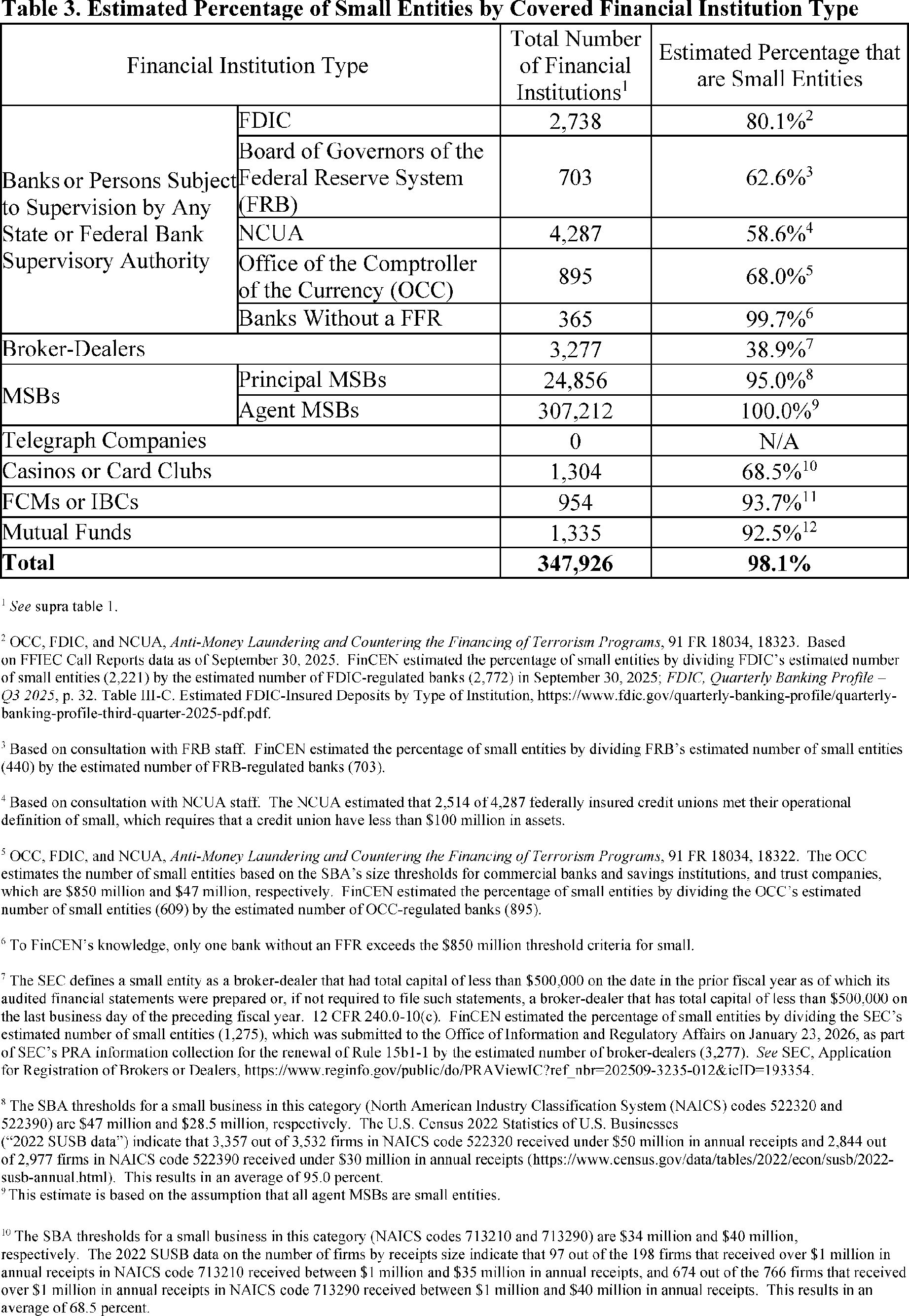
Under the proposed special measure, covered financial institutions would be prohibited from facilitating or participating in certain transmittal of funds involving A7 Network Sub-Agents. As discussed above in Section VIII.A, FinCEN does not expect the rule to affect all financial institutions that it proposes to cover equally, and many, if not most small entities are less likely to incur substantive costs than de minimis ones because of their lower likelihood of interaction with A7 Network Sub-Agents.
While small covered financial institutions would be required to take reasonable measures to detect and prevent the transmittal of funds involving A7 Network Sub-Agents, neither set of newly required activities proposed is expected to introduce significant incremental burdens relative to those covered financial institutions' current obligations and ongoing diligence activities. For example, all U.S. persons, including U.S. financial institutions, must comply with OFAC sanctions, and most covered U.S. financial institutions generally have suspicious activity reporting requirements and systems in place to screen transactions to comply with OFAC sanctions and section 9714(a) special measures administered by FinCEN. The systems that U.S. financial institutions have in place to comply with these requirements are expected to be easily modified to adapt to this proposed rule. FinCEN believes that the increase in burden would be minimal in part because FinCEN would provide a comprehensive list of A7 Network Sub-Agents known to FinCEN to covered financial institutions, who in turn would simply incorporate the list into their existing screening tools and processes. Thus, the special due diligence that would be required under the proposed rule— i.e., preventing the transmittal of funds involving A7 Network Sub-Agents and the transmittal of notification to certain correspondent account holders—is not expected to require a significant change in due diligence activities for small U.S. financial institutions. For these reasons, FinCEN certifies that the proposals contained in this rulemaking are not expected to have a significant impact on a substantial number of small businesses.
FinCEN invites comments from members of the public who believe there would be a significant economic impact on small entities from the imposition of a prohibition under the proposed special measure regarding A7 Network Sub-Agents.
D. Unfunded Mandates Reform Act
Section 202 of the UMRA [90] requires that an agency prepare a budgetary impact statement before promulgating a rule that may result in expenditure by the state, local, and tribal governments, in the aggregate, or by the private sector, of USD 193 million or more in any one year (USD 100 million in 1995, adjusted for inflation).[91 92] If a budgetary impact statement is required, section 202 of the UMRA also requires an agency to identify and consider a reasonable number of regulatory alternatives before promulgating a rule.
FinCEN has determined that this proposed rule would not result in expenditures by state, local, and tribal governments in the aggregate, or by the private sector, of USD 193 million or more in any one year. Accordingly, FinCEN has not prepared a budgetary impact statement or considered the regulatory alternatives outlined in Section IV.C above within the framework of the UMRA.
E. Paperwork Reduction Act
The recordkeeping and disclosure requirements contained in this proposed rule that qualify as “collections of information” under the PRA will be submitted to the Office of Management and Budget (OMB) for review in accordance with the PRA.[93] Under the PRA, an agency may not conduct or sponsor, and a person is not required to respond to, a collection of information unless it displays a valid control number assigned by the OMB.[94] Written comments and recommendations for the proposed prohibition can be submitted by visiting www.reginfo.gov/public/do/PRAMain. Find this particular document by selecting “Currently under Review—Open for Public Comments” or by using the search function. Comments are welcome and must be received by November 4, 2026. In accordance with requirements of the PRA, 44 U.S.C. 3506(c)(2)(A), and its implementing regulations, 5 CFR part 1320, the following information concerning the collection of information as required by 31 CFR 1010.668 is presented to assist those persons wishing to comment on the information collections.
The provisions in this proposed rule pertaining to the collection of information can be found in section 1010.668(b). The notification requirement in section 1010.668(b)(2) are intended to aid cooperation from foreign account holders in preventing transactions involving any A7 Network Sub-Agent from being processed by the U.S. financial system. The information required to be maintained by section 1010.668(b)(5) would be used by federal agencies and certain self-regulatory organizations to verify compliance by covered financial institutions with the requirements in section 1010.668(b). The collection of information would be mandatory.
Frequency: As required.
Description of Affected Financial Institutions: Only those covered financial institutions defined in section 1010.668(a)(4) that are engaged in certain transmittals of funds as defined in proposed section 1010.668(a)(5) with, or processing transactions potentially involving, A7 Network Sub-Agents as defined in section 1010.668(a)(1) and (2) are expected to incur incremental economic effects.[95]
Estimated Number of Potential Respondents: 347,926 covered financial institutions.
Estimated Number of Expected Respondents: 34,793 covered financial institutions.
Estimated Average Annual Burden in Hours per Affected Financial Institution: Imposing the special measure described in this proposed rule is expected to result in a new, incremental recordkeeping and potential disclosure burden on certain ( printed page 63225) covered financial institutions as described above.
The estimated burden includes the time required to determine whether a notification is required, prepare and transmit any notifications required under 1010.668(b)(2), and create and maintain the records required under 1010.668(b)(5). This estimated average annual burden in this proposed rule is, in total, one business day, or eight hours per affected financial institution with expanded obligations ( n = 128) and, in total, one-half business day, or four hours per affected financial institution under more limited requirements ( n = 34,665).
Estimated Total Annual Burden: Approximately 139,700 hours.[96]
Estimated Total Annual Cost: Approximately USD 17,740,000.[97]
General Request for Comments: Comments are invited on: (1) whether the proposed collection of information found in section 1010.668(b)(5) is necessary for the proper performance of the mission of FinCEN, including whether the information would have practical utility; (2) the accuracy of FinCEN's estimate of the burden of the proposed collection of information; (3) ways to enhance the quality, utility, and clarity of the information required to be maintained; (4) ways to minimize the burden of the required collection of information, including through the use of automated collection techniques or other forms of information technology; and (5) estimates of capital or start-up costs and costs of operation, maintenance, and purchase of services to report the information.
VIII. Regulatory Text
List of Subjects in 31 CFR Part 1010
- Administrative practice and procedure
- Banks, banking
- Brokers
- Crime
- Foreign banking
- Terrorism
Authority and Issuance
For the reasons set forth in the preamble, FinCEN proposes amending 31 CFR part 1010 as follows:
PART 1010—GENERAL PROVISIONS
1. The authority citation for part 1010 continues to read as follows:“
Authority: 12 U.S.C. 1829b and 1951-1959; 31 U.S.C. 5311-5314, 5316-5336; title III, sec. 314, Pub. L. 107-56, 115 Stat. 307; sec. 2006, Pub. L. 114-41, 129 Stat. 458-459; sec. 701 Pub. L. 114-74, 129 Stat. 599; sec. 6403, Pub. L. 116-283, 134 Stat. 3388.”
2. Add 1010.668 to read as follows:
(a) Definitions. For purposes of this section, the following terms have the following meanings. To the extent there is a differing definition in § 1010.100 of this chapter, the definition in this Section is what applies to this Section.
(1) A7 Network. The term “A7 Network” means the core grouping of entities and persons involved in the operation of a Russian-Kyrgyzstan based sanctions evasion and money laundering network including: A7 Liability Company, A71 Limited Liability Company, A7 Agent Limited Liability Company, Old Vector LLC, Garantex, Grinex, Independent Decentralize Finance Smartbank and Ecosystem, ExVed, Sergey Mendeleev, Ilan Shor, and Promsvyazbank Public Joint Stock Company, and any other persons whose property and interests in property have been blocked, by designation, order, or by operation of law, in light of their connection to the A7 Network, an OFAC-designated TCO.
(2) A7 Network Sub-Agents. The term “A7 Network Sub-Agents” means businesses including, but not limited to, the following: Galadriel Trading FZCO, Gimli Trade LLC-FZ, Hydrofusion Resources FZ-LLC, Pearl Bridge, Power Sphere LLC-FZ, and Sigizmund FZCO, and any other entity identified by FinCEN as a Sub-Agent of the A7 Network.
(3) Convertible Virtual Currency (CVC). The term “convertible virtual currency (CVC)” means a medium of exchange that either has an equivalent value as currency, or acts as a substitute for currency, but lacks legal tender status. Despite having legal tender status in at least one jurisdiction, for the purpose of this NPRM, the A7A5 stablecoin is included as a type of CVC.
(4) Covered Financial Institution. The term “covered financial institution” has the same meaning as “financial institution” in 31 CFR 1010.100(t).
(5) Transmittals of Funds. The term “transmittals of funds” means the sending and receiving of funds, including convertible virtual currency. For avoidance of doubt, for this section this definition of transmittal of funds applies rather than the definition of transmittal of funds in section 1010.100(ddd).
(6) Recipient. The Term “Recipient” means the person to be paid by the recipient's covered financial institution.
(7) Meaning of Other Terms. All terms used but not otherwise defined herein shall have the meaning set forth in 31 CFR Chapter X, 31 U.S.C. 5312, and 21 U.S.C. 2302.
(b) Prohibition on transmittals of funds and due diligence requirements for covered financial institutions.
(1) Prohibition of certain transmittals of funds. A covered financial institution is prohibited from engaging in a transmittal of funds involving any A7 Network Sub-Agent, including any transmittal of funds from or to an A7 Network Sub-Agent, or from or to any account or CVC address administered by or on behalf of an A7 Network Sub-Agent.
(i) A covered financial institution will be deemed not to have violated this prohibition where, upon determining that it received CVC that originated from an A7 Network Sub-Agent or from an account or CVC address administered by or on behalf of an A7 Network Sub-Agent, that covered financial institution, if required under other authorities, blocks the CVC or rejects the transaction, preventing the intended Recipient from accessing such CVC and returning the CVC to the A7 Network Sub-Agent, or to the account or CVC address from which the CVC originated.
Note 1 to paragraph (b)(1):
Covered financial institutions should block and report ( printed page 63226) to OFAC any accounts, property, or interests in property that are blocked pursuant to any OFAC sanctions authority and in compliance with the Reporting Procedures and Penalties Regulations, 31 CFR part 501.
(2) Notification. If a transmittal of funds is prohibited pursuant to paragraph (b)(1) or is blocked consistent with Note 1 to paragraph (b)(1), the covered financial institution must notify affected persons associated with the transmittal of funds with which the covered financial institution maintains a direct commercial relationship.
(3) Procedures for Removal from the List of A7 Network Sub-Agents.
(i) A person identified by FinCEN as an A7 Network Sub-Agent may submit petition presenting arguments or evidence that the person believes establishes that insufficient basis exists for the person to be identified as an A7 Network Sub-Agent or that the circumstances resulting in being identified as an A7 Network Sub-Agent no longer apply. This submission must be made via email to Globalinvestigations@fincen.gov.
(ii) For the purposes of such petitions:
(A) The information submitted by the person submitting a petition will be reviewed by FinCEN, which may request clarifying, corroborating, or other additional information.
(B) A person submitting a petition may request a meeting with FinCEN; however, such meetings are not required, and FinCEN may, at its discretion, decline to conduct such meetings prior to completing a review of the petition.
(C) After FinCEN has conducted a review of the petition, it will provide a written decision to the person that submitted the petition.
(4) Special Due Diligence. A covered financial institution shall take a risk-based approach when deciding what, if any, other due diligence measures it reasonably must adopt to guard against processing prohibited transmittals of funds associated with transactions involving any A7 Network Sub-Agent.
(5) Recordkeeping and reporting.
(i) A covered financial institution is required to document its compliance with the notification requirement set forth in this section.
(ii) Nothing in paragraph (b) of this section shall require a covered financial institution to report any information not otherwise required to be reported by law or regulation.
Jimmy L. Kirby,
Deputy Director, Financial Crimes Enforcement Network.
Footnotes
1. On October 1, 2026, the Department of the Treasury's Office of Foreign Assets Control (OFAC) sanctioned the A7 Network pursuant to Executive Order 13581, as amended by Executive Order 13863, for being a foreign person that constitutes a significant Transnational Criminal Organization. See U.S. Department of the Treasury, Operation Economic Outcast Takes Unprecedented Action Against Sanctions Evasion Network Used by Iran (Oct. 1, 2026).
Back to Citation2. Section 9714 (as amended) may be found in a note to 31 U.S.C. 5318A.
Back to Citation3. See infra note [4].
Back to Citation4. Pursuant to Treasury Order 180-01, the authority of the Secretary to administer the BSA, including, but not limited to, 31 U.S.C. 5318A, has been delegated to the Director of FinCEN. U.S. Department of the Treasury, Treasury Order 180-01 (Jan. 14, 2020). On August 11, 2022, and in accordance with Treasury Order 101-05 and 31 U.S.C. 321(b), Treasury's Under Secretary for Terrorism & Financial Intelligence re-delegated to the Director of FinCEN the authority of the Secretary under section 9714.
Back to Citation5. See 31 U.S.C. 5318A. 31 U.S.C. 5318A grants the Secretary the authority, upon finding that reasonable grounds exist for concluding that one or more financial institutions operating outside of the United States is of primary money laundering concern, to require domestic financial institutions and domestic financial agencies to take certain “special measures.” Regarding the “special measures” that might be imposed, section 9714 references the five special measures set out in 31 U.S.C. 5318A(b)(1)-(5).
Back to Citation8. See section 9714(a)(2).
Back to Citation9. Congressional Research Service, Russia's War on Ukraine: Financial and Trade Sanctions (Feb. 22, 2023), at p. 2, https://www.congress.gov/crs-product/IF12062.
Back to Citation10. At least some elements of the A7 Network had a job posting listed in early 2026, seeking candidates with experience using SWIFT, and the company has hired staff from major Russian banks—including OFAC-sanctioned Gazprombank, VTB Bank, and Sberbank—suggesting that the A7 Network is intended to supplant the role previously filled by Russia's heavily sanctioned banking sector. HeadHunter, Manager for work with large and medium-sized businesses (last accessed July 1, 2026), https://hh.ru/vacancy/134528312?query=A7+SWIFT&hhtmfrom=vacancy_search_list; Open Source Centre, The Big Shor: A7 and the illusion of Russian financial innovation (2026), at p. 25, https://static.opensourcecentre.org/assets/osc_a7_big_shor.pdf.
Back to Citation11. See generally TRM Labs, “The A7 Leaks: TRM's On-Chain Analysis of Russia's Cryptocurrency Connections” (June 12, 2026).
Back to Citation12. Ilan Shor was designated by OFAC in October 2022, pursuant to E.O. 14024, for his involvement in Russian malign influence operations in Moldova. He was previously arrested on money laundering and embezzlement charges related to a 2014 theft valued at approximately USD 1 billion from Moldovan banks. U.S. Department of the Treasury, Press Release, Treasury Targets Corruption and the Kremlin's Malign Influence Operations in Moldova (Oct. 26, 2022), https://home.treasury.gov/news/press-releases/jy1049. Ilon Shor was also sanctioned by the United Kingdom on December 8, 2022. See UK Foreign, Commonwealth and Development Office (FCDO), Uk Sanctions List, https://search-uk-sanctions-list.service.gov.uk/designations/GAC0029/Individual.
Back to Citation13. PSB was designated by OFAC in February 2022, pursuant to E.O. 14024, for issuing billions of dollars in financial support for Russian defense sector companies in its role as Russia's state defense bank. U.S. Department of the Treasury, Press Release, U.S. Treasury Imposes Immediate Economic Costs in Response to Actions in the Donetsk and Luhansk Regions (Feb. 22, 2022), https://home.treasury.gov/news/press-releases/jy0602. PSB was later redesignated in January 2025, pursuant to E.O. 13662, for operating in the financial services sector of the Russian Federation economy. U.S. Department of the Treasury, Press Release, Treasury Disrupts Russia's Sanctions Evasion Schemes (Jan. 15, 2025), https://home.treasury.gov/news/press-releases/jy2785; see also Open Source Centre, The Big Shor: A7 and the Illusion of Russian Financial Innovation (2026), at. p. 9, https://static.opensourcecentre.org/assets/osc_a7_big_shor.pdf.
Back to Citation14. U.S. Department of the Treasury, Press Release, Treasury Sanctions Cryptocurrency Exchange and Network Enabling Sanctions Evasion and Cyber Criminals (Aug. 14, 2025), https://home.treasury.gov/news/press-releases/sb0225; FCDO, UK Sanctions List, Several entities, https://search-uk-sanctions-list.service.gov.uk/?searchValue=promsvyazbank, https://search-uk-sanctions-list.service.gov.uk/?searchValue=A7%2520llc; European Union Sanctions Tracker, Ilan Shor, https://data.europa.eu/apps/eusanctionstracker/subjects/153809.
Back to Citation15. See FCDO, UK Sanctions List, Several entities, https://search-uk-sanctions-list.service.gov.uk/designations/RUS3614/Individual; https://www.gov.uk/government/news/uk-targets-sanctions-circumvention-and-crypto-networks-exploited-by-russia. European Union Sanctions tracker, Several entities, https://data.europa.eu/apps/eusanctionstracker/subjects/179337, https://data.europa.eu/apps/eusanctionstracker/subjects/172907,https://data.europa.eu/apps/eusanctionstracker/subjects/179375.
Back to Citation16. See U.S. Department of the Treasury, Press Release, Treasury Sanctions Cryptocurrency Exchange and Network Enabling Sanctions Evasion and Cyber Criminals (Aug. 14, 2025), https://home.treasury.gov/news/press-releases/sb0225; U.S. Department of the Treasury, Press Release, Treasury Targets Corruption and the Kremlin's Malign Influence Operations in Moldova (Oct. 26, 2022), https://home.treasury.gov/news/press-releases/jy1049; U.S. Department of the Treasury, Press Release, Treasury Sanctions Russia-Based Hydra, World's Largest Darknet Market, and Ransomware-Enabling Virtual Currency Exchange Garantex (Apr. 5, 2022), https://home.treasury.gov/news/press-releases/jy0701; U.S. Department of the Treasury, Press Release, U.S. Treasury Imposes Immediate Economic Costs in Response to Actions in the Donetsk and Luhansk Regions (Feb. 22, 2022), https://home.treasury.gov/news/press-releases/jy0602.
Back to Citation17. On October 1, 2026, the Department of the Treasury's Office of Foreign Assets Control (OFAC) sanctioned the A7 Network pursuant to Executive Order 13581, as amended by Executive Order 13863, for being a foreign person that constitutes a significant Transnational Criminal Organization. See U.S. Department of the Treasury, Operation Economic Outcast Takes Unprecedented Action Against Sanctions Evasion Network Used by Iran (Oct. 1, 2026).
Back to Citation18. Promsvyazbank, PSB has launched a unique mechanism for crossborder settlements for foreign trade between Russian companies and counterparties from any country (Oct. 8, 2024), https://www.oreanda-news.com/en/finansy/promsvyazbank-has-launched-a-mechanism-for-cross-border-settlements/article1531534/.
Back to Citation19. Kommersant, Investment Cooperation Between Russia and China: Growth Points. Kommersants Session at the Third Russia-China International Forum (Aug. 19, 2025), at p. 2, https://www.events.kommersant.ru/events/sessiya-na-rostki-2025.
Back to Citation20. Centre for Information Resilience, A7 in Africa (Apr. 2, 2026), at p. 3, https://www.info-res.org/app/uploads/2026/04/A7-Africa-Final.pdf.
Back to Citation21. Radio Free Europe/Radio Liberty, A7, Company Implicated In Sanctions Evasion, Reportedly Linked To Russian Oligarchs (Apr. 30, 2026), https://www.rferl.org/a/russia-cryptocurrency-a7a5-ilan-shor-investigation-sanction-evasion/33746026.html.
Back to Citation22. Radio Free Europe/Radio Liberty, A7, Company Implicated In Sanctions Evasion, Reportedly Linked To Russian Oligarchs (Apr. 30, 2026), https://www.rferl.org/a/russia-cryptocurrency-a7a5-ilan-shor-investigation-sanction-evasion/33746026.html; UK Foreign, Commonwealth and Development Office Sanctions List, Roman Arkadyevich Abramovich (Mar. 10, 2022), https://search-uk-sanctions-list.service.gov.uk/designations/RUS0270/Individual; U.S. Department of the Treasury, Treasury Designates Russian Oligarchs, Officials, and Entities in Response to Worldwide Malign Activity (Apr. 6, 2018), https://home.treasury.gov/news/press-releases/sm0338; U.S. Department of the Treasury, Treasury Sanctions Russian Officials, Members Of The Russian Leadership's Inner Circle, And An Entity For Involvement In The Situation In Ukraine (Mar. 20, 2014), https://home.treasury.gov/news/press-releases/jl23331; UK Foreign, Commonwealth and Development Office Sanctions List, Leonid Viktorovich Mikhelson (Apr. 6, 2022), https://search-uk-sanctions-list.service.gov.uk/designations/RUS1126/Individual.
Back to Citation23. PSB pledged its ownership stake in A7 LLC to VEB as collateral for loans to A7 LLC. Centre for Information Resilience, A7 Abroad: How A7 Sells International Sanctions Evasion as a Service (Oct. 2025), at p. 5, https://www.info-res.org/app/uploads/2025/10/A7-Abroad-FINAL-Copy.pdf. VEB was sanctioned by OFAC in 2022 at the same time as PSB. U.S. Department of the Treasury, U.S. Treasury Imposes Immediate Economic Costs in Response to Actions in the Donetsk and Luhansk Regions (Feb. 22, 2022), https://home.treasury.gov/news/press-releases/jy0602. UK Foreign, Commonwealth and Development Office Sanctions List, Roman Abrahmovich, (March 10, 2022) https://search-uk-sanctions-list.service.gov.uk/designations/RUS1126/Individual.
Back to Citation24. Radio Free Europe/Radio Liberty, A7, Company Implicated In Sanctions Evasion, Reportedly Linked To Russian Oligarchs (Apr. 30, 2026), https://www.rferl.org/a/russia-cryptocurrency-a7a5-ilan-shor-investigation-sanction-evasion/33746026.html.
Back to Citation25. Open Source Centre, The Big Shor: A7 and the Illusion of Russian Financial Innovation (2026), at. pp. 25-26, https://static.opensourcecentre.org/assets/osc_a7_big_shor.pdf.
Back to Citation26. See Centre for Information Resilience, A7 Abroad: How A7 Sells International Sanctions Evasion as a Service (Oct. 2025), at p.8, https://www.info-res.org/app/uploads/2025/10/A7-Abroad-FINAL-Copy.pdf; see also Alexander Osipovich, “Russia's Hottest Startup Is a State-Backed Sanctions Evasion Network,” The Wall Street Journal (Aug. 7, 2026), https://www.wsj.com/world/russia/russias-hottest-startup-is-a-state-backed-sanctions-evasion-network-7afc488c?mod=article_inline.
Back to Citation27. Centre for Information Resilience, A7 in Africa (Apr. 2, 2026), at p. 2, https://www.info-res.org/app/uploads/2026/04/A7-Africa-Final.pdf.
Back to Citation28. Reuters, Russia's A7 transborder payments company plans global expansion (June 4, 2026), https://www.reuters.com/business/finance/russias-a7-transborder-payments-company-plans-global-expansion-2026-06-04/.
Back to Citation29. 31 U.S.C. 5318A(c)(2)(B) provides, as relevant here, that in making a finding that reasonable grounds exist for concluding that a class of transactions within, or involving, a jurisdiction outside the United States is of primary money laundering concern and to apply one or more of special measures one through four to such a financial institution, the Secretary shall consider such information as the Secretary determines to be relevant, including the following potentially relevant factors:
(1) The extent to which such financial institutions, transactions, or types of accounts are used to facilitate or promote money laundering in or through the jurisdiction, including any money laundering activity by organized criminal groups, international terrorists, or entities involved in the proliferation of weapons of mass destruction or missiles;
(2) The extent to which such institutions, transactions, or types of accounts are used for legitimate business purposes in the jurisdiction; and
(3) The extent to which such action is sufficient to ensure, with respect to transactions involving the jurisdiction and institutions operating in the jurisdiction, that the purposes of this subchapter continue to be fulfilled, and to guard against international money laundering and other financial crimes.
Back to Citation30. Open Source Centre, The Big Shor: A7 and the Illusion of Russian Financial Innovation (2026), at pp. 25-26, https://static.opensourcecentre.org/assets/osc_a7_big_shor.pdf.
Back to Citation31. See Open Source Centre, The Big Shor: A7 and the Illusion of Russian Financial Innovation (2026), at p. 33, https://static.opensourcecentre.org/assets/osc_a7_big_shor.pdf.
Back to Citation32. A7 Abroad: How A7 Sells International Sanctions Evasion as a Service (Oct. 2025), at p. 16, https://www.info-res.org/app/uploads/2025/10/A7-Abroad-FINAL-Copy.pdf.
Back to Citation33. Open Source Centre, The Big Shor: A7 and the illusion of Russian financial innovation (2026), at pp. 41-42, https://static.opensourcecentre.org/assets/osc_a7_big_shor.pdf.
Back to Citation34. See Centre for Information Resilience, A7A5: Circumventing sanctions with stablecoin cryptocurrency (June 25, 2025), at p. 15, https://www.info-res.org/app/uploads/2025/06/A7A5-Report-June-2025-Final-Draft-1.pdf; Open Source Centre, The Big Shor: A7 and the Illusion of Russian Financial Innovation (2026), at pp. 28, 68, https://static.opensourcecentre.org/assets/osc_a7_big_shor.pdf.
Back to Citation35. See Open Source Centre, The Big Shor: A7 and the Illusion of Russian Financial Innovation (2026), at pp. 26, 39, https://static.opensourcecentre.org/assets/osc_a7_big_shor.pdf.
Back to Citation36. See Alexander Osipovich, “Russia's Hottest Startup Is a State-Backed Sanctions Evasion Network,” The Wall Street Journal (Aug. 7, 2026). For more information about the use of AI to alter or generate fraudulent documents in furtherance of illicit finance schemes, see FinCEN, FIN-2024-Alert004, “FinCEN Alert on Fraud Schemes Involving Deepfake Media Targeting Financial Institutions” (Nov. 14, 2024), at pp. 3-5.
Back to Citation37. See Open Source Centre, The Big Shor: A7 and the Illusion of Russian Financial Innovation (2026), at pp. 30-31, https://static.opensourcecentre.org/assets/osc_a7_big_shor.pdf.
Back to Citation38. Id. at pp. 30-31.
Back to Citation39. Id., at. pp. 32-34. Several sanctioned Russian financial institutions were removed from the SWIFT system in March 2022 shortly after its full-scale invasion of Ukraine, making it significantly harder for Russian financial institutions to conduct cross-border transactions. See SWIFT, “An update to our message for the Swift Community” (Mar. 20, 2022), https://www.swift.com/news-events/news/message-swift-community.
Back to Citation40. Open Source Centre, The Big Shor: A7 and the illusion of Russian financial innovation (2026), at p. 41, https://static.opensourcecentre.org/assets/osc_a7_big_shor.pdf. The A7 Network's Sub-Agents are tailored, insofar as it is possible, to the industries for which they are moving payments to avoid scrutiny from financial institutions. However, there are some indications that the A7 Network at times struggles to match Sub-Agents with specific customer business profiles. Id. at p. 20.
Back to Citation41. Id. at pp. 33, 39.
Back to Citation42. Id. at pp. 41-42.
Back to Citation43. Id. at p. 46.
Back to Citation44. Id. at pp. 52-53.
Back to Citation45. Open Source Centre, The Big Shor: A7 and the illusion of Russian financial innovation (2026), at pp. 25, 34, 37, https://static.opensourcecentre.org/assets/osc_a7_big_shor.pdf.
Back to Citation46. The A7A5 tokens operate from smart contracts with addresses at 0x6fA0BE17e4beA2fCfA22ef89BF8ac9aab0AB0fc9 and TLeVfrdym8RoJreJ23dAGyfJDygRtiWKBZ. See https://etherscan.io/token/0x6fA0BE17e4beA2fCfA22ef89BF8ac9aab0AB0fc9#code; https://tronscan.org/token20/TLeVfrdym8RoJreJ23dAGyfJDygRtiWKBZ/code.
47. Stablecoins are a type of digital asset for which the value of the token is tied to another asset, typically a fiat currency such as the U.S. dollar. Stablecoins are appealing to illicit actors due to their relative liquidity, ease of settlement, and exchange rate stability. See U.S. Department of the Treasury, 2026 National Proliferation Financing Risk Assessment (Mar. 2026), at p. 16, https://home.treasury.gov/system/files/246/2026-NPFRA.pdf; see also U.S. Department of the Treasury, 2026 National Money Laundering Risk Assessment (Mar. 2026), at pp. 52-53, https://home.treasury.gov/system/files/246/2026-NMLRA.pdf.
Back to Citation48. See U.S. Department of the Treasury, Press Release, Treasury Sanctions Cryptocurrency Exchange and Network Enabling Sanctions Evasion and Cyber Criminals (Aug. 14, 2025), https://home.treasury.gov/news/press-releases/sb0225.
Back to Citation49. Garantex, which had been previously sanctioned as a prolific money launderer for Russian cybercriminals and other illicit actors, executed a scheme to move its funds to a successor exchange, Kyrgyzstan-based Grinex, following disruptive action by U.S. law enforcement in March 2025. Garantex allowed its customers who lost their funds following the law enforcement disruptions to regain access to their accounts using the A7A5 token. See Treasury Press Release, “Treasury Sanctions Russia-Based Hydra, World's Largest Darknet Market, and Ransomware-Enabling Virtual Currency Exchange Garantex” (Apr. 5, 2026); see also Aug. 2025 Treasury Press Release, supra note 2. See also Etherscan, Contract, “Token A7A5” (accessed Aug. 17, 2026).
Back to Citation50. U.S. Department of the Treasury, Press Release, Treasury Sanctions Cryptocurrency Exchange and Network Enabling Sanctions Evasion and Cyber Criminals (Aug. 14, 2025), https://home.treasury.gov/news/press-releases/sb0225; A7A5, Homepage, https://www.a7a5.kg/trade_and_earn?chain=tron%3Flang%3Den.https://www.a7a5.kg/trade_and_earn?chain=tron%3Flang%3Den.
Back to Citation51. A7A5, Why A7A5, at p. 1, https://www.a7a5.kg/why_a7a5; Chainalysis, How A7A5 and Grinex Enable The Russian Shadow Crypto Economy (Aug. 14, 2025), at pp. 2-3, https://www.chainalysis.com/blog/a7a5-grinex-russian-crypto-economy-ofac-sanctions-august-2025/.
Back to Citation52. The term “mirror transactions” or “mirror transfer” is used by U.S. law enforcement to describe a money laundering typology involving foreign currency exchange. The process typically happens within Chinese underground banking and black market peso exchange schemes and usually involves a money broker or an accountant who conducts two equal, but separate, transactions involving at least two parties who often are unaware of each other. In this scheme, the broker or accountant makes payments to each party using the other parties' currency, “mirroring” or balancing the transactions. In the instance of the A7 Network, transactions within Russia using the A7A5 token “mirror” movements of fiat currency through “Sub-Agents,” balancing the transactions while ensuring that the counterparties remain completely firewalled from one another. See Treasury, “2024 National Money Laundering Risk Assessment” (Feb. 2024), at pp. 29-30. For more information about Chinese underground banking and the black market peso exchange, see FinCEN, FIN-2025-A003, “FinCEN Advisory on the Use of Chinese Money Laundering Networks by Mexico-Based Transnational Criminal Organizations to Launder Illicit Proceeds” (Aug. 28, 2025).
Back to Citation53. See June 2026 TRM Labs Report, supra note 12.
Back to Citation54. See TRM Labs, “The A7 Leaks: TRM's On-Chain Analysis of Russia's Cryptocurrency Connections” (June 12, 2026), https://www.trmlabs.com/resources/blog/the-a7-leaks-trms-on-chain-analysis-of-russias-cryptocurrency-connections.
Back to Citation55. See Elliptic, “The fall of A7A5: how sanctions strangled the ruble stablecoin” (July 29. 2026), https://www.elliptic.co/insights/the-fall-of-a7a5-how-sanctions-strangled-the-ruble-stablecoin/.
Back to Citation56. See Hannah Curtis, “One wallet now holds 94.5% of A7A5's supply,” Crystal Intelligence (July 30, 2026), https://crystalintelligence.com/stablecoin/one-wallet-now-holds-94-5-of-a7a5s-supply/.
Back to Citation57. See Elliptic, “A7A5: The ruble-backed stablecoin crosses $100 billion in transactions” (Jan. 21, 2026), https://www.elliptic.co/insights/a7a5-the-ruble-backed-stablecoin-100-billion-in-transactions/; see also Elliptic, “The fall of A7A5: how sanctions strangled the ruble stablecoin” (July 29. 2026), Centre for Information Resilience “A7A5: Circumventing sanctions with stablecoin cryptocurrency” (June 25, 2025), at p. 9, https://www.info-res.org/app/uploads/2025/06/A7A5-Report-June-2025-Final-Draft-1.pdf.
Back to Citation58. OTCs are money services businesses (MSBs) that conduct peer-to-peer exchanges of digital assets for fiat currency, or digital assets for digitals assets, between two parties without the use of a centralized digital asset exchange and usually involving large volumes. As part of the money laundering process, illicit actors often seek to convert digital assets, specifically stablecoins, into fiat currency via diffuse networks of OTC brokers in third countries. These OTCs can receive substantial fees from illicit actors for providing cash-out services that leverage proxy accounts to circumvent digital asset service providers' Customer Due Diligence (CDD) processes or exploit providers with weaker AML/CFT controls, among other tactics. See U.S. Department of the Treasury, 2026 National Money Laundering Risk Assessment (Mar. 2026), at p. 50, https://home.treasury.gov/system/files/246/2026-NMLRA.pdf.
Back to Citation59. The A7A5 token is only available for purchase on a small number of exchanges, most of which are sanctioned by the U.S., EU and/or UK; however, it is also traded using peer-to-peer exchangers and decentralized exchanges. See Centre for Information Resilience “A7A5: Circumventing sanctions with stablecoin cryptocurrency” (June 25, 2025), at pp. 12-13, https://www.info-res.org/app/uploads/2025/06/A7A5-Report-June-2025-Final-Draft-1.pdf.
Back to Citation60. A “wrapped” token is a digital asset that represents another digital asset on a non-native blockchain where the original asset is not offered. For example, a “wrapped” A7A5 token may offer trading of a representation of A7A5 on a blockchain other than A7A5's native blockchains. Wrapped tokens maintain a peg to the original asset, which is traditionally locked by a smart contract or maintained in a digital vault. See Securities and Exchange Commission and Commodity Futures Trading Commission, 17 CFR parts 231 RIN 3235-AN56 and 241 and 17 CFR part 1 RIN 3038-AF67, “Application of the Federal Securities Laws to Certain Types of Crypto Assets and Certain Transactions Involving Crypto Assets” (Mar. 23, 2026), https://www.sec.gov/files/rules/interp/2026/33-11412.pdf. Wrapped tokens may also be created on the same blockchain as the original token to make them compatible with decentralized exchanges. See Centre for Information Resilience “A7A5: Circumventing sanctions with stablecoin cryptocurrency” (June 25, 2025), at p. 13, https://www.info-res.org/app/uploads/2025/06/A7A5-Report-June-2025-Final-Draft-1.pdf.
Back to Citation61. See Ethereum Foundation, “Wrapped ether (WETH),” https://ethereum.org/wrapped-eth/ (last accessed Aug. 20, 2026).
Back to Citation62. See TRM Labs, “The A7 Leaks: TRM's On-Chain Analysis of Russia's Cryptocurrency Connections” (June 12, 2026), https://www.trmlabs.com/resources/blog/the-a7-leaks-trms-on-chain-analysis-of-russias-cryptocurrency-connections.
Back to Citation63. All of the Sub-Agents discussed below were identified as Sub-Agents of the A7 Network. See Centre for Information Resilience, A7 Abroad: How A7 Sells International Sanctions Evasion as a Service (Oct. 2025), at pp. 19-20, https://www.info-res.org/app/uploads/2025/10/A7-Abroad-FINAL-Copy.pdf.
Back to Citation64. Id. at p. 19.
Back to Citation65. Id. at p. 20.
Back to Citation66. Centre for Information Resilience, A7 Abroad: How A7 Sells International Sanctions Evasion as a Service (Oct. 2025), at p. 20, https://www.info-res.org/app/uploads/2025/10/A7-Abroad-FINAL-Copy.pdf.
Back to Citation67. Open Source Centre, The Big Shor: A7 and the illusion of Russian financial innovation (2026), at p. 34, https://static.opensourcecentre.org/assets/osc_a7_big_shor.pdf.
Back to Citation68. UK Foreign, Commonwealth and Development Office, Gimli Trade LLC-FZ (Dec. 18, 2025), https://search-uk-sanctions-list.service.gov.uk/designations/RUS3177/Entity?utm_content=&utm_medium=email&utm_name=&utm_source=govdelivery.
Back to Citation69. Centre for Information Resilience, A7 Abroad: How A7 Sells International Sanctions Evasion as a Service (Oct. 2025), at p. 19, https://www.info-res.org/app/uploads/2025/10/A7-Abroad-FINAL-Copy.pdf.
Back to Citation70. Centre for Information Resilience, A7 Abroad: How A7 Sells International Sanctions Evasion as a Service (Oct. 2025), at p. 19, https://www.info-res.org/app/uploads/2025/10/A7-Abroad-FINAL-Copy.pdf.
Back to Citation71. Id.
Back to Citation73. Kommersant, Investment Cooperation Between Russia and China: Growth Points. Kommersants Session at the Third Russia-China International Forum (Aug. 19, 2025), at p. 2, https://www.events.kommersant.ru/events/sessiya-na-rostki-2025.
Back to Citation75. In connection with this action, and consistent with 31 U.S.C. 5318A(a)(4)(A), FinCEN consulted with staff at the following Departments and agencies with regard to the proposed rule and prohibition: the Department of Justice; the Department of State; the Board of Governors of the Federal Reserve System; the Federal Deposit Insurance Corporation; the Securities and Exchange Commission; the Commodity Futures Trading Commission; the Office of the Comptroller of the Currency; and the National Credit Union Administration. Neither the Departments nor agencies objected to the issuance of this NPRM based on the information provided to staff at the time of this consultation.
Back to Citation76. 31 U.S.C. 5318A(a)(4)(B) provides, as relevant here, that in selecting which special measure(s) to take, the Secretary shall consider:
(1) Whether similar action has been or is being taken by other nations or multilateral groups;
(2) Whether the imposition of any particular special measure would create a significant competitive disadvantage, including any undue cost or burden associated with compliance, for financial institutions organized or licensed in the United States;
(3) The extent to which the action or the timing of the action would have a significant adverse systemic impact on the international payment, clearance, and settlement system, or on legitimate business activities involving the particular jurisdiction, institution, class of transactions, or type of account; and
(4) The effect of the action on United States national security and foreign policy.
Back to Citation77. See 31 U.S.C. 5318A(a)(4)(B)(i), (iv).
Back to Citation78. Likewise, imposing conditions on transmittals of funds, pursuant to section 9714(a)(2), would be insufficient to address the threat. While imposing conditions, rather than a full prohibition, may be appropriate in circumstances where the institution provides services for legitimate business that are not easily replicated or where a complete prohibition on transactional activity would otherwise unduly harm legitimate economic activity, the A7 Network's Sub-Agents provide a service that, by design, is intended to benefit sanctioned persons. And, to the extent that the A7 Network carries on any legitimate activity, FinCEN assesses that such services would be easily obtainable for legitimate customers through other providers. Accordingly, in this case the value of any legitimate activity it may conduct is outweighed by the significant proportion of illicit financial activity identified and its lack of mandatory Know Your Customer controls.
Back to Citation79. Persons whose property and interests in property are blocked pursuant to an Executive Order or regulations administered by OFAC (blocked persons) are considered to have an interest in all property and interests in property of an entity in which such blocked persons own, whether individually or in the aggregate, directly or indirectly, a 50 percent or greater interest. Consequently, any entity owned in the aggregate, directly or indirectly, 50 percent or more by one or more blocked persons is itself considered to be a blocked person. The property and interests in property of such an entity are blocked regardless of whether the entity itself is listed in the annex to an Executive order or otherwise placed on OFAC's List of Specially Designated Nationals. Accordingly, a U.S. person generally may not engage in any transactions with such an entity, unless authorized by OFAC. In certain OFAC sanctions programs ( e.g., Cuba and Sudan), there is a broader category of entities whose property and interests in property are blocked based on, for example, ownership or control. See OFAC, Revised Guidance on Entities Owned by Persons Whose Property and Interests in Property are Blocked (Aug. 13, 2014), https://ofac.treasury.gov/media/6186/download?inline.
Back to Citation80. FinCEN notes that CVC payment systems are often designed to limit the control of specific financial institutions over transactions and to prevent rejections of funds by persons or entities other than the sender of funds. As a result, although covered financial institutions may institute an internal prohibition on the sending of CVC transactions to another address or entity, FinCEN assesses that there are few, if any, readily available ways for covered financial institutions to “reject” incoming CVC transactions (prior to receipt).
Back to Citation81. Executive Order 14294, Fighting Overcriminalization in Federal Regulations,90 FR 20367 (issued May 9, 2025; published May 14, 2025), https://www.federalregister.gov/executive-order/14294.
Back to Citation82. Executive Order 12866, Regulatory Planning and Review,58 FR 51735 (issued Sept. 30,1993; published Oct. 4, 1993).
Back to Citation83. Executive Order 13563, Improving Regulation and Regulatory Review,76 FR 3821 (issued Jan. 18, 2011; published Jan. 21, 2011).
Back to Citation84. 5 U.S.C. 601 et seq.
Back to Citation87. See supra Section V.
Back to Citation88. See Sections VI and VIII.D.
Back to Citation90. 2 U.S.C. 1532, Public Law 104-4 (Mar. 22, 1995).
Back to Citation91. Id.
92. The U.S. Bureau of Economic Analysis reports the annual value of the gross domestic product implicit price deflator for calendar year 1995 (the year UMRA was enacted), as 66.939, and as 128.974 for the calendar year 2025 (the most recent available). Thus, the inflation-adjusted estimate for $100 million is 128.974 ÷ 66.939 × $100 million, or $192.7 million. U.S. Bureau of Economic Analysis, Table 1.1.9. Implicit Price Deflators for Gross Domestic Product, BEA Interactive Data Application.
Back to Citation93. See 44 U.S.C. 3507(a)(1)(D). The PRA defines a “collection of information” as “the obtaining, causing to be obtained, soliciting, or requiring the disclosure to third parties or the public, of facts or opinions by or for an agency, regardless of form or format, calling for either (i) answers to identical questions posed to, or identical reporting or recordkeeping requirements imposed on, ten or more persons, other than agencies, instrumentalities, or employees of the United States; or (ii) answers to questions posed to agencies, instrumentalities, or employees of the United States which are to be used for general statistical purposes[.]” See 44 U.S.C. 3502(3).
Back to Citation95. FinCEN recognizes that the petition process that would be provided under proposed 31 CFR 1010.668(b)(3) would also generate required paperwork and thereby impose burden on affected respondents. However, because (1) a petition is only expected to be undertaken by a listed A7 Network Sub-Agent that believed itself capable of demonstrating why it should be removed from the list and (2) the likelihood of this occurring 10 or more times in a given year is exceptionally low, FinCEN has not estimated or assigned a separate PRA burden to the reporting, recordkeeping, or disclosure activities accompanying proposed subsection 1010.668(b)(3).
Back to Citation96. (128 financial institutions with expanded obligations × 8 hours per institution) + (34,665 financial institutions with limited obligations × 4 hours per institution)) = 139,682 hours = ~ 139,700 hours.
Back to Citation97. The wage rate applied here is a general composite hourly wage (USD 89.24), scaled by a private-sector benefits factor of 1.42 (USD 127.03 = USD 89.24 × 1.42). This incorporates Bureau of Labor Statistics (BLS) mean wage data associated with the six occupational codes (11-1010: Chief Executives; 11-3021: Computer and Information Systems Managers; 11-3031: Financial Managers; 13-1041: Compliance Officers; 23-1010: Lawyers and Judicial Law Clerks; 43-3099: Financial Clerks, All Other) for each of the nine groupings of North American Industry Classification System industry codes that FinCEN determined are most directly comparable to its 11 categories of potentially affected financial institutions as delineated in 31 CFR parts 1020 to 1030. See BLS, May 2025—National industry-specific and by ownership, https://www.bls.gov/oes/tables.htm. Given that many occupations provide benefits beyond wages ( e.g., insurance and paid leave), FinCEN applies the private sector benefit factor to the unloaded wage rate to reflect the total cost to the employer. The benefit factor is the ratio of total compensation (which includes wages and benefits) to wages. Total compensation = USD 45.65 and Wages and salaries = USD 32.07 (1.42 = USD 45.65 ÷ USD 32.07) as of June 2025, based on the private industry workers series data downloaded from BLS, Employer Costs for Employee Compensation data, https://www.bls.gov/news.release/archives/ecec_09122025.pdf. 139,682 total annual burden hours multiplied by USD 127.03 per hour equals a total annual cost of USD 17,743,855, or approximately USD 17,740,000.
See discussion of how compliance with the proposed rule is expected to be integrated into covered financial institutions' broader OFAC sanctions and 311 special measures compliance activities at Section X.B.
See FinCEN, Renewal Without Change of Prohibition on Correspondent Accounts for Foreign Shell Banks; Records Concerning Owners of Foreign Banks and Agents for Service of Legal Process,90 FR 21987, 21994 (May 22, 2025), https://www.federalregister.gov/d/2025-09162/p-134.
Back to CitationCommon questions
- What does "Proposal of Special Measure Prohibiting the Transmittal of Funds Regarding Transactions Involving the A7 Network's Sub-Agents" cover?
- FinCEN proposes to find that transactions involving any company operating outside the U.S. controlled by the A7 Network—a Russia-linked sanctions evasion…
- Which agency issued this update?
- This update was issued by Treasury Department.
- When was it published?
- It was published on October 5, 2026.
Related updates
- OCC AA-CE-2026-11 — Order of Prohibition
- Two Ocean No-Action Letter: Digital Asset Custody & Qualified Custodian Status
- Consent Order Block Inc.
- Pionex, Inc. Consent Order issued by the Division of Banking
- Ultralight FS,. Inc., formerly known as Obopay, Inc., also doing business as Obopay USA
- Consent Order Ramad Pay Inc.