
Treasury Department
Regulatory Capital Rule: Modifications to the Enhanced Supplementary Leverage Ratio Standards for U.S. Global Systemically Important Bank Holding Companies and Their Subsidiary Depository Institutions; Total Loss-Absorbing Capacity and Long-Term Debt Requirements for U.S. Global Systemically Important Bank Holding Companies
December 1, 2025 · Effective April 1, 2026
Summary
This final rule adjusts the enhanced supplementary leverage ratio (eSLR) standards for U.S. global systemically important bank holding companies (GSIBs) and certain subsidiary depository institutions. The amendments aim to ensure leverage standards serve as a backstop rather than a primary constraint, alongside technical updates to loss-absorbing capacity requirements and capital reporting frameworks.
AI-generated summary · May 24, 2026. Verify with your compliance counsel before acting.
How this was generated
We record the exact prompt, model, and output for every AI response so it can be audited for accuracy.
Document headings vary by document type but may contain the following:
- the agency or agencies that issued and signed a document
- the number of the CFR title and the number of each part the document amends, proposes to amend, or is directly related to
- the agency docket number / agency internal file number
- the RIN which identifies each regulatory action listed in the Unified Agenda of Federal Regulatory and Deregulatory Actions
See the Document Drafting Handbook for more details.
Department of the Treasury
Office of the Comptroller of the Currency
- 12 CFR Parts 3 and 6
- [Docket ID OCC—2025-0006]
- RIN 1557-AF31
Federal Reserve System
- 12 CFR Parts 208, 217, and 252
- [Regulations H, Q, and YY; Docket No. R-1867]
- RIN 7100-AG96
Federal Deposit Insurance Corporation
- 12 CFR Part 324
- RIN 3064-AG11
AGENCY:
Office of the Comptroller of the Currency, Treasury; the Board of Governors of the Federal Reserve System; and the Federal Deposit Insurance Corporation.
ACTION:
Final rule.
SUMMARY:
The Office of the Comptroller of the Currency (OCC), Board of Governors of the Federal Reserve System (Board), and Federal Deposit Insurance Corporation (FDIC) are adopting a final rule to modify the enhanced supplementary leverage ratio standards applicable to U.S. bank holding companies identified as global systemically important bank holding companies (GSIBs), their subsidiary depository institutions that are Board- or FDIC-regulated, and national banks and Federal savings associations that are subsidiaries of a U.S. top-tier bank holding company with total consolidated assets of more than $700 billion or assets under custody of more than $10 trillion (together with Board- and FDIC-regulated subsidiary depository institutions of GSIBs, covered depository institutions). These modifications are intended to help ensure that the enhanced supplementary leverage ratio standards serve as a backstop to risk-based capital requirements rather than a frequently binding constraint, thus reducing potential disincentives for GSIBs and covered depository institutions to participate in low-risk, low-return activities. The Board is also finalizing conforming amendments to its total loss-absorbing capacity and long-term debt requirements. In addition, the Board is making conforming amendments to relevant regulatory reporting forms, and the Board and FDIC are making final certain technical corrections to the capital rule and the prompt corrective action framework. Banking organizations subject to the final rule may elect to early adopt the final rule as of January 1, 2026.
DATES:
The final rule is effective April 1, 2026.
FOR FURTHER INFORMATION CONTACT:
OCC: Venus Fan, Risk Expert, Benjamin Pegg, Technical Expert, Capital Policy, (202) 649-6370; Carl Kaminski, Assistant Director, Ron Shimabukuro, Senior Counsel, Scott Burnett, Counsel, Chief Counsel's Office, (202) 649-5490, Office of the Comptroller of the Currency, 400 7th Street SW, Washington, DC 20219. If you are deaf, hard of hearing, or have a speech disability, please dial 7-1-1 to access telecommunications relay services.
Board: Juan Climent, Deputy Associate Director, (202) 872-7526; Brian Chernoff, Manager, (202) 731-8914; Missaka Nuwan Warusawitharana, Manager, (202) 452-3461; Akos Horvath, Principal Economist, (202) 452-3048; Nadya Zeltser, Lead Financial Institution Policy Analyst, (202) 452-3164; Anthony Sarver, Senior Financial Institution Policy Analyst, (202) 475-6317, Division of Supervision and Regulation; or Jay Schwarz, Deputy Associate General Counsel, (202) 731-8852; Mark Buresh, Senior Special Counsel, (202) 499-0261; Ryan Rossner, Counsel, (202) 430-1368; Isabel Echarte, Senior Attorney, (202) 945-2412, Legal Division, Board of Governors of the Federal Reserve System, 20th and C Streets NW, Washington, DC 20551. For the hearing impaired only, Telecommunication Device for the Deaf (TDD), (202) 263-4869.
FDIC: Benedetto Bosco, Chief, Capital Policy Section; Michael Maloney, Senior Policy Analyst; Kyle McCormick, Senior Policy Analyst; Keith Bergstresser, Senior Policy Analyst; Eric Schatten, Senior Policy Analyst; Soo Jeong Kim, Policy Analyst; Matthew Park, Financial Analyst; Capital Markets and Accounting Policy Branch, Division of Risk Management Supervision; Catherine Wood, Counsel; Merritt Pardini, Counsel; Kevin Zhao, Senior Attorney; Nicholas Soyer, Attorney, Legal Division; regulatorycapital@fdic.gov, (202) 898-6888; Federal Deposit Insurance Corporation, 550 17th Street NW, Washington, DC 20429.
SUPPLEMENTARY INFORMATION:
Table of Contents
I. Introduction
A. Overview of Leverage Capital Requirements for Large Banking Organizations
B. Objective of Rulemaking
C. Overview of the Proposed Rule and Summary of Comments
D. Overview of the Final Rule
II. Final Rule
A. Changes to the Enhanced Supplementary Leverage Ratio Standards
1. Proposed Calibration and Comments Received
2. Calibration of the Holding Company Standard
3. Calibration of the Depository Institution Standard
4. Modification to the Form of the Depository Institution Standard
B. Amendments to Total Loss-Absorbing Capacity and Long-Term Debt Requirements
C. Applicability Thresholds of the eSLR Standard for OCC-Supervised Institutions
D. Comments on Other Potential Modifications to the Supplementary Leverage Ratio Requirement and Other Elements of the Agencies' Regulatory Framework
E. Technical Corrections
III. Effective Date
IV. Economic Analysis
A. Introduction
B. Baseline
1. Role of Banking Organizations as Investors in U.S. Treasury Securities
2. Treasury Securities Held by Banking Organizations Subject to Category I to III Standards
C. Policy Change
D. Reasonable Alternatives
E. Changes in the Supplementary Leverage Ratio and Tier 1 Capital Requirements
F. Benefits
G. Costs
H. Additional Comments on the Economic Analysis
1. Requests To Consider Potential Future Developments
2. Requests To Consider Potential Interaction Effects
3. Requests To Consider Further Benefits and Costs
I. Analysis of TLAC and Long-Term Debt Requirement Changes
1. Baseline
2. Changes in Requirements
3. Anticipated Economic Effects
J. Conclusion
K. Appendix
1. Estimating the Available Capacity of Holding Companies for Additional Reserves and U.S. Treasury Securities Held as Investment Securities at Depository Institution Subsidiaries ( printed page 55249)
2. Estimating the Available Capacity of Holding Companies for Additional U.S. Treasury Securities Held at Broker-Dealer Subsidiaries, Assuming Perfect Hedging
V. Administrative Law Matters
A. Paperwork Reduction Act
B. Regulatory Flexibility Act Analysis
C. Plain Language
D. Riegle Community Development and Regulatory Improvement Act of 1994
E. Executive Orders 12866, 13563, and 14192
F. OCC Unfunded Mandates Reform Act of 1995
G. Congressional Review Act
I. Introduction
On July 10, 2025, the Office of the Comptroller of the Currency (OCC), Board of Governors of the Federal Reserve System (Board), and Federal Deposit Insurance Corporation (FDIC) (collectively, the agencies) published in the Federal Register a notice of proposed rulemaking (the proposal) [1] that would modify the enhanced supplementary leverage ratio (eSLR) standards that apply to U.S. bank holding companies identified as global systemically important bank holding companies (GSIBs) [2] and their subsidiary depository institutions (covered depository institutions).[3] Following review of the comments received on the proposal, the agencies are finalizing the proposed changes, with certain adjustments discussed below.
A. Overview of Leverage Capital Requirements for Large Banking Organizations
Congress has authorized the agencies to establish leverage capital requirements and standards for banking organizations subject to this final rule. Section 165 of the Dodd-Frank Wall Street Reform and Consumer Protection Act (Dodd-Frank Act),[4] as amended by section 401 of the Economic Growth, Regulatory Relief, and Consumer Protection Act,[5] requires the Board to establish leverage limits for bank holding companies with $250 billion or more in total consolidated assets.[6] The prompt corrective action framework in section 38 of the Federal Deposit Insurance Act (FDI Act) requires the agencies to prescribe capital standards for insured depository institutions that include a leverage limit and provides that the agencies may establish any additional relevant capital measures to carry out the purpose of that section.[7] Various statutory authorities provide the agencies with broad discretionary authority to set capital requirements and standards for banking organizations supervised by the agencies, including national banking associations, state-chartered banks, savings associations, and depository institution holding companies.[8]
In 2013, the agencies adopted a revised regulatory capital rule to address weaknesses that became apparent during the financial crisis of 2007-09,[9] which includes two leverage-based requirements for large banking organizations.[10] The tier 1 leverage ratio, measured as the ratio of a banking organization's tier 1 capital to average total consolidated assets, applies to all banking organizations subject to the capital rule. Under this requirement, a banking organization is required to maintain a minimum leverage ratio of at least four percent; moreover, an insured depository institution is required to maintain a leverage ratio of at least five percent to be considered “well capitalized” under the prompt corrective action framework.[11] The supplementary leverage ratio, measured as the ratio of a banking organization's tier 1 capital to its total leverage exposure, applies only to banking organizations subject to Category I-III capital standards.[12] Each of these ( printed page 55250) banking organizations must maintain a supplementary leverage ratio of at least three percent. Total leverage exposure includes certain off-balance sheet exposures in addition to all on-balance sheet assets.[13]
In 2014, the agencies adopted a final rule that required GSIBs and covered depository institutions to meet enhanced supplementary leverage ratio standards.[14] Specifically, this framework requires each GSIB to maintain a supplementary leverage ratio of at least three percent plus a leverage buffer greater than two percent to avoid limitations on the GSIB's capital distributions and certain discretionary bonus payments.[15] In addition, any insured depository institution subsidiary of a GSIB must maintain a supplementary leverage ratio of at least six percent to be “well capitalized” under the prompt corrective action framework of the Board, OCC, or FDIC, as applicable.[16]
B. Objective of Rulemaking
Within the regulatory capital framework, leverage and risk-based capital requirements play complementary roles, with each addressing potential risks not addressed by the other.[17] Risk-based capital requirements that are commensurate with the risk profile of a banking organization's exposures help to encourage prudent behavior by requiring a banking organization to maintain higher levels of capital for activities and exposures that present greater risk. Historical experience, however, has demonstrated that risk-based measures alone may be insufficient to support loss-absorbing capacity at banking organizations through economic cycles. Leverage capital requirements, which do not take into account the risks of a banking organization's exposures, can help to mitigate underestimations of those risks by both banking organizations and risk-based capital requirements.[18]
As discussed in the proposal, an appropriately calibrated leverage capital requirement sets a simple and transparent limit on a banking organization's leverage. In addition, leverage capital requirements can be useful to address cases where the level of risk at a particular banking organization or across the financial system is difficult to measure. However, when a leverage capital requirement is calibrated too high and becomes a banking organization's regularly binding capital requirement, it can create incentives for the banking organization to engage in higher-risk activities in search of higher returns and to reduce participation in lower-risk, lower-return activities. A banking organization that has a leverage capital requirement as its binding capital requirement can, on the margin, replace a lower-risk asset with a higher-risk asset without a corresponding increase in its overall regulatory capital requirement.[19]
The proposal discussed, as an example, concerns that a regularly binding leverage capital requirement could disincentivize large banking organizations from intermediating in the U.S. Treasury market. Market participants have suggested that such disincentives could, under certain circumstances, impede the orderly functioning of the U.S. Treasury market and of U.S. and global financial markets more broadly.[20] As discussed further below, some commenters on the proposal echoed this concern. The U.S. Treasury market is one of the deepest and most liquid markets in the world and serves as a source of safe and liquid assets that are used for a variety of purposes in the financial markets.[21] Confidence in the efficient functioning of the U.S. Treasury market, including during times of stress, is critical to the stability of the domestic and global banking and financial systems.
As discussed in the proposal, appropriate calibration of regulatory capital requirements involves a balancing of considerations. A banking organization should maintain sufficient capital to absorb losses and continue to serve as a financial intermediary over a range of conditions. In addition, it is important that the capital framework not create potential disincentives for a banking organization to prudently engage in low-risk activities or important market functions. The agencies regularly review the regulatory capital framework to help ensure requirements are appropriate in view of evolving risks and financial innovation and that the framework is functioning as intended. In reviewing the eSLR standards, the agencies considered factors such as alignment of requirements with risks; incentives for banking organizations to perform critical financial services over a range of economic conditions; and ways to enhance the efficiency of the framework. ( printed page 55251)
C. Overview of the Proposed Rule and Summary of Comments
In light of the agencies' review of the eSLR standards and experience gained since their initial adoption, on July 10, 2025, the agencies published the proposal. The proposal would recalibrate the eSLR standards to reduce the likelihood and frequency of the eSLR standards becoming a binding capital requirement for GSIBs and covered depository institutions. The proposed recalibration of the eSLR standards sought to reduce disincentives for banking organizations to engage in lower-risk, lower-return activities, such as U.S. Treasury market intermediation, and reduce the need for temporary adjustments in the event of severe market stress, as occurred in 2020.[22]
Under the proposal, the Board proposed to recalibrate the eSLR buffer standard for GSIBs to equal 50 percent of a GSIB's method 1 surcharge calculated under the Board's GSIB surcharge framework, rather than the current leverage buffer standard of two percent.[23] Similarly, the agencies proposed to modify the eSLR standard for covered depository institutions from the current six percent “well capitalized” threshold under the prompt corrective action framework to an eSLR buffer standard equal to 50 percent of the parent GSIB's method 1 surcharge calculation, above the minimum supplementary leverage ratio requirement of three percent. The proposal also included conforming amendments to the leverage-based components of the Board's total loss-absorbing capacity and long-term debt requirements, and the OCC proposed changes to the criteria it uses to identify which national banks and Federal savings associations are subject to the eSLR standards. In addition, the Board and FDIC proposed to make certain technical corrections to the capital rule and prompt corrective action framework, and the Board proposed to make conforming amendments to relevant regulatory reporting forms.
The proposal also requested comment on potential additional or alternative approaches that could help to achieve the objectives of the proposal, including a potential exclusion of Treasury securities held for trading at broker-dealer subsidiaries (and foreign equivalents thereof) of depository institution holding companies from the denominator of the supplementary leverage ratio (the narrow exclusion approach).
The agencies received approximately 40 comments on the proposal from a range of parties, including policy advocacy groups, banking organizations, banking and financial industry trade associations, other financial market participants, academics, members of Congress, research organizations, and individuals.
Some commenters, including nearly all trade associations, large banking organizations, and other financial market participants, along with some academics and other individuals, were broadly supportive of the proposal. These commenters stated that the current eSLR standards disincentivize banking organizations from participating in a range of low-risk activities, including U.S. Treasury market intermediation and holding customer deposits. These commenters stated that the proposed modifications to the eSLR standards would increase the capacity of banking organizations to serve their clients and the broader economy across a range of low-risk activities. Some of these commenters also stated that the proposed modifications may prove especially beneficial to U.S. Treasury market intermediation and other low-risk activities during episodes of financial stress, when, these commenters stated, supplementary leverage ratio requirements are more likely to become a binding capital constraint. Some of these commenters urged the agencies to promptly finalize and implement the proposal.
Other commenters, including advocacy groups, members of Congress, a trade group for community banking organizations, academics, and individuals, objected to the proposal. These commenters generally asserted that the proposal would significantly weaken the existing capital framework for GSIBs and covered depository institutions and increase risks to the safety and soundness of banking organizations, the banking system, and overall financial stability. Some of these commenters also asserted that the agencies should not adopt the proposal because, in these commenters' view, the proposed changes would not aid U.S. Treasury market intermediation. Instead, these commenters asserted that banking organizations would choose to allocate extra capital capacity created by the proposal to other higher-risk activities or to distribute extra capital to shareholders, thereby putting banking organizations and the Deposit Insurance Fund at greater risk while not improving Treasury market intermediation. Additionally, one commenter argued that the proposal would give preferential treatment to GSIBs relative to other banking organizations and undermine the competitive position of smaller banking organizations.
The agencies also received comments regarding specific aspects of the proposal discussed further below.
D. Overview of the Final Rule
The agencies are finalizing the proposal, with some modifications. The final rule recalibrates the eSLR standard for GSIBs as proposed. For covered depository institutions, the final rule includes a change from the proposal based on comments received. Specifically, the final rule adopts an eSLR buffer standard equal to 50 percent of a covered depository institution's parent GSIB's method 1 surcharge, capped at 1 percent. The eSLR buffer standard will apply in addition to the three percent supplementary leverage ratio minimum requirement.
The final rule also implements the proposed changes to the leverage-based components of the total loss-absorbing capacity and long-term debt requirements for GSIBs without modification. The final rule does not adopt the proposed criteria that the OCC would have used to determine applicability of the eSLR standard for OCC-supervised institutions. Further, the agencies are not including in the final rule any additional modifications to the supplementary leverage ratio ( printed page 55252) requirement, such as the narrow exclusion approach discussed in the proposal, or changes to other elements of the agencies' regulatory framework requested by some commenters. The final rule adopts technical corrections to the capital rule and changes to the prompt corrective action framework consistent with the proposal. The final rule includes an effective date of April 1, 2026, with the optional early adoption of the final rule's modified eSLR standards beginning January 1, 2026. This SUPPLEMENTARY INFORMATION also presents the economic analysis of the final rule's changes and discusses administrative law matters.
II. Final Rule
A. Changes to the Enhanced Supplementary Leverage Ratio Standards
1. Proposed Calibration and Comments Received
The proposal would have recalibrated the eSLR buffer standard for GSIBs to equal 50 percent of a GSIB's method 1 surcharge calculated under the Board's GSIB surcharge framework, rather than the current leverage buffer standard of two percent. Similarly, the proposal would have modified the eSLR standard for covered depository institutions from the current six percent “well capitalized” threshold under the prompt corrective action framework to an eSLR buffer standard equal to 50 percent of the parent GSIB's method 1 surcharge calculation.[24] As a result, the eSLR standards would have been the same in both form and calibration at the bank holding company and subsidiary depository institution levels.
The agencies received a number of comments on the proposed modifications to the eSLR standards. Many commenters strongly supported recalibrating the eSLR standards to help ensure that this requirement serves as a backstop to risk-based capital requirements, rather than a frequently binding constraint. These commenters stated that a regularly binding leverage ratio requirement disincentivizes banking organizations from participating in low-risk, low-return activities, such as intermediation in the U.S. Treasury market, and more broadly decreases the capacity of banking organizations to perform critically important functions across a range of low-risk activities, particularly in periods of stress. Some of these commenters further stated that recalibrating the current eSLR buffer of two percent to a buffer that is equal to 50 percent of a GSIB's method 1 surcharge would help ensure that the eSLR standards serve as a backstop to risk-based capital requirements and increase the capacity of GSIBs to engage in low-risk activities, including U.S. Treasury market intermediation. Some of these commenters also asserted that GSIBs would continue to have strong levels of capital, while being more capable of effectively allocating capital within their organizations.
Conversely, many commenters opposed the proposed modifications to the calibration of the eSLR standards, with some commenters stating the agencies should withdraw the proposal. Some of these commenters argued that the proposal did not provide sufficient justification or rationale for the recalibration. Some commenters also asserted that the proposed changes would reduce the eSLR standards by too much relative to risk-based capital requirements, such that supplementary leverage ratio requirements would not serve as a meaningful backstop to risk-based requirements, or disagreed with the idea that the eSLR standards should serve as a backstop rather than a regularly binding constraint. In these commenters' views, the eSLR standards should serve a more primary or equal role relative to risk-based capital requirements, in order to better address risks not well addressed by risk-based capital requirements. For example, some commenters asserted that the risk-based capital framework has many shortcomings and does not sufficiently capture credit and interest rate risks of U.S. Treasury securities or risks related to off-balance sheet exposures. Therefore, in these commenters' view, the supplementary leverage ratio requirement serves as a simple and important requirement to help mitigate such risks, which, in turn, promotes the safety and soundness of the banking system and the financial system more broadly. Additionally, one commenter asserted that leverage capital requirements must be binding in some cases to ensure such requirements are effective.
Some commenters asserted that declines in capital requirements resulting from the proposed changes to the eSLR standards would undermine banking organizations' ability to lend during economic downturns or periods of financial stress, particularly if the agencies also reduce risk-based capital requirements in the future. Some commenters also stated that reductions in capital at GSIBs as a result of the proposal would increase the risks of bank failures and financial crises. Several commenters expressed concerns that the proposal would advantage the largest banking organizations over community and regional banking organizations.
Some commenters suggested alternative approaches to the proposal that the agencies should consider that, in these commenters' views, would help ensure the safety and soundness of banking organizations, alter the incentives arising from capital requirements, or achieve other objectives of the proposal. One commenter suggested that agencies should increase risk-based capital requirements to address the incentive concerns, rather than lowering the eSLR standards, and some commenters stated that the agencies should generally increase capital requirements, including leverage capital requirements. Some commenters suggested that the agencies could make the eSLR buffer standards more countercyclical, such as by adopting a mechanism that would temporarily lower the eSLR buffer standards in periods of stress.
Several commenters supported the proposal because, in these commenters' view, it would reduce regulatory disincentives for GSIBs to participate in low-risk, low-return businesses, such as U.S. Treasury market intermediation, and welcomed the agencies' proposed modifications to the eSLR standards as a change that would reduce costs of intermediating in the U.S. Treasury market. These commenters expressed concerns with the current bindingness of the eSLR standards and its effects on U.S. Treasury market intermediation, other low-risk activities, and the broader financial system. Commenters supportive of the proposal stated that a binding supplementary leverage ratio requirement has an adverse impact on intermediation in the U.S. Treasury market by constraining the activities of GSIBs' broker-dealers, particularly during periods of stress, when GSIBs may face additional balance sheet constraints due to such factors as deposit inflows, increased demand for Treasury market intermediation, and changes in the aggregate level of deposits at Federal Reserve Banks.[25] Some commenters stated that lower-risk assets have increased proportionally with banking organizations' balance sheets over the past decade, driven in ( printed page 55253) part by increased overall levels of Treasury security issuance and deposits at Federal Reserve Banks; these commenters stated these developments have caused the supplementary leverage ratio requirement to become more binding over time. One commenter asserted that, when the agencies originally calibrated the eSLR standards, the agencies underestimated growth in the supply of these assets, resulting in supplementary leverage ratio requirements becoming regularly binding in a manner that was not intended.
In contrast, some commenters asserted that the agencies should not adopt the proposed changes because, in the view of these commenters, there is not sufficient evidence that the supplementary leverage ratio is a binding requirement that constrains GSIBs' U.S. Treasury market intermediation or that the proposal would support U.S. Treasury market intermediation. These commenters asserted that banking organizations have sufficient capacity under the current supplementary leverage ratio requirement to engage in Treasury market intermediation and can, in periods of stress, use their buffers to absorb any increased demand for Treasury market intermediation. One commenter stated that insured depository institutions and primary dealers have more than doubled their exposure to U.S. Treasury securities relative to other assets in the last decade, which, in the view of this commenter, indicates that the proposed changes to the eSLR standards are not necessary.
Some commenters asserted that the agencies should not adopt the proposed changes because other measures could help promote Treasury market intermediation, such as increased central clearing of U.S. Treasury security-related transactions, improvements to data quality, enhancements to market transparency, and examination of the effects of risk management practices. Some commenters also asserted that increased central clearing of U.S. Treasury security-related transactions could provide additional balance sheet capacity for banking organizations due to netting benefits, which some of these commenters asserted would reduce the need for the proposal, whereas another commenter saw the proposal as beneficial to Treasury market intermediation notwithstanding developments in central clearing. Several commenters asserted that large holdings of U.S. Treasury securities could pose risks to banking organizations because the risks of these assets may not be sufficiently captured by risk-based capital requirements. Another commenter suggested that recent issues in U.S. Treasury markets relate primarily to the sustainability of fiscal deficits rather than the capital framework for banking organizations. Certain commenters expressed concern that the objective of the proposal was to reduce government borrowing costs, rather than the objectives stated in the proposal. Some commenters expressed concerns that banking organizations would elect not to use available capital to facilitate Treasury market intermediation, and some asserted that banking organizations would instead increase capital distributions to shareholders or engage in riskier activities, such as lending to hedge funds.
The agencies also received comments on the proposed use of the Board's GSIB surcharge framework to determine eSLR buffer standards. Several commenters supported using the GSIB surcharge framework to calibrate the eSLR buffer standard and more specifically supported the use of a GSIB's method 1 surcharge. These commenters stated that this calibration methodology would appropriately achieve the proposal's objective to help ensure that the supplementary leverage ratio requirement serves as a backstop to risk-based capital requirements, rather than a binding constraint. Some commenters also noted the benefit of consistency in the eSLR standards for GSIBs with the leverage ratio framework published by the Basel Committee on Banking Supervision (Basel Committee) and with the implementation of these requirements in other jurisdictions.[26]
Several commenters supportive of the proposed recalibration also recommended capping the eSLR buffer at the current level of two percent to help ensure that the supplementary leverage ratio requirement continues to appropriately function as a backstop to risk-based capital requirements should a banking organization's method 1 surcharge increase in the future. Specifically, these commenters asserted that the proposed approach might result in an eSLR buffer standard that, in the view of these commenters, could be inappropriately high, which these commenters stated would be contrary to the intent of the proposed recalibration. According to these commenters, capping the eSLR buffer standard at a fixed amount, such as two percent, would mitigate the potential for constraints in U.S. Treasury market and other intermediation activities if increases over time in the method 1 surcharge calculation flow through to the eSLR calibration. Conversely, one commenter asserted that it is important that GSIBs with surcharges above four percent would be subject to the eSLR buffers above two percent to reflect their higher risk profiles.
Other commenters opposed the proposed use of the Board's GSIB surcharge framework to calculate the eSLR buffer standards. Some of these commenters asserted that using the GSIB surcharge framework to establish a firm's eSLR buffer standard would undermine key features of the eSLR standard as a leverage requirement, such as its relative simplicity and its insensitivity to risk. In these commenters' view, leverage capital requirements are designed to operate independently of risk assessments and therefore integrating the risk-based GSIB surcharge methodology into a risk-insensitive leverage capital requirement would not be prudent. Some commenters also asserted that the proposed calibration based on a GSIB's method 1 surcharge would introduce unnecessary complexity because this approach would differ from the Board's GSIB risk-based surcharge framework, which uses the higher of a GSIB's method 1 or method 2 surcharges. One commenter asserted that use of a GSIB's method 1 surcharge would not be appropriate because potential variations in the method 1 surcharge could be driven by changes to aggregate global indicator amounts used in the method 1 calculation, which incorporate data provided to the Basel Committee by foreign banking organizations. This commenter stated that the relevance of certain foreign banking organization indicators in measuring the riskiness of U.S. banking organizations is unclear.
One commenter asserted that setting the eSLR buffer annually based on a GSIB's most recent GSIB surcharge could introduce unnecessary volatility. This commenter suggested calculating simple averages for the last two years and phasing in any change equally over two consecutive quarters to mitigate any ( printed page 55254) volatility in the GSIB surcharges. Some commenters suggested alternative methodologies for the calibration of the eSLR buffer, such as using the higher of a GSIB's method 1 or method 2 surcharge, only using a method 2 surcharge with a multiplier, developing a new methodology, or establishing a one percent minimum floor to ensure that the eSLR buffer would not fall below one percent of total leverage exposure. One commenter suggested that the agencies should apply a distinct calibration to GSIBs that are heavily involved in custody activities, to reflect the exclusions applicable for deposits at the Federal Reserve and certain other central banks that are linked to fiduciary or custodial and safekeeping accounts from the denominator of the supplementary leverage ratio.[27]
Some commenters raised concerns regarding the agencies' statutory authority to implement the proposed changes, including assertions that the agencies were not permitted to consider burden, efficiency, or U.S. Treasury market functioning when establishing capital requirements. In addition, another commenter asserted that the proposed changes would result in the eSLR standards becoming less stringent than requirements applicable to banking organizations with a lesser systemic risk profile, which the commenter asserted was not permitted under provisions of the Dodd-Frank Act. Another commenter asserted that provisions of the Dodd-Frank Act and FDI Act require the agencies to ensure that their risk-based and leverage capital requirements are both binding and effective.
As discussed in section I.A of this SUPPLEMENTARY INFORMATION , Congress has granted the agencies with authority to establish leverage capital requirements and standards for banking organizations subject to this final rule. The agencies regularly review and may implement changes to improve the effectiveness of their regulations, including to minimize unintended, adverse consequences or interactions, while continuing to achieve the intended effects. The agencies note that the eSLR standards exceed leverage capital requirements applicable to less systemically important firms, as the eSLR buffer standard is additive to the supplementary leverage ratio minimum requirement of three percent that also applies to banking organizations subject to Category II and III capital standards. Moreover, GSIBs and covered depository institutions will remain subject to tier 1 leverage ratio requirements. Both risk-based and leverage requirements will continue to have an impact on decision making. For example, there are business models and market conditions that could result in the eSLR standards and supplementary leverage ratio, along with the tier 1 leverage ratio, becoming binding constraints for certain banking organizations. Indeed, as discussed in section IV.E of this SUPPLEMENTARY INFORMATION , the agencies estimate that some covered depository institution subsidiaries are still expected to have higher supplementary leverage ratio requirements than risk-based requirements.
In addition to the comments discussed above, the agencies also received comments that specifically discuss proposed changes to covered depository institutions, as discussed in more details in section II.A.3 of this SUPPLEMENTARY INFORMATION .
As discussed below, the agencies are finalizing the proposal with some modifications to the calibration of the eSLR standards for covered depository institutions.
2. Calibration of the Holding Company Standard
After reviewing the comments, the Board is adopting as final the recalibration of the eSLR buffer standard for GSIBs to equal 50 percent of a GSIB's method 1 surcharge. This recalibration is important to help mitigate potential disincentives for GSIBs to engage in low-risk, low-return, balance-sheet-intensive activities, such as intermediation by GSIBs' broker-dealer subsidiaries in markets for Treasury securities, and from holding low-risk assets in general. As many commenters observed, a regularly binding supplementary leverage ratio requirement can create disincentives for banking organizations to engage in low-risk, low-return activities and may contribute to increased volatility and reduced liquidity in U.S. Treasury markets during periods of stress. GSIBs play a key role in supporting market liquidity and providing financing in Treasury markets, as discussed in section IV of this SUPPLEMENTARY INFORMATION .[28]
As noted above, many commenters stated that the agencies should not change the eSLR standards to create additional demand for U.S. Treasury securities, or that the agencies should not adopt the proposed changes to enhance U.S. Treasury market functioning when, in the view of the commenters, other regulatory changes or measures could directly achieve such an outcome. While the agencies expect the final rule to reduce unintended disincentives for GSIBs to intermediate in the U.S. Treasury market,[29] the primary purpose of the final rule is not to support increased U.S. Treasury market issuance or substitute for other regulatory or private sector efforts that more directly seek to target U.S. Treasury market structure or functioning, as some commenters suggested. Rather, the final rule seeks to calibrate the eSLR standards such that they serve as a backstop to risk-based capital requirements, rather than a regularly binding capital constraint, to address the potential negative incentive effects that can occur when a leverage requirement is too frequently binding or near-binding. Furthermore, and importantly, while the final rule seeks to reduce regulatory disincentives for low-risk activities, the final rule does not create preferences for certain low-risk activities over others.
As some commenters noted, the use of method 1 to calculate the eSLR buffer standard for GSIBs would incorporate the use of a risk-based indicator methodology to determine the calibration of a risk-insensitive leverage requirement. Such an approach, however, results in the application of more stringent requirements to banking organizations that present the greatest systemic risks. It is also consistent with the methodology used in the Board's existing regulatory framework to determine whether a bank holding company is a GSIB, and therefore whether it is subject to the eSLR standards under both the current and final rule.[30] The use of a risk-based measure to determine application of a leverage requirement is also consistent with other parts of the agencies' regulatory tailoring framework, which, for example, uses indicators of risk to determine the application of the supplementary leverage ratio requirement.[31] Importantly, the GSIB surcharge is risk-based in the sense that it is based on the risks that the failure of a systemically important bank ( printed page 55255) holding company could present to the stability of the financial system, which is different from the risk-based capital requirements' differentiation of exposures by risk presented to the banking organization by each exposure.[32] The final rule determines a GSIB's eSLR buffer standard based on its systemic footprint and therefore subjects such systemically important banking organizations to more stringent capital requirements.
The final rule's calibration of the eSLR standard based on the GSIB surcharge framework also helps promote consistency in the eSLR standards for large, complex, and internationally active banking organizations across jurisdictions, as it is consistent with the leverage ratio framework published by the Basel Committee. International consistency can enhance the resilience of the U.S. financial system by limiting the potential for a global “race to the bottom” on prudential standards and reduce the likelihood of financial distress in foreign jurisdictions having negative effects in the United States.[33] In addition, international consistency of banking regulations, in general and where appropriate, can help to reduce compliance costs and barriers to market entry for banking organizations that operate across jurisdictions.
The final rule does not base the calibration of a GSIB's eSLR buffer standard on the higher of its method 1 or method 2 surcharge as some commenters advocated. As discussed in the proposal, using a GSIB's method 1 surcharge produces a generally lower calibration that meets the objective for leverage capital requirements to act as a backstop to risk-based capital requirements, and it is consistent with the leverage ratio framework published by the Basel Committee.
The final rule's calibration of the eSLR standard for GSIBs does not include a cap, as suggested by some commenters. The Board considers the final rule's calibration of the eSLR standard to be appropriate, as it correlates with the systemic footprint of a GSIB at the consolidated level and achieves the goals of the rule.
The Board does not consider it appropriate to apply, as one commenter suggested, a different eSLR standard calibration for GSIBs with significant custodial activity than would apply to other GSIBs. Under the current rule, uniform calibrations of the eSLR standards apply to GSIBs and covered depository institutions, respectively. No adjustment to the calibration of the eSLR standards applies for banking organizations that are predominantly engaged in custody, safekeeping, and asset servicing activities (custodial banking organizations), which are subject to a modified supplementary leverage ratio calculation as required by section 402 of the Economic Growth, Regulatory Relief, and Consumer Protection Act. The final rule would not change this aspect of the current rule.[34]
The Board expects the final rule's recalibration of the eSLR standard for GSIBs will reduce disincentives for these banking organizations to participate in low-risk, balance sheet-intensive activities that are important for the functioning of the banking system and the financial system more broadly, while generally not materially changing the amount of capital in the banking system.[35] However, because GSIB risk-based capital requirements and buffers fluctuate over time in response to changes in stress test results and other factors, the effect of recalibrating the eSLR standard on capital requirements will vary over time and may result in more or less material changes in overall capital requirements. Additionally, although the final rule is intended to calibrate the eSLR standards to serve as a backstop to risk-based capital requirements rather than as a constraint that is frequently binding, the eSLR standards may nonetheless, in certain circumstances, serve as the binding constraint. As discussed in section IV of this SUPPLEMENTARY INFORMATION , the supplementary leverage ratio is currently the binding tier 1 capital requirement for almost all GSIBs, creating unintended incentives and rendering tier 1 capital requirements less risk sensitive. The agencies estimate that the final rule will achieve the objective of making the supplementary leverage ratio requirement a backstop to risk-based capital requirements for all GSIBs.
The Board is not adopting modifications to the eSLR standards that would cause them to automatically change over economic cycles or specifically during periods of stress, as recommended by some commenters. As discussed in section IV.F of this SUPPLEMENTARY INFORMATION , the final rule's approach would provide significant capacity for banking organizations to engage in low-risk, balance-sheet intensive activities, including during periods of economic or financial market stress. Moreover, as the agencies have previously emphasized, capital buffers are designed to be used in times of stress.[36]
3. Calibration of the Depository Institution Standard
The proposal would have modified the six percent eSLR standard applicable to a covered depository institution to instead be an eSLR buffer standard equal to 50 percent of its parent GSIB's method 1 surcharge as determined under the Board's GSIB surcharge framework in addition to the minimum supplementary leverage ratio requirement of three percent. As described in the proposal, this approach would have resulted in a lower eSLR standard for most covered depository institutions. It also would have produced a dynamic standard that could change from year-to-year for each banking organization subject to the eSLR standard.
Commenters expressed a range of views on the proposed eSLR calibration for covered depository institutions, in addition to the comments discussed in section II.A.1 of this SUPPLEMENTARY INFORMATION . Commenters supportive of the proposal mostly supported the proposed modification to the eSLR standard for covered depository institutions, as it would support the objective of an eSLR standard that generally serves as a backstop to risk-based capital requirements and reduce disincentives for low-risk activities, similar to the views on the proposed ( printed page 55256) modification to the eSLR standard for GSIBs. These commenters also generally supported aligning the proposed eSLR standard for covered depository institutions with the proposed GSIB eSLR standard because, in their view, having a consistent standard at the parent and bank-subsidiary levels would allow GSIBs to more flexibly manage capital allocation throughout their organizations. One commenter supportive of the proposal noted that banking organization affiliates other than broker-dealers also engage in activities related to U.S. Treasury market intermediation, including depository institutions that hold Treasury securities for investment, liquidity, or risk management, and engage in repurchase and reverse repurchase agreements collateralized by Treasury securities, such as inter-affiliate transactions for funding and collateral. This commenter stated that custodian and trust affiliates also provide services related to U.S. Treasury markets, such as safekeeping, settlement, collateral management, and facilitation with central counterparties. This commenter further stated that the proposal would help reduce constraints on these entities' capacity to conduct such activities.
As discussed above, some commenters that were generally supportive of the proposal also asserted that the variable standard that could result from using the risk-based surcharge applicable to GSIBs might result in inappropriately high eSLR standards in certain cases, which would be contrary to the intent of the proposed recalibration. To avoid such an outcome, these commenters suggested capping the eSLR standard at a fixed amount. According to these commenters, capping the eSLR standard would mitigate the potential for constraints in U.S. Treasury market and other intermediation activities that could result if increases in the GSIB risk-based surcharge calculation over time flow through to the eSLR calibration.
Other commenters asserted that the proposed eSLR standard for covered depository institutions would undermine such institutions' safety and soundness and increase the risk of bank failure, especially in light of the expected decrease in required tier 1 capital levels at covered depository institutions. Some of these commenters expressed concerns that the decrease in capital could pose risks to the Deposit Insurance Fund and would reduce loss-absorbing capacity of GSIBs and covered depository institutions. Some of these commenters also asserted that such concerns would not be mitigated by smaller changes in tier 1 capital requirements for GSIBs because, these commenters asserted, GSIBs may not be well positioned to support the financial condition of their depository institution subsidiaries in the event of stress. Some of these commenters also noted that depository institutions facing a capital shortfall in a downturn are less able or likely to continue lending to customers over the course of the economic cycle. Certain commenters expressed concern that the proposal would increase the risks arising from insured depository institutions holding more U.S. Treasury securities, asserting that this increase would pose risks similar to those that impacted banking organizations and financial markets during the 2010-12 Eurozone sovereign debt crisis. Other commenters stated that the proposal to reduce the eSLR standards for covered depository institutions would not improve Treasury market intermediation because that activity is conducted through broker-dealers.
Some commenters criticized the use of the method 1 GSIB surcharge in the proposed eSLR standard for covered depository institutions. One commenter asserted that the agencies should not adopt this approach because it would calibrate the eSLR standard based on factors measured at the holding company level that may diverge substantially from the measurement of such risk factors for depository institutions, especially where such depository institutions have limited direct international activities. As such, in this commenter's view, the proposed eSLR buffer standard may not appropriately reflect the risks and business models of covered depository institutions. The same commenter also asserted that using a systemic risk measure, such as a GSIB's method 1 surcharge, for the leverage capital requirements but not the risk-based capital requirements of covered depository institutions would create inconsistency in the regulatory capital framework.
After reviewing the comments and considering the potential impact of reducing the eSLR standard for covered depository institutions, the agencies have decided to adopt an eSLR buffer standard applicable to covered depository institutions equal to 50 percent of a covered depository institution's parent GSIB's method 1 surcharge, capped at one percent.[37] The cap recognizes that the method 1 surcharge of a parent GSIB may be in part driven by activities outside of the covered depository institution. As such, the agencies consider it appropriate to limit the role that a depository institution's affiliates play in sizing capital requirements applicable to the depository institution itself.
In addition, because covered depository institutions, unlike GSIBs, are not subject to the GSIB risk-based capital surcharge or the stress capital buffer requirement, the final rule's capped approach helps to better ensure that the eSLR standard serves as a backstop to risk-based capital requirements for covered depository institutions, as compared to an uncapped approach. Moreover, compared to the proposal, imposing a cap of one percent would have a similar aggregate impact on capital requirements based on covered depository institutions' current assets and exposures. Therefore, this approach supports the objectives of establishing the eSLR standard for covered depository institutions that serves as a backstop to risk-based capital requirements, rather than as a frequently binding requirement.
Under the final rule, covered depository institutions must maintain the eSLR buffer in addition to the minimum supplementary leverage ratio of three percent to avoid restrictions on capital distributions and certain discretionary bonus payments. In addition, insured depository institutions must maintain the three percent minimum supplementary leverage ratio to be considered “adequately capitalized” under the prompt corrective action framework, as discussed further in section II.A.4 of this SUPPLEMENTARY INFORMATION .
The final rule does not adopt an adjustment to the eSLR standard calibration for covered depository institutions that are custodial banking organizations, as suggested by one commenter. As discussed above for the eSLR standard for GSIBs, no such adjustment to the eSLR standards applies under the current rule, and the final rule does not change this approach for covered depository institutions.
As discussed in section IV of this SUPPLEMENTARY INFORMATION , the agencies estimate that the final rule will set the level of the supplementary leverage ratio requirement below the level of the risk-based tier 1 capital requirement for the majority of major ( printed page 55257) covered depository institutions.[38] Accordingly, the recalibrated eSLR buffer standard under the final rule generally achieves the objective of adjusting the eSLR standard so that it better serves as a backstop to risk-based capital requirements for covered depository institutions. As discussed above and consistent with the objective of the proposal, reducing the eSLR buffer for covered depository institutions reduces disincentives for these banking organizations to participate in low-risk, low-return activities.
The final rule's calibration would result in a reduction in the level of covered depository institutions' tier 1 capital requirements.[39] Under the agencies' current prompt corrective action framework, covered depository institutions must maintain a level of tier 1 capital to be considered “well capitalized” that is higher than the level required by the risk-based capital framework for these depository institutions. The final rule would improve the alignment of the eSLR standards for covered depository institutions with their risk-based capital requirements, which take into account these entities' risk profiles. In so doing, the final rule would help to reduce the negative incentive effects that can result when leverage requirements, rather than risk-based capital requirements, are too frequently binding. The final rule would not change the risk-based capital requirements of covered depository institutions.
In addition, although the capital requirements of covered depository institutions would decrease, the capital requirements applicable to GSIBs generally would remain near their present level, with better incentive effects from leverage-based requirements declining below risk-based requirements.[40] As a consequence, the final rule would not materially alter the ability of these consolidated banking organizations to distribute capital to shareholders. Under the final rule, GSIBs would have greater flexibility in allocating capital among different subsidiaries and would continue to be required to act as a source of strength for their depository institution subsidiaries, including in the event of financial stress.
4. Modification to the Form of the Depository Institution Standard
The proposal would have removed the eSLR threshold for a covered depository institution to be considered “well capitalized” under the prompt corrective action framework and instead implemented the eSLR as a buffer standard for covered depository institutions.
The prompt corrective action framework establishes capital categories at which an insured depository institution will become subject to increasingly stringent limitations on its activities.[41] Among other measures, the prompt corrective action framework includes a three percent supplementary leverage ratio threshold for any insured depository institution subject to Category I-III capital standards to be considered “adequately capitalized.” Until the adoption of the eSLR standards in 2014, the prompt corrective action framework did not specify a corresponding supplementary leverage ratio threshold at which such an insured depository institution subsidiary would be considered “well capitalized.” The 2014 eSLR standards established a six percent supplementary leverage ratio threshold at which covered insured depository institution subsidiaries of the largest and most complex banking organizations would be considered “well capitalized.”
The proposal would have removed the six percent supplementary leverage ratio threshold from the definition of “well capitalized” in the prompt corrective action framework and instead would have implemented the eSLR standard for covered depository institutions as a regulatory capital buffer. If a covered depository institution's supplementary leverage ratio dropped below the buffer amount, under the proposal, the institution would become subject to increasingly strict limitations on its ability to make certain capital distributions, including the issuance of dividends, and to pay certain discretionary bonuses. This approach would have aligned the form of the depository institution eSLR standard with that of the holding company eSLR standard.
Some commenters expressed strong support for the proposal to remove the eSLR standard from the prompt corrective action framework. These commenters noted that implementing the eSLR as a regulatory capital buffer at both the holding company and covered depository institution levels would better harmonize the standards and promote more coherent capital management across consolidated GSIB organizations. These commenters also stated that the buffer approach would ensure that regulators maintain flexibility necessary for dealing with a depository institution with decreasing capital. The commenters stated a buffer would act as an early warning and trigger changes in a banking organization's capital management before more severe consequences of the prompt corrective action framework apply.
One commenter supported the proposed change and advocated for removing all leverage-based thresholds from the prompt corrective action framework, based on a view that the prompt corrective action framework should be based only on risk-based capital measures. This commenter stated that adopting a buffer approach that would only impose limits on distributions, rather than the more severe limitations included in the prompt corrective action framework, would help ensure the eSLR standard serves as a backstop to the risk-based capital rules.
After reviewing the comments and considering the potential impact of applying the eSLR standard to covered depository institutions as a regulatory capital buffer, rather than as part of the definition of “well capitalized” in the prompt corrective action framework, the agencies have decided to finalize this aspect of the proposal as proposed. The agencies are retaining the minimum supplementary leverage ratio threshold of three percent to be considered “adequately capitalized” under the prompt corrective action framework.[42]
The agencies continue to expect that a buffer approach will enhance effective capital management across a banking organization, have fewer pro-cyclical effects as it would provide “early warning” benefits relative to the prompt ( printed page 55258) corrective action-based approach, and lessen the likelihood that a covered depository institution will reduce lending and other activities during times of economic stress.
At the same time, the payout restrictions of a leverage buffer framework will provide an incentive for covered depository institutions to maintain sufficient capital and reduce the risk that their capital levels may fall below their minimum requirements during economic downturns.
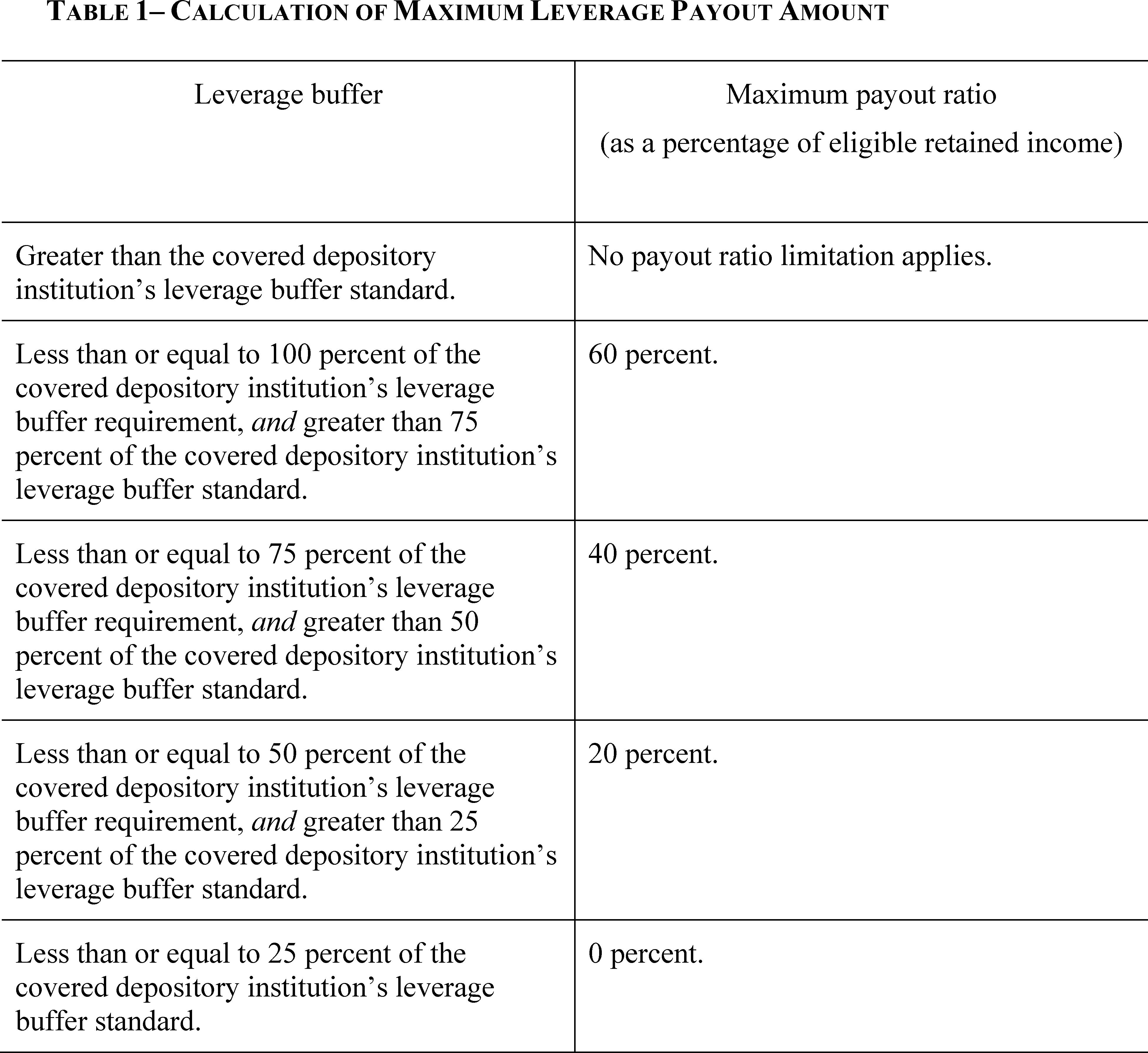
Consistent with the proposal, the final rule implements a leverage buffer framework that follows the same general mechanics and structure as the capital conservation buffer and the leverage buffer applicable to GSIBs currently contained in the agencies' respective capital rules. A covered depository institution will need to have a supplementary leverage ratio equal to three percent minimum supplementary leverage ratio requirement plus the eSLR buffer standard to avoid limitations on capital distributions and certain discretionary bonus payments. If the covered depository institution maintains a leverage buffer that is less than or equal to 100 percent of its leverage buffer standard, a payout limitation will apply in accordance with Table 1 below. The limitations on distributions and discretionary bonus payments will be applied to a covered depository institution alongside any limitations imposed by the capital conservation buffer or any other supervisory or regulatory measures. If the depository institution is constrained by either the capital conservation buffer or the leverage buffer, or both, the depository institution will be required to apply the more binding payout ratio.
B. Amendments to Total Loss-Absorbing Capacity and Long-Term Debt Requirements
The proposal would have made conforming amendments to the leverage-based components of the Board's TLAC and long-term debt requirements to maintain alignment of these components with the eSLR buffer standard for GSIBs. Under the TLAC framework, GSIBs must maintain outstanding minimum levels of TLAC based on risk-based and leverage-based measures. GSIBs must also maintain TLAC levels sufficient to meet buffers on top of both the risk-weighted asset and leverage components of the TLAC requirements in order to avoid ( printed page 55259) limitations on their capital distributions and certain discretionary bonus payments.[43] The leverage-based TLAC buffer is equal to two percent, above the 7.5 percent minimum leverage component of a GSIB's external TLAC requirement.[44] This buffer amount was expressly designed to align with the eSLR buffer standard applicable to these firms.[45] Accordingly, the Board proposed to replace the two percent TLAC leverage buffer with a new TLAC leverage buffer equal to the eSLR buffer standard under the proposal.
The Board also requires GSIBs to maintain a minimum leverage-based external long-term debt amount equal to a GSIB's total leverage exposure multiplied by 4.5 percent. As described in the preamble to the final rule that established the long-term debt requirement, the requirement was calibrated primarily on the basis of a “capital refill” framework.[46] According to the capital refill framework, the objective of the external long-term debt requirement is to ensure that each GSIB has a minimum amount of eligible external long-term debt such that, if the GSIB's going-concern capital is depleted and the covered bank holding company fails and enters resolution, the eligible external long-term debt can be used to replenish the GSIB's going-concern capital to at least the amount required to meet the minimum leverage capital requirement and buffer applicable to GSIBs. Therefore, the Board proposed to revise the minimum leverage-based external long-term debt requirement to reflect the proposed change to the eSLR standard. The proposed minimum leverage-based external long-term debt requirement would have been total leverage exposure multiplied by 2.5 percent (the minimum supplementary leverage ratio of three percent minus 0.5 percentage points to allow for balance sheet depletion) plus the eSLR buffer standard under the proposal.
The Board also requested comments on other potential adjustments to the TLAC and long-term debt framework that it should consider, including whether the Board should apply a 50 percent haircut on the amount of long-term debt principal that is due to be paid in one year or more but less than two years that can be considered for purposes of the minimum TLAC requirements and buffers. In addition, the Board requested comment on the advantages and disadvantages of adjusting the amount of balance sheet run-off embedded in the minimum long-term debt requirement or of removing the assumption of balance sheet run-off entirely from the minimum long-term debt requirement.
The Board received several comments on the proposed changes to the TLAC and long-term debt requirements. Many commenters supported the proposed changes, seeing them as necessary to maintain the internal consistency of the Board's regulatory framework. Some commenters opposed the proposed modifications to TLAC and long-term debt requirements, asserting that they would undermine the orderly resolution of GSIBs and weaken the safety and soundness of the U.S. banking system, particularly given these commenters' concerns with declines in capital requirements resulting from the proposal. One commenter suggested that the Board clarify how the proposed changes would interact with the resolution planning process.
In response to a question asking whether the Board should apply a 50 percent haircut on certain long-term debt used to satisfy the TLAC requirement and buffers, some trade association and banking organization commenters recommended that the Board not do so, arguing that the 50 percent haircut would add significant costs for issuers without material benefits. Some commenters also recommended that the Board eliminate, or reduce, the long-term debt requirement and thereby allow firms greater flexibility to determine the composition of their TLAC. Some trade association and banking organization commenters also recommended that the Board eliminate the existing 50 percent haircut on long-term debt that is due to be paid in one year or more but less than two years and which is used to satisfy the long-term debt requirement as well as the assumption of balance sheet run-off. Several commenters recommended that the agencies rescind the 2023 long-term debt proposal applicable to certain non-GSIBs. One commenter suggested that the TLAC requirement applicable to U.S. intermediate holding companies of foreign banking organizations be recalibrated to account for their risk profiles, local supervisory frameworks, and particular structural considerations.
The final rule revises the TLAC and long-term debt requirements as proposed. As discussed in the proposal, these changes maintain alignment between the TLAC and long-term debt requirements and the enhanced supplementary leverage ratio standard for GSIBs, in accordance with the manner in which these requirements were originally calibrated. Consistent with the proposal, the final rule does not change the minimum level of TLAC that a GSIB is required to maintain or change the general structure of the TLAC and long-term debt frameworks.
As discussed in section IV.I of this SUPPLEMENTARY INFORMATION , the final rule results in a reduction in the overall level of TLAC for some GSIBs and in the levels of long-term debt necessary to comply with the long-term debt requirement for all GSIBs. However, GSIBs will continue to be subject to robust TLAC and long-term debt requirements.
The Board considered commenters' views on other potential modifications it could make to the TLAC and long-term debt frameworks. Consistent with the proposal, the Board is not making any further changes to the TLAC and long-term debt frameworks at this time and is amending these requirements only to maintain alignment with the eSLR standards.
C. Applicability Thresholds of the eSLR Standard for OCC-Supervised Institutions
The OCC's eSLR standard applies to national banks and Federal savings associations that are subsidiaries of holding companies with more than $700 billion in total consolidated assets or more than $10 trillion in total assets under custody.
In the proposal, the OCC proposed to revise the applicability thresholds of its eSLR standard to be consistent with the Board's regulations for identifying GSIBs and applying the eSLR standard only to national banks and federal savings associations that are subsidiaries of bank holding companies identified as GSIBs. In the proposal, the OCC further noted that the asset thresholds the OCC uses to determine applicability of the eSLR standard scope in all the national bank and federal savings association subsidiaries of GSIBs, but no other institutions. Therefore, this proposed change would not have had any practical impact on the current application of the eSLR ( printed page 55260) standard to national banks and federal savings associations.
Some commenters supported the proposal to revise the scope of the OCC's eSLR standard and asserted that it would be appropriate to remove the thresholds based on asset size and custody activities and instead reference the GSIB determinations made under the Board's rules. The commenters asserted this revision would have harmonized the OCC, FDIC, and Board rules and would not result in unintended consequences.
One commenter, on the other hand, argued against adopting this aspect of the proposal. This commenter acknowledged that the proposed change would not have any immediate impact, but it noted that the OCC's standard was potentially broader than the Board's and FDIC's and may capture different banking organizations at some point in the future. The commenter further suggested expanding the application of the eSLR standard to scope in even more organizations, including those with well below $700 billion in total consolidated assets because, according to the commenter, the failure of large regional banking organizations can pose systemic risks.
The OCC has decided not to finalize this aspect of the proposal. The asset thresholds the OCC currently uses to determine the applicability of the eSLR standard scope in all the national bank and federal savings association subsidiaries of GSIBs, but no other institutions. Therefore, the decision not to finalize this aspect of the proposal will have no impact on which entities will currently be subject to the eSLR standard.
Regardless of whether their parent holding companies are identified as GSIBs by the Board, the OCC believes the eSLR standard should apply to those national banks and federal savings associations that the OCC determines pose the greatest risks to public and private stakeholders in the event of adverse performance, disruption, or failure of the national banks or federal savings associations or the activities they engage in. The OCC will continue to monitor the national banks and federal savings associations under its supervision and as the banking industry grows, the OCC will consider whether changes are needed to ensure the continued appropriate application of the eSLR standard through a future rulemaking action, if necessary.
D. Comments on Other Potential Modifications to the Supplementary Leverage Ratio Requirement and Other Elements of the Agencies' Regulatory Framework
In addition to the proposed changes to the eSLR standards, the proposal requested comment on potential additional or alternative changes the agencies could make that would achieve the objectives of the proposal. The Board requested comment on a specific potential additional change, the narrow exclusion approach described above. The proposal also requested comment on other changes to the bank regulatory framework that the agencies should consider to reduce regulatory impediments to well-functioning U.S. Treasury markets.
Many commenters opposed any exclusions from the supplementary leverage ratio denominator, including the narrow exclusion approach. Some commenters asserted that the narrow exclusion approach would diminish the effectiveness of the supplementary leverage ratio requirement, which broadly treats assets and exposures in a risk-insensitive manner, and that the narrow exclusion approach would prompt requests for additional exclusions that would further erode the risk-insensitive nature of the requirement. Other commenters asserted that the narrow exclusion approach—and other approaches that exclude assets or exposures from the supplementary leverage ratio denominator—would represent a departure from the Basel Committee's leverage ratio framework and could invite a “race to the bottom” in the international regulatory treatment of sovereign exposures. Additionally, some commenters expressed concern that the narrow exclusion approach would lead banking organizations to increase holdings of Treasury securities, including longer-dated securities that carry greater interest rate risk, a scenario which, in these commenters' view, could lead to banks having inadequate capital to absorb losses from shifts in market interest rates. Finally, one commenter expressed doubt that the narrow exclusion would result in a meaningful increase of U.S. Treasury market intermediation.
A few commenters supported including the narrow exclusion approach in a final rule, and some additional commenters expressed openness to this concept but supported finalizing the proposal without the narrow exclusion. One commenter stated that the narrow exclusion approach may aid market intermediation while limiting additional exposure to interest rate risk, since the securities excluded from total leverage exposure would be trading securities measured at fair value and would be subject to the market risk capital requirements of the risk-based capital framework. Another commenter asserted that the narrow exclusion approach would provide some incremental support for Treasury market intermediation, but the approach's benefit would be limited by the current method 2 GSIB surcharge calculation in the risk-based capital framework.
Other commenters suggested broader exclusions from the supplementary leverage ratio denominator. Some commenters suggested excluding banking organizations' deposits held at central banks (reserves); reserves and short-term Treasury securities; or reserves and all Treasury security holdings. In addition, one commenter supported excluding from the denominator of the supplementary leverage ratio all reserves, Treasury securities, and repurchase and reverse repurchase agreements backed by Treasury security collateral across all entities within a banking organization. A few commenters called for applying some of these exclusions to all leverage capital requirements applicable to banking organizations. Some commenters requested that the agencies state that they may exclude certain assets from total leverage exposure during exceptional macroeconomic circumstances, as the agencies did on a temporary basis through interim final rules in 2020, as the onset of the COVID-19 pandemic significantly and adversely affected global financial markets.[47]
The final rule does not adopt the narrow exclusion approach or other exclusions requested by commenters. As discussed in the proposal and in section IV of this SUPPLEMENTARY INFORMATION, and as observed by many of the commenters, the final rule's changes to the eSLR standards achieve the objectives of the rulemaking and continues to broadly treat exposures equally under the supplementary leverage ratio framework.
The proposal also included a question about potential additional modifications to the regulatory capital framework that the agencies should consider to reduce ( printed page 55261) regulatory impediments to well-functioning U.S. Treasury markets. Many commenters recommended several additional changes to the regulatory capital framework for the agencies to consider in potential future rulemakings. Specifically, some commenters suggested modifying the GSIB surcharge framework by, for example, removing U.S. Treasury security holdings or other assets or exposures from the GSIB surcharge calculation and recognizing the risk-mitigation effects of cross-product master netting agreements in the standardized approach for counterparty credit risk.[48] Some commenters advocated for changes to the tier 1 leverage ratio requirement, such as a reduction in the level of the requirement at the holding company and depository institution levels or exclusion of certain assets, such as reserves, Treasury securities, and certain other Treasury-collateralized exposures, from the denominator of the ratio.
Some commenters suggested removing supplementary leverage ratio requirements for certain banking organizations, such as Category III banking organizations and U.S. intermediate holding companies of foreign banking organizations with less than $250 billion in total assets. Some other commenters recommended modifications to the calibration of the community bank leverage ratio requirement to a level lower than the current nine percent calibration.
Some commenters advocated for changes to elements of the agencies' regulatory frameworks that are not related to leverage requirements. For example, some commenters advocated that the agencies should adjust certain regulatory thresholds based on factors such as economic growth or inflation. A few commenters suggested changes to the Board's method 2 GSIB surcharge calculation, the Board's supervisory stress tests, the applicability of the global market shock component of the stress test, and the stress capital buffer requirement. Some commenters also expressed concerns that the method 1 GSIB surcharge calculation incorporates global data to compute aggregate global indicator amounts. Other commenters suggested specific changes to the risk-based capital framework. One commenter suggested removing Treasury security cash-market and repurchase agreement positions from certain risk-based indicators of the agencies' regulatory tailoring framework for large banking organizations and removing from the off-balance sheet exposure risk-based indicator exposures that arise in connection with central clearing services for U.S. Treasury security-related transactions provided by a clearing member banking organization to another firm. One commenter called for mandating equity issuance or retention of capital to avoid what the commenter viewed as inefficiencies in changing ratio-based capital requirements, and another commenter called for inclusion of weather- and climate-related risks in the capital framework. One commenter expressed concern that the Board has not yet adopted a countercyclical capital buffer requirement greater than zero and has not yet responded to a petition for rulemaking related to the boards of directors of holding companies and their subsidiary depository institutions.
The final rule does not address these requests, as they are beyond the scope of the proposal. As noted previously, the agencies monitor the effectiveness of their rules for potential improvements and may make changes in the future as appropriate.
E. Technical Corrections
The proposal would have implemented certain technical corrections. The Board proposed to revise 12 CFR 217.11(c)(3)(ii)(A) through (C) to correct certain cross-references. Those paragraphs had erroneously referred to 12 CFR 217.10(c)(1)(ii), (c)(2)(ii), and (c)(3)(ii), respectively; the proposed technical correction would have replaced those references with the appropriate references to 12 CFR 217.10(d)(1)(ii), (d)(2)(ii), and (d)(3)(ii), respectively. Second, the FDIC proposed to remove outdated references in its prompt corrective action regulation to the supplementary leverage ratio's effective date of January 1, 2018. The Board and FDIC did not receive comments on the proposed technical corrections. The Board and FDIC are finalizing the technical corrections as proposed.
Additionally, the Board is finalizing additional technical corrections that were not included in the proposal but are related to the same incorrect cross-reference. First, the Board is revising 12 CFR 208.41(d), (m), and (p). Those paragraphs had erroneously referred to 12 CFR 217.10(c)(1), (c)(2), and (c)(3), respectively; the Board is replacing those references with appropriate references to 12 CFR 217.10(d)(1), (d)(2), and (d)(3), respectively. Second, the Board is revising the definition of “common equity tier 1 capital ratio” in both 12 CFR 252.61 (“common equity tier 1 capital ratio”) and 12 CFR 252.161 (“common equity tier 1 capital ratio”). Those definitions had erroneously referred to 12 CFR 217.10(c); the Board is replacing those references with appropriate references to 12 CFR 217.10(d). Additionally, the Board is removing paragraph 12 CFR 208.43(a)(1)(iv)(C), which is now unnecessary.
III. Effective Date
The agencies received several comments relating to the length of the comment period on the proposal, timing of adoption of a final rule, and the effective date of a final rule.
Several commenters asked the agencies to withdraw the proposal or delay adoption of the final rule and, instead, prioritize changes to risk-based capital requirements. Specifically, these commenters asserted that the agencies should delay adoption of the proposed modifications of the eSLR standards until completion of a further study and additional public comment on the effect of other potential changes to the regulatory capital framework on the proposal. Other commenters requested an extension of the comment period before finalizing the proposal. In these commenters' view, the proposal has significant implications and warrants a longer comment period than 60 days to ensure meaningful public participation.
Several other commenters asked the agencies to adopt the proposal as a final rule without delay. Of these, some commenters suggested that the effective date for implementation of the final rule should be no later than January 1, 2026, or as promptly as possible. One commenter noted that prompt adoption is particularly important, given the implementation of mandatory clearing for certain U.S. Treasury security transactions.
The agencies received approximately 40 comments on the proposal. The comments received by the agencies represent a broad range of views and included thoughtful engagement with the proposal.[49] The agencies do not consider an extension of the comment period to be warranted, given the volume, depth, and diversity of comments submitted.
The final rule includes an effective date of April 1, 2026, for the modified eSLR standard applicable to GSIBs and ( printed page 55262) covered depository institutions. This effective date is intended to provide banking organizations subject to the rule with time to comply with the modified eSLR standards. The agencies will permit GSIBs and covered depository institutions subject to the eSLR standards to elect to voluntarily adopt the final rule's modified eSLR standards as of January 1, 2026, prior to the mandatory compliance date.
IV. Economic Analysis
A. Introduction
As discussed in section I.B of this SUPPLEMENTARY INFORMATION, the final rule aims generally for the supplementary leverage ratio requirement to be a backstop to risk-based tier 1 capital requirements for GSIBs and covered depository institutions.[50] The final rule's changes reduce the likelihood and frequency of the supplementary leverage ratio requirement being a binding tier 1 capital requirement for these banking organizations. As a consequence, the changes reduce disincentives for these organizations to participate in low-risk, low-return activities, such as U.S. Treasury market intermediation.
In recent years, the supplementary leverage ratio requirement has regularly been the binding tier 1 capital requirement for many GSIBs and most covered depository institutions. This can create unintended incentives for these banking organizations to engage in higher-risk activities and to reduce their participation in low-risk, low-return activities. The final rule will address these incentives by reducing the calibration of the eSLR standards. As a consequence, the final rule increases the balance sheet capacity of most GSIBs for low-risk activities, which can reduce the need for temporary policy adjustments in the event of severe market stress.
The agencies estimate that, in the period from the second quarter of 2021 to the fourth quarter of 2024, the supplementary leverage ratio requirement was the binding tier 1 capital requirement 60 percent of the time, on average, for seven out of the eight GSIBs. In the same period, the supplementary leverage ratio requirement was the binding tier 1 capital requirement 87 percent of the time, on average, for major covered depository institutions.
When the binding capital requirement for a banking organization is a leverage ratio requirement, it can discourage the banking organization from engaging in low-risk activities, especially in high-volume, low-return activities, while creating incentives for the organization to conduct higher-risk activities. These incentives are due to what may be called the “level effect” and the “marginal effect” of a binding leverage ratio requirement. Specifically, for a given amount of tier 1 capital, the level effect of a binding leverage ratio requirement restricts the growth of the banking organization because it cannot engage in even low-risk activities without further increasing its tier 1 capital requirement. Additionally, the marginal effect of a binding leverage ratio requirement makes the banking organization prefer higher-risk activities to low-risk activities because both activities need to be financed by the same amount of tier 1 capital under the supplementary leverage ratio requirement, while higher-risk activities typically have higher expected returns. This marginal effect could incentivize the banking organization to forego investments in low-risk activities or substitute its existing low-risk exposures with higher-risk ones. Such unintended incentives are further amplified by the fact that low-risk activities tend to be balance sheet intensive because their typically low expected returns make them profitable only if they are conducted in large volumes. Hence, general economic theory predicts that a binding leverage ratio requirement can discourage banking organizations from engaging in low-risk activities, which might reduce social welfare.
A prime example of such low-risk, low-return, high-volume activities conducted by banking organizations is intermediation in the U.S. Treasury market, a key financial market.[51] Acting as intermediaries in this market, banking organizations enter into temporary positions in U.S. Treasury securities, classified as trading assets on their balance sheets. Most of these trading assets are held by the broker-dealer subsidiaries of banking organizations to facilitate transactions across different participants and segments in the U.S. Treasury market.[52] These broker-dealers play a critical role in the U.S. Treasury market by providing liquidity to market participants through both market making and securities financing activities; [53] in particular, GSIBs' primary dealer subsidiaries are the largest U.S. Treasury securities dealers.[54]
As discussed in the proposal, both the U.S. Treasury market and primary dealers' U.S. Treasury securities positions have grown rapidly over the last decade. As Table 2 shows, the amount of U.S. Treasury securities outstanding, excluding holdings of the Federal Reserve System Open Market Account (SOMA), has expanded by 139 percent, from $10 trillion to $24 trillion, since 2014.[55] Meanwhile, the U.S. Treasury securities positions of primary dealers have grown by 155 percent, reaching $0.6 trillion in aggregate. This expansion in primary dealers' U.S. Treasury securities positions reflects both the abundant supply of these securities and the central role of these broker-dealer subsidiaries of banking organizations as intermediaries in this market. Notably, despite the rapid increase in primary dealers' U.S. ( printed page 55263) Treasury securities positions, measured in dollar terms, the size of these positions relative to the size of the market has been stable over time. Specifically, relative to the amount of U.S. Treasury securities outstanding, excluding holdings of the Federal Reserve System Open Market Account, the U.S. Treasury securities positions of primary dealers stayed at about 2.5 percent over the last decade, which indicates the strong connection between the size of the U.S. Treasury market and the magnitude of market intermediation activities by these broker-dealers.[56]
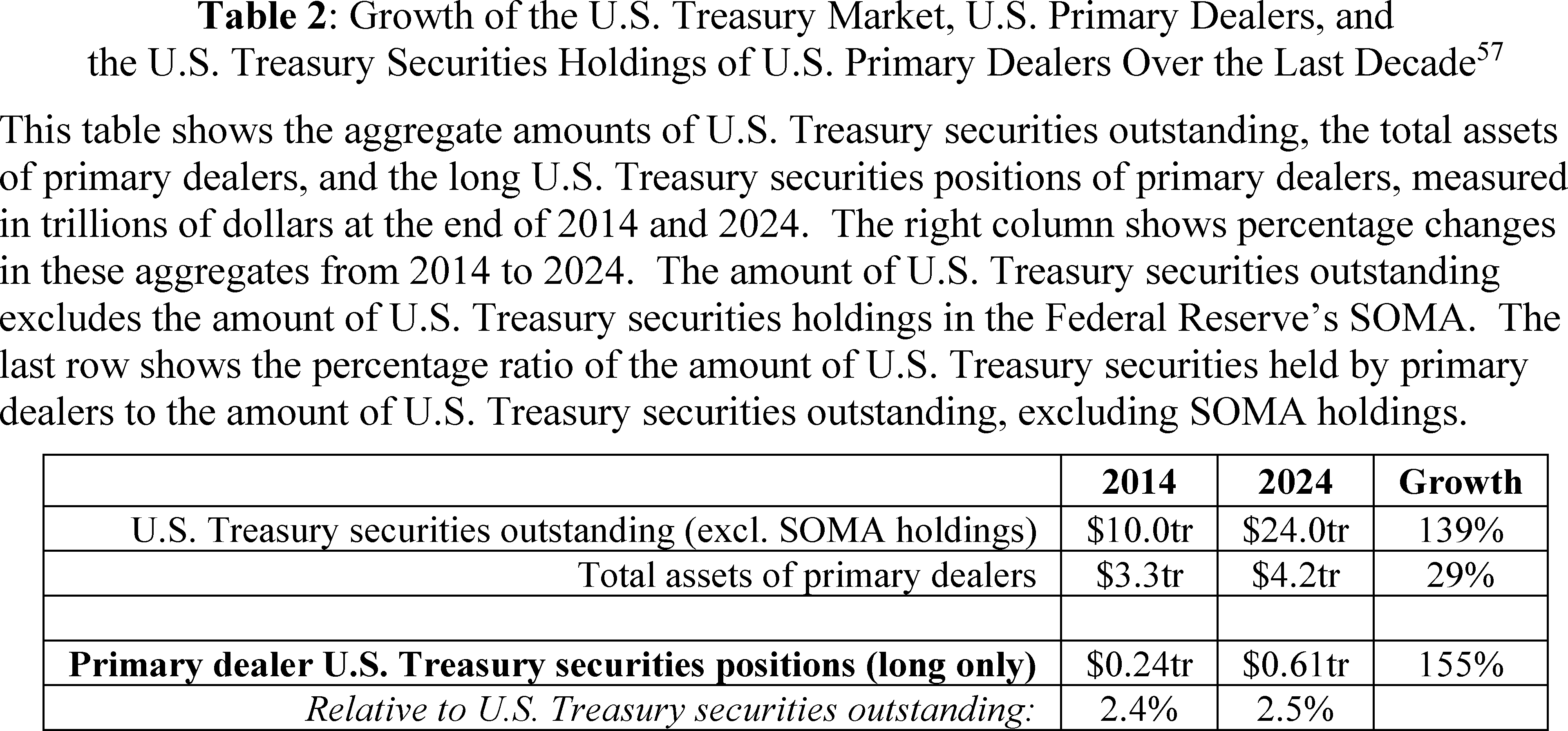
The rapid growth of the U.S. Treasury market has raised concerns about its liquidity and resiliency, especially considering that the balance sheets of primary dealers, key intermediaries in this market, have grown at a more moderate pace (by 29 percent, in aggregate, since 2014).[58] These concerns partly drove the agencies' decision to temporarily exclude deposits at Federal Reserve Banks and U.S. Treasury securities holdings from the calculation of total leverage exposure for banking organizations subject to Category I-III standards in the wake of the COVID-19 market stress.[59] Empirical evidence in BCBS (2021) suggests that the exclusions enabled these banking organizations, and especially GSIBs, which had smaller supplementary leverage ratio management buffers than banking organizations subject to Category II and III standards, to significantly expand their U.S. Treasury securities holdings.[60]
There are several factors that influence broker-dealers' decisions to engage in financial market intermediation.[61] As discussed in the proposal, academic studies also provide support for the concern that the supplementary leverage ratio requirement could potentially discourage U.S. Treasury market intermediation by the broker-dealer subsidiaries of large banking organizations. Favara, Infante, Rezende (2022) find that large and unexpected increases to GSIBs' balance sheets discourage GSIBs' broker-dealer subsidiaries from participating in the U.S. Treasury market, with the estimated effect being stronger for GSIBs with smaller supplementary leverage ratio management buffers.[62] Duffie et al. (2023) show that U.S. Treasury market liquidity measures deteriorate as primary dealers face capacity constraints, suggesting that a lack of ability by broker-dealers to participate in U.S. Treasury markets can have a detrimental effect on market liquidity.[63] The empirical findings in Bräuning and Stein (2024) indicate that the primary dealer subsidiaries of banking organizations subject to Category I-III standards that face relatively more ( printed page 55264) binding supplementary leverage ratio requirements or internal risk limits reduce their U.S. Treasury securities positions relative to less constrained primary dealers, which in turn leads to a decrease in market liquidity in the form of lower aggregate turnover and wider bid-ask spreads.[64] Overall, the academic literature suggests that reducing the supplementary leverage ratio requirement's bindingness could improve the functioning of the U.S. Treasury market.
Several commenters requested evidence that the eSLR standard is currently acting as a constraint to U.S. Treasury market intermediation, with some commenters noting that internal risk limits could also constrain such activities. One commenter noted that GSIBs may not purchase more U.S. Treasury securities under the proposal. Meanwhile, several commenters supported the agencies' assessment that the eSLR is currently a binding capital constraint, which can create unintended disincentives for GSIBs.
As discussed in section II.A of this SUPPLEMENTARY INFORMATION , the final rule's objective is to set the supplementary leverage ratio requirement as a backstop to risk-based tier 1 capital requirements for GSIBs and covered depository institutions, rather than creating incentives for these banking organizations to hold more U.S. Treasury securities. Accordingly, as discussed in section IV.F of this SUPPLEMENTARY INFORMATION , the agencies anticipate that the final rule will reduce unintended disincentives for GSIBs to engage in low-risk activities through both its marginal and level effect. In particular, the level effect of the final rule will create additional capacity for these banking organizations to hold low-risk assets on their balance sheets. One notable example where this benefit may manifest is the U.S. Treasury market intermediation activity of GSIBs, which could be affected by balance sheet constraints, as evidenced by the empirical studies cited above. The findings in these studies indicate that the supplementary leverage ratio requirement could pose a potential constraint to the intermediation activity of primary dealers, although, as discussed in the proposal and earlier in this subsection, other factors, such as internal risk limits can also influence broker-dealers' decisions to participate in the U.S. Treasury market.
The structure of the economic analysis is as follows. Section IV.B describes the baseline for the impact assessment, which is the current regulatory framework, and the data sources used. Sections IV.C and IV.D present the policy change and four reasonable alternatives. Section IV.E estimates the change in the supplementary leverage ratio requirement and the binding tier 1 capital requirement for banking organizations subject to Category I-III standards under the final rule and the policy alternatives, relative to the baseline. Sections IV.F and IV.G evaluate the economic benefits and costs, respectively, of the final rule and the policy alternatives. Section IV.H addresses further comments received on the analysis in the proposal. Section IV.I analyzes the impact of the changes to the long-term debt and total loss-absorbing capacity buffer requirements under the final rule. Section IV.J concludes the analysis.
B. Baseline
The economic analysis uses the current regulatory framework as a baseline, which includes the current supplementary leverage ratio requirement, described in section I.A of this SUPPLEMENTARY INFORMATION . The baseline represents the state of banking organizations subject to Category I-III standards in the absence of a policy change. Accordingly, throughout the analysis, the agencies assess the economic impact of the final rule and the policy alternatives considered, described in sections IV.C and IV.D of this SUPPLEMENTARY INFORMATION , respectively, by comparing outcomes estimated under the final rule and the alternatives to the outcome estimated under the baseline.
The analysis uses the year 2024 as the sample period to produce quantitative estimates, which reflects a recent state of banking organizations subject to Category I-III standards. Unless stated otherwise, the calculations and estimates in the analysis take the average values of balance sheet quantities and ratios measured at the end of each quarter in 2024. A review of balance sheets of banking organizations subject to Category I-III standards from 2021 to 2024 indicates that using a longer sample period yields similar estimates.[65]
Unless stated otherwise, the analysis uses publicly available data reported in FR Y-9C filings for holding companies and the Federal Financial Institutions Examination Council (FFIEC) Call Reports for depository institutions.[66] In certain calculations related to the total leverage exposure of holding companies, the agencies use publicly available data reported in FFIEC 101 filings.[67] The agencies calculate method 1 and method 2 surcharges by using publicly available data from FR Y-15 filings as well as the aggregate global systemic indicator amounts published annually by the Board.[68] The agencies calculate the amount of U.S. Treasury securities holdings of primary dealers by using confidential data from FR 2004A filings.[69]
In calculations involving the depository institution subsidiaries of holding companies subject to Category I-III standards, the agencies focus on each holding company's major depository institution subsidiaries ( i.e., the largest depository institution subsidiary as well as any of its depository institution subsidiaries with total assets greater than $50 billion at the end of any quarter in 2024). The rest of their depository institution subsidiaries, with total assets less than $50 billion in 2024, account for 0.7 percent of the consolidated total assets of these holding companies, in aggregate.[70]
Table 3 compares the baseline levels of the different tier 1 capital requirements, inclusive of buffer requirements, for banking organizations subject to Category I-III standards in ( printed page 55265) 2024.[71] On average, for GSIBs, the supplementary leverage ratio requirement is at a similar level to the risk-based tier 1 capital requirement. On average, for major covered depository institutions, the supplementary leverage ratio requirement is higher than the risk-based tier 1 capital requirement. On average, for banking organizations subject to Category II and III standards, the risk-based tier 1 capital requirement is higher than the tier 1 leverage ratio requirement, which in turn is higher than the supplementary leverage ratio requirement.
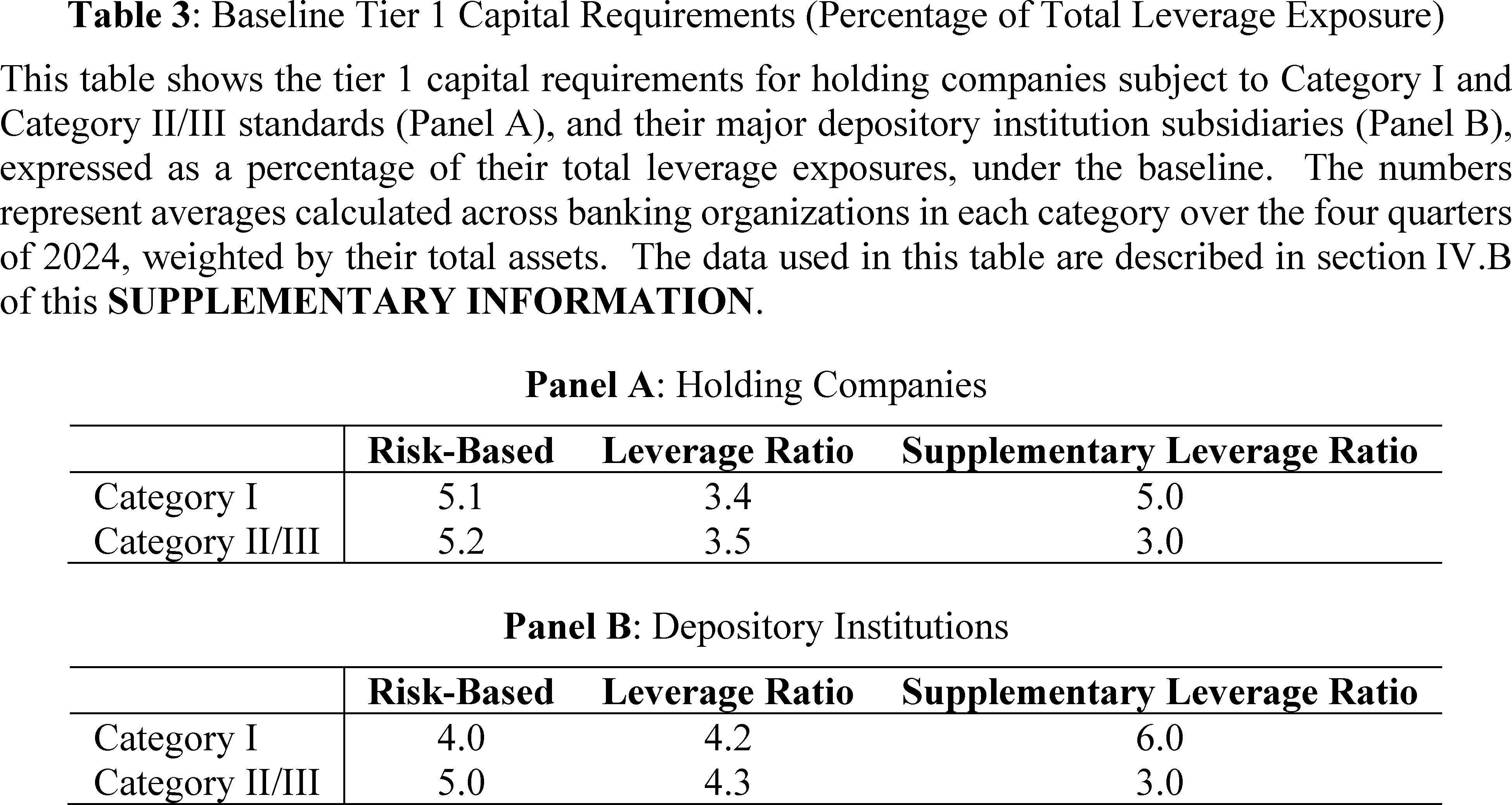
The agencies estimate that the supplementary leverage ratio requirement is the highest tier 1 capital requirement for five out of the eight GSIBs and eight out of the nine major covered depository institutions under the baseline.[72] By contrast, for almost all holding companies subject to Category II and III standards, as well as for nine out of their 12 major depository institution subsidiaries, the risk-based tier 1 capital requirement is the highest tier 1 capital requirement.
Table 3 also shows that, compared to the risk-based tier 1 requirement, the relative level of the supplementary leverage ratio requirement is significantly lower for GSIBs than for their major covered depository institutions under the baseline. For GSIBs, the relative level of the supplementary leverage ratio requirement ranges from 87 to 111 percent of the risk-based tier 1 capital requirement, whereas for major covered depository institutions, the relative level of the supplementary leverage ratio requirement ranges from 128 to 244 percent of the risk-based tier 1 capital requirement. This difference between GSIBs and major covered depository institutions in the level of the supplementary leverage ratio requirement is due to the lower risk-based capital buffer requirements and the higher eSLR standard at the depository institutions.[73] Therefore, any adjustment to the eSLR standards that aims for the supplementary leverage ratio requirement to be a backstop to risk-based capital requirements would lead to a larger reduction in tier 1 capital requirements for covered depository institutions than for GSIBs.
The final rule also affects requirements and buffer standards for TLAC and long-term debt. The agencies present a baseline analysis for these standards in section IV.I of this SUPPLEMENTARY INFORMATION .
1. Role of Banking Organizations as Investors in U.S. Treasury Securities
In addition to their critical role as intermediaries in the U.S. Treasury market, banking organizations also act as investors. Specifically, in addition to U.S. Treasury securities held as trading assets, banking organizations also hold such securities as investment securities on their balance sheets, typically for longer periods, and sometimes until maturity.[74] Most of these investment securities are held by depository institution subsidiaries.[75]
Over the last decade, banking organizations have increased their market share as investors in the U.S. Treasury market, with the growth of U.S. Treasury securities held by depository institutions outpacing the expansion of the market. Indeed, Table 4 shows that the amount of U.S. Treasury securities outstanding has expanded by 125 percent, from $12.5 trillion to $28.1 trillion, whereas the U.S. Treasury securities holdings of U.S. ( printed page 55266) depository institutions have grown by 264 percent, reaching $1.54 trillion in aggregate. Hence, the aggregate market share of depository institutions has increased from 3.4 percent to 5.5 percent.
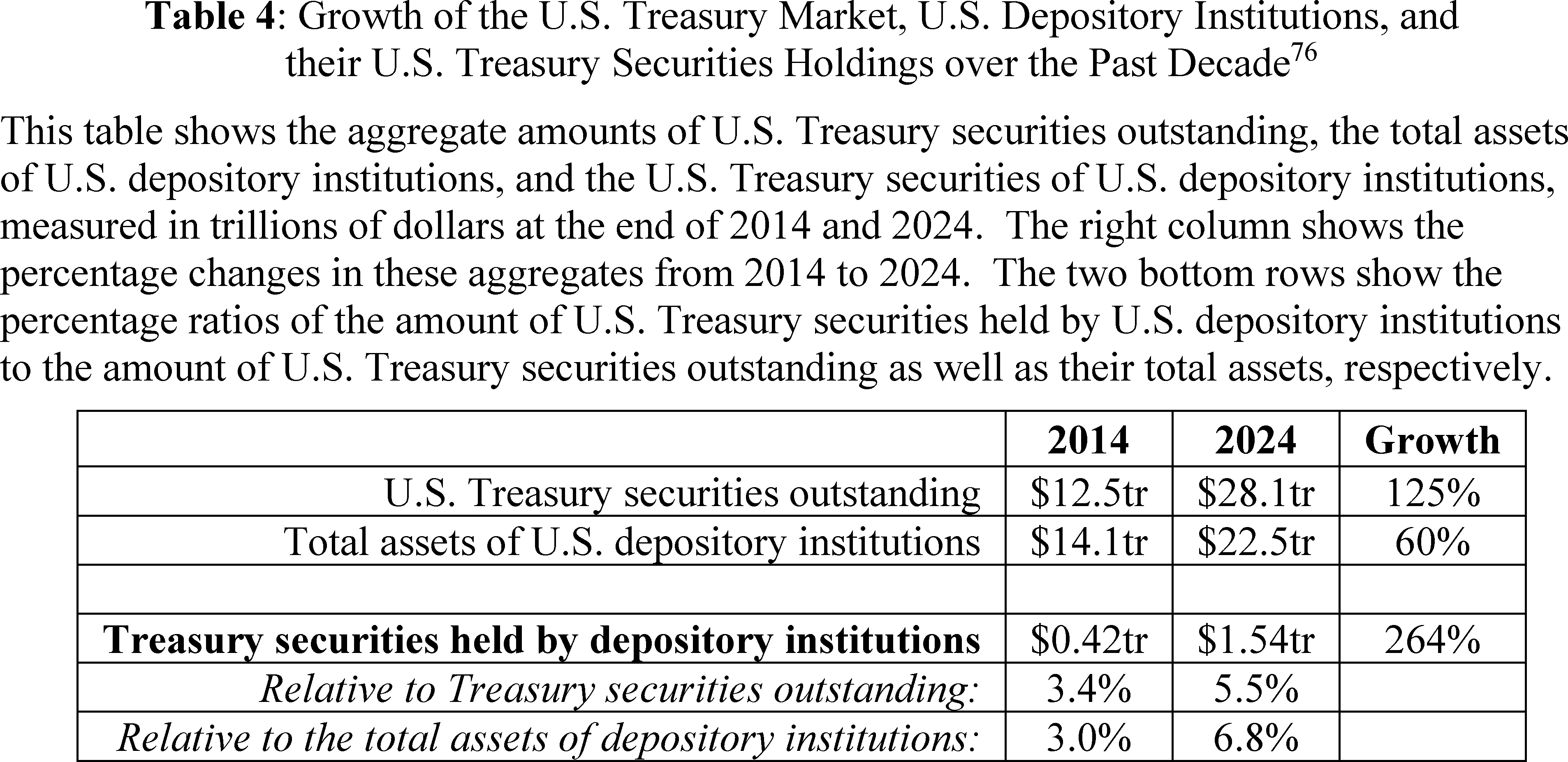
Table 4 shows that while the U.S. Treasury securities holdings of U.S. depository institutions have grown significantly, their balance sheets have grown at a more moderate pace, by 60 percent, in aggregate, since 2014. Consequently, the aggregate share of U.S. Treasury securities held on their balance sheets has more than doubled, from 3.0 percent to 6.8 percent, which indicates that the relative importance of U.S. Treasury securities as investment assets has increased for banking organizations over the last decade. These developments contribute to the increased bindingness of leverage ratio requirements because U.S. Treasury securities held on the balance sheet of a depository institution have zero risk weight under the risk-based capital framework; hence, increases in such securities holdings can increase leverage ratio requirements relative to risk-based capital requirements.
2. Treasury Securities Held by Banking Organizations Subject to Category I to III Standards
Banking organizations subject to Category I-III standards had large U.S. Treasury holdings, in both nominal and relative terms, in 2024. As Table 5 shows, measured at fair value at the consolidated holding company level, these banking organizations held $1.9 trillion of U.S. Treasury securities, in aggregate, which was almost 7 percent of the total amount of U.S. Treasury securities outstanding. On average, these securities holdings constituted 9 percent of GSIBs' total leverage exposures and 5 percent of the total leverage exposures of holding companies subject to Category II and III standards.
( printed page 55267)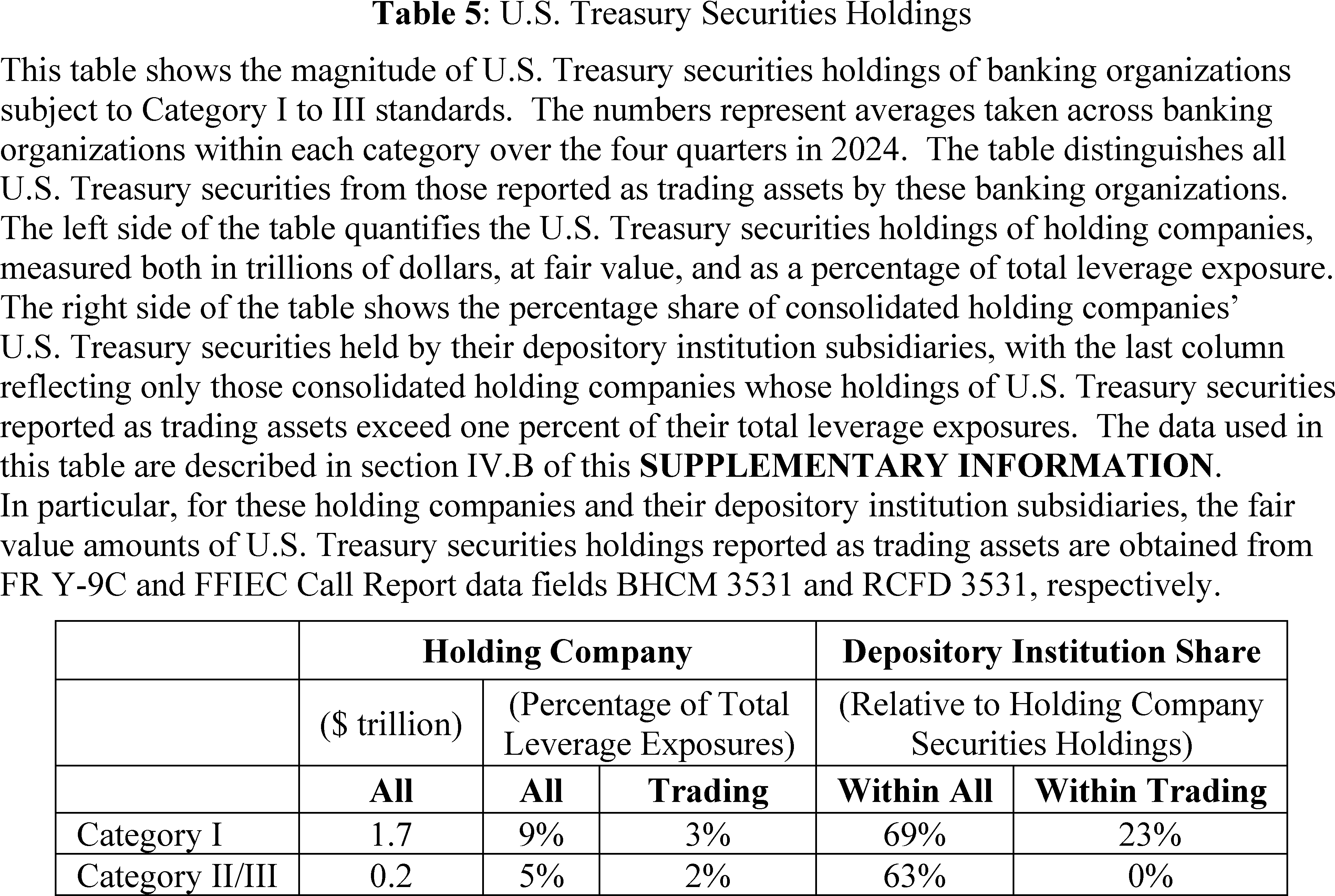
Table 5 also shows the two distinct roles of banking organizations subject to Category I-III standards as both intermediaries and investors in the U.S. Treasury market. On average across these banking organizations, about two thirds of U.S. Treasury securities held on consolidated holding company balance sheets are classified as investment assets, with the remaining one third classified as trading assets. In aggregate, the depository institution subsidiaries of these banking organizations hold the majority of the U.S. Treasury securities classified as investment assets and a minor share of U.S. Treasury securities classified as trading assets on the consolidated balance sheets of their parent holding companies. As noted earlier, most of the U.S. Treasury holdings classified as trading assets are held by the broker-dealer subsidiaries of these banking organizations.[77]
C. Policy Change
The final rule sets the eSLR buffer standard for GSIBs to 50 percent of their method 1 surcharge, instead of the two percent eSLR buffer standard applicable under the baseline. Additionally, for covered depository institutions, the final rule sets the eSLR buffer standard to 50 percent of their parent GSIB's method 1 surcharge, capped at one percent. This eSLR buffer standard applies in addition to the three percent supplementary leverage ratio minimum requirement. This requirement for covered depository institutions replaces the six percent “well-capitalized” prompt corrective action threshold applicable under the baseline.
The final rule does not change the three percent supplementary leverage ratio minimum requirement or the calculation of total leverage exposure for banking organizations subject to Category I-III standards.
D. Reasonable Alternatives
The analysis considered four reasonable alternatives to the final rule. The agencies assess the expected benefits and costs of these alternatives relative to the baseline and compare them to the expected benefits and costs of the final rule.
Alternative 1 is the “narrow exclusion” approach, which includes all changes for GSIBs and covered depository institutions under the final rule and additionally excludes from the calculation of total leverage exposure for holding companies subject to Category I-III standards U.S. Treasury securities reported as trading assets on the holding companies' balance sheets and held at broker-dealer subsidiaries (and foreign equivalents thereof) that are not subsidiaries of a depository institution.
Alternative 2 is the “broader exclusion” approach, which does not change the eSLR standards like the final rule but instead excludes deposits held at Federal Reserve Banks (reserves) and all U.S. Treasury securities holdings from the calculation of total leverage exposure for all banking organizations subject to Category I-III standards. This policy alternative is similar to the temporary exclusion of these assets from the calculation of total leverage exposure implemented by the agencies in 2020.[78]
Alternative 3 (“2018 proposal”) sets the eSLR standards for both GSIBs and covered depository institutions equal to ( printed page 55268) 50 percent of the higher of method 1 and method 2 surcharges. This policy alternative is similar to the notice of proposed rulemaking published in the Federal Register by the Board and OCC on April 19, 2018, which would have recalibrated the eSLR standards for these banking organizations.[79] This proposed rule was not finalized.
Alternative 4 (“combined”) is a combination of the final rule and Alternative 2. As such, this policy alternative both sets the eSLR standards for GSIBs as well as covered depository institutions like the final rule and excludes reserves as well as U.S. Treasury securities holdings from the calculation of total leverage ratio exposure for all banking organizations subject to Category I-III standards.
E. Changes in the Supplementary Leverage Ratio and Tier 1 Capital Requirements
The agencies estimate that the final rule will substantially reduce the supplementary leverage ratio requirement for GSIBs and covered depository institutions relative to the baseline. As Table 6 shows, the final rule reduces the requirement by 23 percent, on average, for the holding companies and by 37 percent for major covered depository institutions. The final rule does not change the supplementary leverage ratio requirement for banking organizations subject to Category II and III standards.
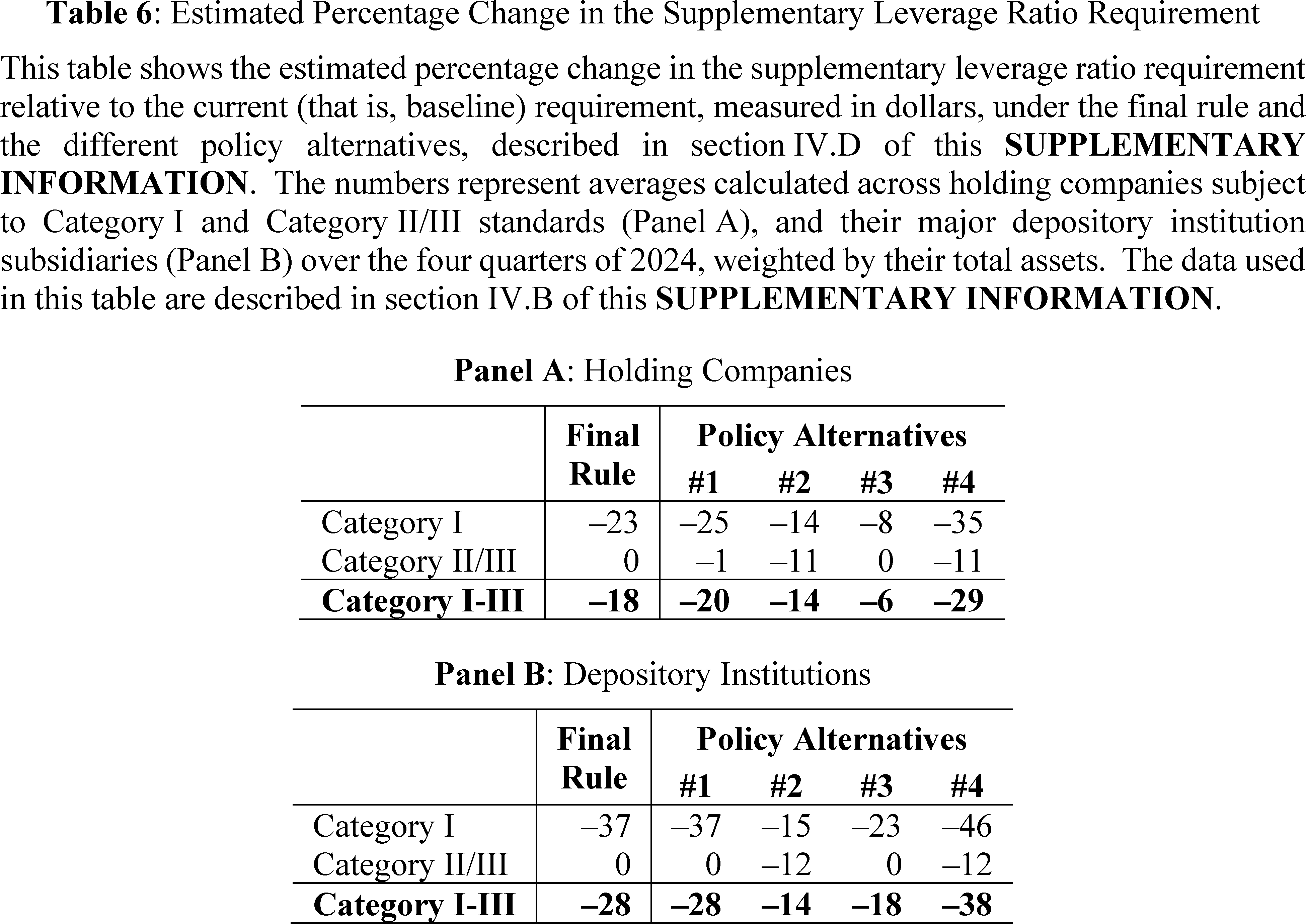
Alternative 1 (“narrow exclusion”) has a similar effect to that of the final rule, reducing the supplementary leverage ratio requirement slightly more, by 25 percent, on average, for GSIBs and by the same amount, 37 percent for major covered depository institutions. Relative to the baseline, this alternative slightly reduces the supplementary leverage ratio requirement for holding companies subject to Category II and III standards.[80] This small incremental reduction in the supplementary leverage ratio requirement for holding companies is due to the exclusion of U.S. Treasury securities held by their broker-dealer subsidiaries from the calculation of total leverage exposure for these holding companies.[81]
Alternative 2 (“broader exclusion”) leads to a much smaller reduction in the supplementary leverage ratio requirement for GSIBs and covered depository institutions than the final rule. This policy alternative affects GSIBs and banking organizations subject ( printed page 55269) to Category II and III standards to a similar extent because it excludes reserves and all U.S. Treasury securities holdings from the calculation of total leverage exposure for all of these banking organizations. Specifically, this alternative reduces the supplementary leverage ratio requirement for these banking organizations by 14 percent, on average. The reduction in the requirement is similar between holding companies and depository institution subsidiaries because most of the excluded assets are held at the depository institution subsidiaries.
Alternative 3 (“2018 proposal”) leads to a smaller reduction in the supplementary leverage ratio requirement for GSIBs and covered depository institutions than the final rule. This is because this policy alternative sets the eSLR standards to 50 percent of the higher of the method 1 and method 2 surcharges. Specifically, Alternative 3 reduces the supplementary leverage ratio requirement by 8 percent, on average, for GSIBs and by 23 percent, on average, for major covered depository institutions. Like the final rule, this alternative leads to a much larger reduction in the supplementary leverage ratio requirement for the depository institutions than for the holding companies because, as described in section IV.D of this SUPPLEMENTARY INFORMATION , it sets eSLR standards to the same percentage amount for both GSIBs and their major depository institution subsidiaries, whereas the eSLR standard is one percentage point higher for covered depository institutions under the baseline. Like the final rule, this alternative does not change the supplementary leverage ratio requirement for banking organizations subject to Category II and III standards.
Alternative 4 (“combined”) combines the effects of the final rule and the “broader exclusion” alternative, reducing the supplementary leverage ratio requirement by 35 percent and 46 percent, on average, for GSIBs and major covered depository institutions, respectively, and by a little more than 10 percent, on average, for banking organizations subject to Category II and III standards.[82] Similar to the “narrow exclusion” alternative, the “combined” alternative reduces tier 1 capital requirements for GSIBs and covered depository institutions much more than for banking organizations subject to Category II and III standards. This greater reduction is due to GSIBs and covered depository institutions being affected by both the reduced calibration of the eSLR standards and the exclusion of reserves and U.S. Treasury securities holdings from the calculation of total leverage exposure, whereas banking organizations subject to Category II and III standards are only affected by the exclusion.
The final rule will meaningfully reduce the supplementary leverage ratio requirement relative to the risk-based tier 1 capital requirements for GSIBs and covered depository institutions, thereby achieving the goal of making the supplementary leverage ratio requirement a backstop for these banking organizations. As Table 7 shows, the final rule will reduce the relative level of the supplementary leverage ratio requirement from about 100 percent and 155 percent of the risk-based tier 1 capital requirement to about 75 percent and 100 percent of it, on average, for GSIBs and major covered depository institutions, respectively. Under the final rule, the level of the supplementary leverage ratio requirement will range from 61 percent to 86 percent of the risk-based tier 1 requirement for GSIBs and from 75 percent to 143 percent of the risk-based tier 1 requirement for major covered depository institutions. Therefore, the final rule sets the supplementary leverage ratio requirement below the level of the risk-based tier 1 capital requirement for all GSIBs, making it a backstop to risk-based tier 1 capital requirements. The final rule also sets the level of the supplementary leverage ratio requirement below the level of the risk-based tier 1 capital requirement for six out of the nine major covered depository institutions. The final rule does not change the supplementary leverage ratio requirement for banking organizations subject to Category II and III standards. The supplementary leverage ratio requirement is already well below (about 65 percent of) the risk-based tier 1 capital requirement for these banking organizations under the baseline.
( printed page 55270)
The estimated changes in the relative level of the supplementary leverage ratio requirement under the policy alternatives are consistent with the estimated percentage changes in the supplementary leverage ratio requirement discussed earlier. The effect of Alternative 1 (“narrow exclusion”) is similar to that of the final rule. Alternative 2 (“broader exclusion”) reduces the relative level of the leverage ratio requirement for GSIBs and covered depository institutions by less than the final rule. For banking organizations subject to Category II and III standards, the reduction is larger than under the final rule. Alternative 3 (“2018 proposal”) reduces the relative level of the leverage ratio requirement less for GSIBs and covered depository institutions than the final rule. Notably, under Alternatives 2 and 3, the supplementary leverage ratio requirement remains above the risk-based tier 1 capital requirement for some GSIBs. Alternative 4 reduces the relative level of the leverage ratio requirement the most of all policy alternatives. The supplementary leverage ratio requirement still exceeds the risk-based tier 1 capital requirement for one major covered depository institution under this alternative.
Turning to changes in tier 1 capital requirements, the agencies estimate that the final rule will reduce tier 1 capital requirements for most GSIBs and covered depository institutions. Table 8 shows that the estimated aggregate reduction in tier 1 capital requirement under the final rule is $13 billion for GSIBs and $219 billion for major covered depository institutions. For GSIBs, the estimated reduction in tier 1 capital requirement relative to the baseline is small, less than 2 percent, in aggregate. This is because the baseline levels of the supplementary leverage ratio requirement and the risk-based tier 1 capital requirement, expressed in dollar terms, are similar for GSIBs, and thus lowering the supplementary leverage ratio requirement reduces the tier 1 capital requirement only up to the point that other tier 1 capital requirements become binding.[83] By contrast, for major covered depository institutions, the estimated reduction in tier 1 capital requirement relative to the baseline is sizable, about 28 percent, in aggregate. This is because, for these depository institutions, the baseline level of the supplementary leverage ratio requirement, in dollar terms, is significantly higher than the baseline levels of the other tier 1 capital requirements.
( printed page 55271)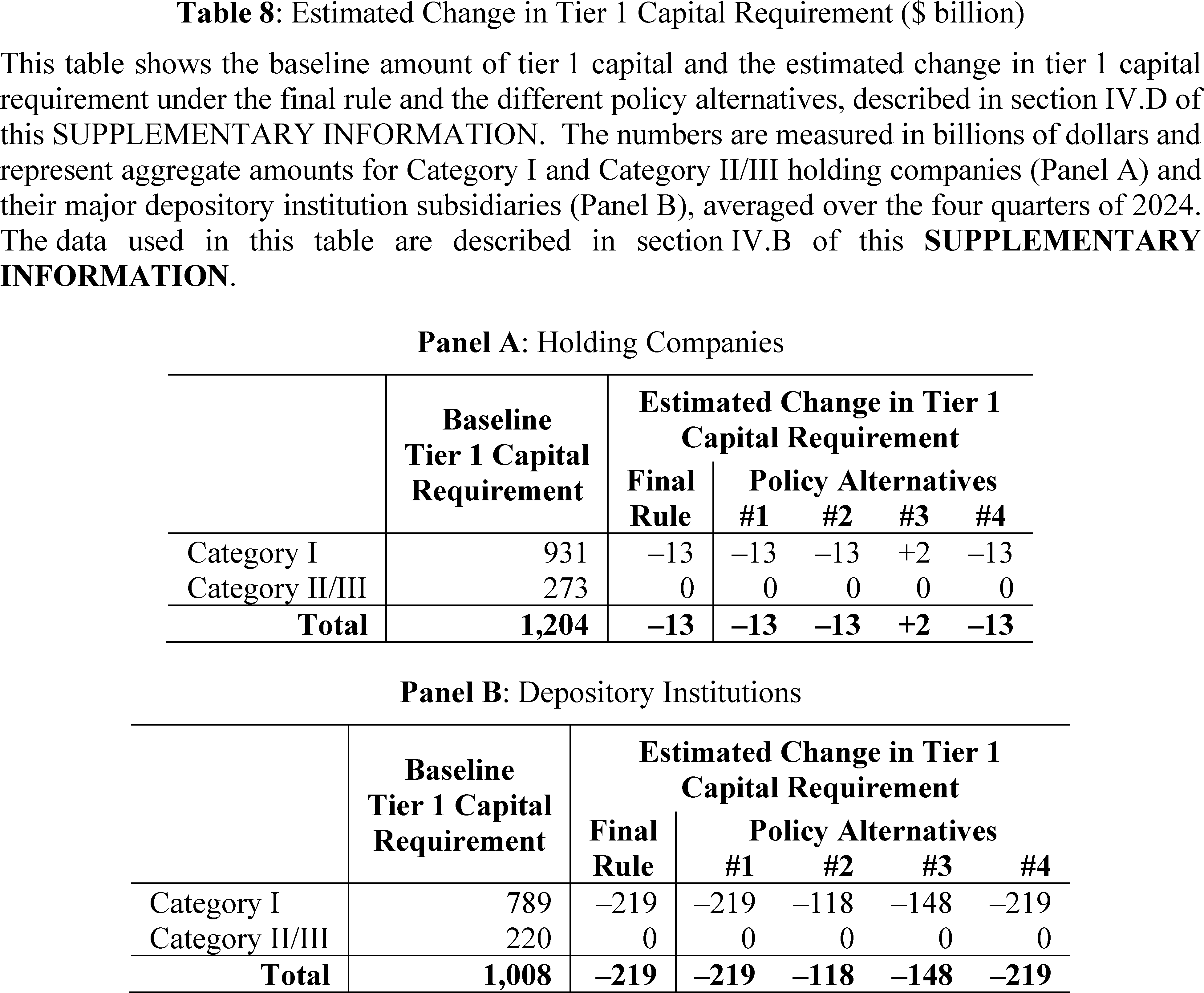
Alternatives 1, 2, and 4 lead to the same reduction in the tier 1 capital requirement for GSIBs as the final rule because all of these policy alternatives reduce the supplementary leverage ratio requirement below the other (risk-based and leverage) tier 1 capital requirements for all GSIBs. By contrast, Alternative 3 leads to a small, less than $2 billion, aggregate increase in the tier 1 capital requirement for GSIBs, as one GSIB faces an increase in its tier 1 capital requirement under this policy alternative.
For major covered depository institutions, the estimated dollar reduction in tier 1 capital requirements is in line with the estimated percentage reduction in the supplementary leverage ratio requirement across policy alternatives, with the exception of Alternative 4. Specifically, even though this alternative combines the effects of the final rule and the “broader exclusion” alternative, the estimated aggregate reduction in tier 1 capital requirement under Alternative 4 is the same as the reduction under the final rule. This is because the final rule already sets the supplementary leverage ratio requirement for all major covered depository institutions below at least one of the other (risk-based and leverage) tier 1 capital requirements, and therefore the additional effect of excluding assets from the calculation of total leverage exposures under the “combined” alternative for these depository institutions does not lead to a further reduction in their tier 1 capital requirements.
Similar to the final rule, the policy alternatives considered do not reduce the tier 1 capital requirements for banking organizations subject to Category II and III standards because the supplementary leverage ratio requirement is not the binding tier 1 capital requirement for these banking organizations under the baseline.
For major covered depository institutions, the final rule's estimated impact is slightly different from the proposal's estimated impact.[84] This small change is due to the difference in the eSLR standard for covered depository institutions under the final rule and the proposal. In particular, as explained in section II.A of this SUPPLEMENTARY INFORMATION , the proposal would have set the eSLR standard for covered depository institutions equal to 50 percent of their parent GSIB's method 1 surcharge, whereas the final rule sets the eSLR standard for covered depository institutions equal to 50 percent of their parent GSIB's method 1 surcharge, capped at one percent. Even though this change relative to the proposal does not meaningfully change the estimated aggregate impact on tier 1 capital requirements and the related economic implications, it leads to a somewhat lower supplementary leverage ratio requirement for some covered ( printed page 55272) depository institutions whose parent GSIBs have method 1 surcharges above two percent. Nevertheless, this change does not affect the estimated reduction in the tier 1 capital requirements for most of these depository institutions because both the proposal and the final rule achieve the objective of setting the supplementary leverage ratio requirement as a backstop for these depository institutions, as other (risk-based and leverage) tier 1 capital requirements become binding.
One commenter requested that the agencies provide public, reliable data supporting the estimated aggregate reduction in the tier 1 capital requirements of GSIBs and covered depository institutions, respectively. As discussed in section IV.B of this SUPPLEMENTARY INFORMATION, the agencies use publicly available data reported in FR Y-9C and FFIEC Call Report filings in their calculations. The section also describes how the agencies use these data to calculate their impact estimates, with the relevant data fields specified in the corresponding footnotes.
Notably, the estimated changes in tier 1 capital requirements discussed above in Table 8 do not reflect potential short-run transition effects due to risk-based total capital requirements. So far, the analysis has only considered the risk-based tier 1 capital requirements, the tier 1 leverage ratio requirement, and the supplementary leverage ratio requirement. However, banking organizations also have to meet risk-based total capital requirements, where total capital comprises tier 1 and tier 2 capital, which includes a limited allowance for credit losses on loans and leases as well as subordinated debt. Therefore, if the baseline tier 2 capital amounts ($76 billion, in aggregate) of covered depository institutions remain unchanged in the short run, they would likely continue to use their existing tier 1 capital amounts to satisfy the rest of their total capital requirements. Taking this effect into account, the agencies estimate that the aggregate reduction in tier 1 requirements for covered depository institutions would be $197 billion. However, over time, or in anticipation of the policy change, these depository institutions could increase their tier 2 capital such that the aggregate reduction in their tier 1 capital requirements would be closer to the $219 billion estimate in Table 8.
Up to this point, the analysis has focused on the major depository institution subsidiaries of holding companies subject to Category I-III standards. The rest of the insured depository institution subsidiaries of holding companies subject to Category I-III standards account for 0.7 percent of the consolidated total assets of these holding companies, in aggregate. These smaller subsidiaries will slightly add to the aggregate reduction in the supplementary leverage ratio and the tier 1 capital requirements estimated above.
Finally, the final rule will impose an enhanced supplementary leverage ratio requirement on the uninsured national bank subsidiaries of GSIBs. As noted in section IV.B of this SUPPLEMENTARY INFORMATION, there are six such subsidiaries, which account for 0.01 percent of the consolidated total assets of GSIBs, in aggregate. Under the baseline, these small subsidiaries have a supplementary leverage ratio above 90 percent, on average, well in excess of the requirement that they will be subject to under the final rule. Hence, the agencies expect that the final rule will generally have little impact on the uninsured national bank subsidiaries of GSIBs.
F. Benefits
The agencies expect that the reduced calibration of the eSLR standards for GSIBs and covered depository institutions under the final rule will have two main economic benefits: (1) it will reduce unintended disincentives for these banking organizations to engage in low-risk activities as well as unintended incentives to engage in higher-risk activities; and (2) it could enhance the functioning of financial markets, including the U.S. Treasury market, by creating additional capacity for GSIBs to engage in market intermediation. In the rest of this section, the agencies discuss these benefits in more detail.
The first benefit is due to the significant reduction in the supplementary leverage ratio requirement for these banking organizations under the final rule, estimated in section IV.E, which has both a level effect and a marginal effect, as discussed in section IV.A of this SUPPLEMENTARY INFORMATION . The level effect manifests because the reduced calibration of the eSLR standards will enable these banking organizations to substantially increase low-risk asset holdings without raising their tier 1 capital requirements. The marginal effect manifests as the final rule sets the supplementary leverage ratio requirement, in dollar terms, below risk-based tier 1 capital requirements for all GSIBs and most covered depository institutions. By doing so, the final rule will make the binding tier 1 capital requirement for these banking organizations more risk sensitive because risk-based requirements are more closely aligned with the underlying risks of different asset classes. In particular, under the final rule, increasing low-risk-weight activities will not lead to a significant increase in tier 1 capital requirements for these banking organizations, because the risk-based tier 1 capital requirement will be their binding tier 1 capital requirement. Moreover, this marginal effect will reduce unintended incentives for these banking organizations to engage excessively in higher-risk activities because such activities are required to be backed by more tier 1 capital under the risk-based capital framework than under the supplementary leverage ratio requirement.[85]
Similar to the final rule, the “narrow exclusion” Alternative 1 and the “combined” Alternative 4 reduce these unintended marginal incentives for GSIBs and covered depository institutions. By contrast, this economic benefit does not fully manifest under the “broader exclusion” Alternative 2 and the “2018 proposal” Alternative 3, as the supplementary leverage ratio requirement remains above the risk-based tier 1 capital requirement for one GSIB under “the 2018 proposal” alternative and for most covered depository institutions under both alternatives. However, the “broader exclusion” alternative still reduces unintended marginal incentives for these banking organizations to hold reserves and U.S. Treasury securities, as this alternative excludes such assets from the calculation of total leverage exposure.
The level effect of the final rule will enable these banking organizations to add certain low-risk assets to their balance sheets without increasing their tier 1 capital requirements as long as their leverage-based tier 1 capital requirements remain below their risk-based tier 1 capital requirements.[86] The agencies do not predict the type and dollar amount of low-risk assets that banking organizations subject to Category I-III standards may add to their balance sheets under the final rule and the policy alternatives considered ( printed page 55273) because such predictions are both highly uncertain and depend on various macroeconomic factors, such as the market and economic environment. However, the agencies provide a simple measure for the potential magnitude of this effect by estimating the available capacity of GSIBs to increase reserves or U.S. Treasury securities held as investment securities at covered depository institutions and assessing how the final rule will increase this capacity estimate.[87] Specifically, for each GSIB, the agencies define “available capacity” as the dollar amount of such assets that its depository institution subsidiaries can add to their balance sheets without raising their or their consolidated holding company's tier 1 capital requirements above baseline levels.[88] For a comprehensive assessment of the policy alternatives considered, the agencies also estimate this available capacity for holding companies subject to Category II and III standards. Additionally, further below in this subsection, the agencies also estimate GSIBs' available capacity to hold U.S. Treasury securities at their broker-dealer subsidiaries, which is more closely tied to U.S. Treasury market intermediation.
Table 9 compares the aggregate estimated amounts of the available capacity of GSIBs and holding companies subject to Category II and III standards for reserves and U.S. Treasury securities held as investment securities at their depository institution subsidiaries under the baseline, the final rule, and the policy alternatives considered. Under the final rule, the agencies estimate that GSIBs' available capacity for such assets will increase from nearly zero to $1.1 trillion, in aggregate, which is about 6 percent of their aggregate total leverage exposures or about the size of their aggregate U.S. Treasury securities held as investment securities under the baseline.[89] Under both the final rule and the policy alternatives considered, the primary limiting factors to the estimated increase in GSIBs' available capacity are the effect of increasing reserves or U.S. Treasury securities holdings on their GSIB surcharge and on the tier 1 leverage ratio requirements of their depository institution subsidiaries.

Alternative 1 (“narrow exclusion”) leads to a similar estimated increase in GSIBs' available capacity for reserves and U.S. Treasury securities held as investment securities at their depository institution subsidiaries as the final rule, consistent with the similar quantitative effect of this alternative on the supplementary leverage ratio ( printed page 55274) requirement. The agencies estimate that, of all the alternatives considered, the “broader exclusion” and the “combined” alternatives lead to the largest estimated increase in GSIBs' available capacity for such assets. The estimated increase is $1.4 trillion, in aggregate, which is about 8 percent of their aggregate total leverage exposures or about 125 percent of their aggregate U.S. Treasury securities held as investment securities under the baseline. This is because these alternatives exclude reserves and all U.S. Treasury securities holdings from the calculation of total leverage exposure.[90]
Of the policy alternatives considered, Alternative 3 (“2018 proposal”) leads to the least estimated increase in GSIBs' available capacity for such assets. The estimated increase is $0.2 trillion, in aggregate, which is less than 1 percent of their aggregate total leverage exposures under the baseline. This is because this policy alternative reduces the calibration of the eSLR standards for GSIBs and their depository institution subsidiaries less than the final rule. Finally, the alternatives considered do not meaningfully increase the available capacity of holding companies subject to Category II and III standards for reserves and U.S. Treasury securities held as investment securities at their depository institution subsidiaries. However, these banking organizations have ample available capacity (14 percent of their total leverage exposures, in aggregate) for such zero-risk-weight assets at their depository institution subsidiaries under the baseline because leverage-based requirements are not the highest tier 1 capital requirements for most of these banking organizations.
One commenter queried why the U.S. banking system, financial markets, and economy would benefit from removing potential disincentives for GSIBs to hold more low-risk assets. Because GSIBs are key participants in critical financial markets, such as the money market, the U.S. Treasury market, and the agency-backed mortgage securities market, their reluctance to hold low-risk assets transacted in these markets and to act as counterparties and intermediaries could have negative implications for the functioning, liquidity, and stability of these markets.[91] Additionally, by creating significant additional capacity for GSIBs and covered depository institutions to hold low-risk assets, the final rule will enhance the ability of these banking organizations to absorb surges in the demand for their services and liquidity provision, especially during stress periods. These positive changes due to the final rule can have broader economic benefits, including improving the stability of financial markets and the financial system, as well as facilitating the effective intermediation of monetary policy to businesses and households.
Beyond reducing disincentives to holding low-risk assets in general, the final rule could improve GSIBs' ability to perform their role as key intermediaries in the U.S. Treasury market, through the marginal and level effects discussed above. In particular, the marginal effect can reduce the amount of tier 1 capital required per each dollar of U.S. Treasury securities held by GSIBs' primary dealer subsidiaries. This is because, under the final rule, the risk-based tier 1 capital requirement will be the binding tier 1 capital requirement for all GSIBs with primary dealer subsidiaries, and the amount of tier 1 capital that GSIBs are required to have against the U.S. Treasury securities holdings of their broker-dealer subsidiaries can be lower under the risk-based capital framework than under the supplementary leverage ratio requirement.[92] A reduction in GSIBs' marginal tier 1 capital requirement would lower the marginal funding cost of holding U.S. Treasury securities in their primary dealer subsidiaries, which could reduce potential disincentives for these primary dealers to engage in U.S. Treasury market intermediation and improve their competitiveness as intermediaries in this market.
In addition to the marginal effect, the level effect of the final rule will enable GSIBs to increase their market intermediation activities more flexibly in response to short- and long-run changes in market participants' demand for liquidity. The level effect manifests as the final rule reduces the calibration of the eSLR standard for GSIBs, thereby increasing the capacity of their broker-dealer subsidiaries to hold additional U.S. Treasury securities without raising the tier 1 capital requirements of GSIBs above baseline levels. The agencies provide a simple measure for the magnitude of this effect under the final rule and the policy alternatives considered by estimating the available capacity of GSIBs to increase U.S. Treasury securities held at their broker-dealer subsidiaries and assess how the final rule will increase this capacity estimate. Specifically, for each GSIB, the agencies define “available capacity” as the dollar amount of U.S. Treasury securities that their broker-dealer institution subsidiaries could add to their balance sheets without raising their consolidated holding company's tier 1 capital requirements above baseline levels, assuming that such securities holdings are perfectly hedged.[93] Notably, the capacity estimates would be meaningfully lower if the securities holdings are not fully hedged.[94] For a comprehensive assessment of the policy alternatives, the agencies also estimate this available capacity for holding companies subject to Category II and III standards.
Table 10 compares the aggregate estimated amounts of the available capacity of GSIBs and holding companies subject to Category II and III standards for U.S. Treasury securities held at their broker-dealer subsidiaries ( printed page 55275) under the baseline, the final rule, and the policy alternatives. Under the final rule, the agencies estimate that the available capacity of GSIBs' broker-dealers to hold U.S. Treasury securities will increase from nearly zero to $2.1 trillion, in aggregate, which is about 12 percent of GSIBs' aggregate total leverage exposures or about 350 percent of GSIBs' aggregate U.S. Treasury securities reported as trading assets under the baseline. Under both the final rule and the policy alternatives, the primary limiting factor to the estimated increase in the available capacity of GSIBs' broker-dealers is the effect of increasing U.S. Treasury securities holdings on the GSIB surcharge and the tier 1 leverage ratio requirement of their consolidated holding companies. The capacity estimates in Table 10 are about twice as much as the capacity estimates for reserves and U.S. Treasury securities held at covered depository institutions, shown in Table 9, because the latter estimates also take into account leverage-based capital requirements at covered depository institutions.
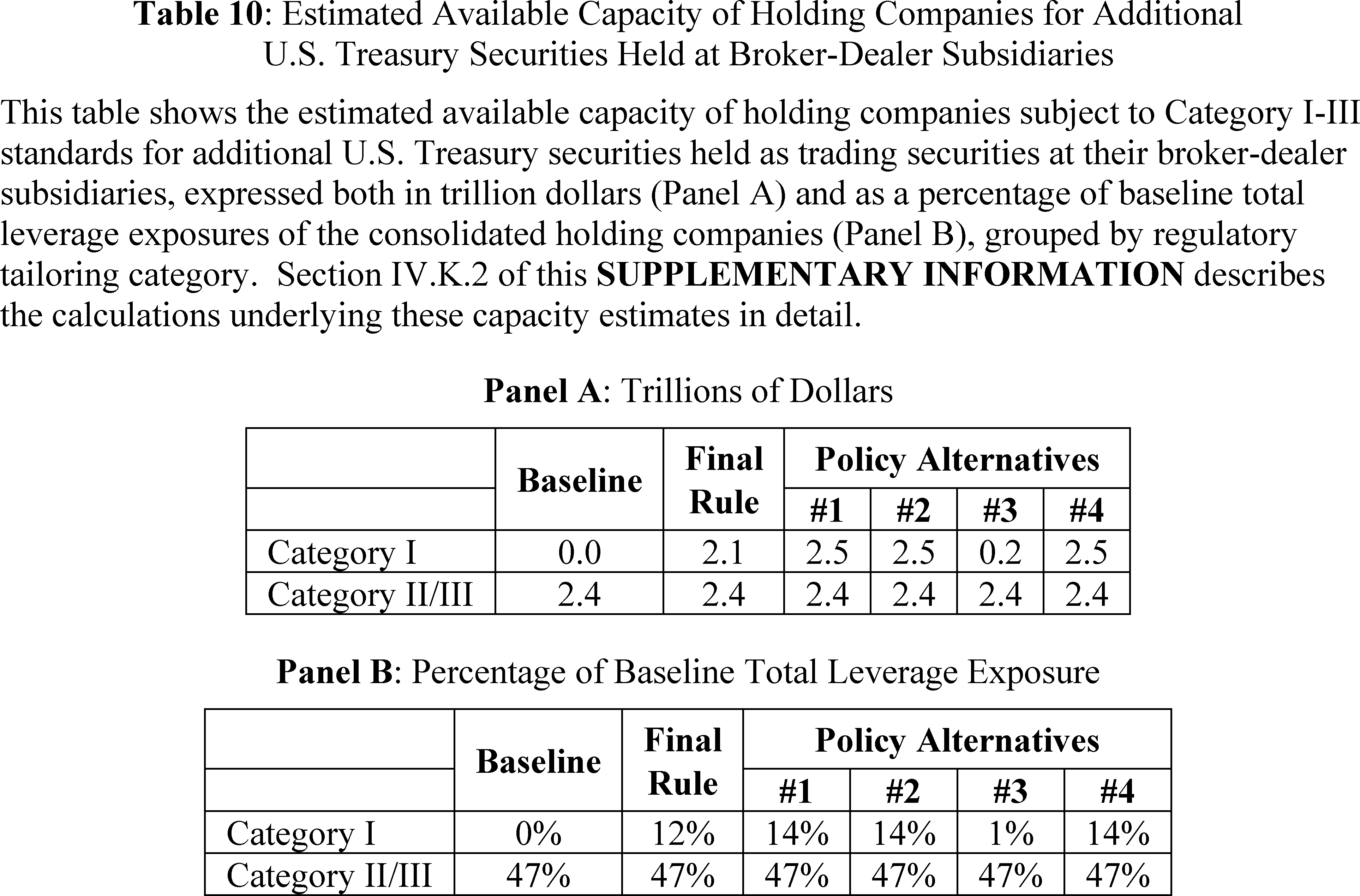
Alternatives 1, 2, and 4 (“exclusion” alternatives) lead to a larger estimated increase in the available capacity of GSIBs' broker-dealers for U.S. Treasury securities than the final rule. The estimated increase is $2.5 trillion, in aggregate, which is about 14 percent of GSIBs' aggregate total leverage exposures or about 420 percent of GSIBs' aggregate U.S. Treasury securities reported as trading assets under the baseline. The estimated increase in available capacity is larger because all of these policy alternatives exclude U.S. Treasury securities held at broker-dealer subsidiaries from the calculation of total leverage exposure for both GSIBs and holding companies subject to Category II and III standards. Therefore, beyond meaningfully reducing the likelihood that the supplementary leverage ratio requirement becomes a binding tier 1 capital requirement for these holding companies, these alternatives could further mitigate potential constraints to their U.S. Treasury market intermediation activities, in the event that the supplementary leverage ratio requirement does become binding in the future.
Of the policy alternatives considered, Alternative 3 (“2018 proposal”) leads to the least estimated increase in the available capacity of GSIBs' broker-dealers for U.S. Treasury securities. The estimated increase is $0.2 trillion in aggregate, which is less than 1 percent of their aggregate total leverage exposures under the baseline. Finally, the alternatives considered do not meaningfully increase the available capacity of holding companies subject to Category II and III standards for U.S. Treasury securities held at their broker-dealer subsidiaries. However, these banking organizations already have ample available capacity (47 percent of their total leverage exposures, in aggregate) for such asset holdings under the baseline because leverage ratio requirements are not the highest tier 1 capital requirements for most of these organizations.
By facilitating the U.S. Treasury market intermediation activity of GSIBs' broker-dealers, the final rule and the “exclusion” alternatives could improve the functioning of this market, in both normal and stressed times. This is because, as discussed in section IV.A of this SUPPLEMENTARY INFORMATION , these large broker-dealers play a central role in the U.S. Treasury market, and constraints to their capacity to act as intermediaries can affect market liquidity. U.S. Treasury market liquidity is important because it supports the market's critical economic functions. Indeed, as Goldberg (2020) shows, decreases in liquidity supplied by dealers in U.S. Treasury markets are ( printed page 55276) related to declines in the liquidity of corporate bonds and other asset classes, which in turn are associated with declines in debt issuance and investment by non-financial firms, with potential real economic repercussions.[95] More broadly, by reducing regulatory constraints for broker-dealer subsidiaries of GSIBs, the final rule and the “exclusion” alternatives could support these entities in providing liquidity (for example, in the form of securities financing transactions) to other market participants, which could in turn reduce the propagation of liquidity shocks across financial markets and thus prevent or mitigate “liquidity spirals,” discussed in Brunnermeier and Pedersen (2009).[96] Notably, this economic benefit is stronger under the “exclusion” alternatives because these policy alternatives exclude the U.S. Treasury securities holdings of broker-dealer subsidiaries from the calculation of total leverage exposure for their consolidated holding companies. This exclusion could further enhance the ability of banking organizations subject to Category I to III standards to flexibly adjust their U.S. Treasury market intermediation activities in response to short- and long-run changes in market participants' demand for liquidity.
Several commenters requested evidence that the proposal would facilitate trading in U.S. Treasury securities, in both normal and stressed times, by reducing the eSLR standard. As discussed in this subsection, the agencies anticipate that the final rule will reduce unintended disincentives for GSIBs to participate in U.S. Treasury markets due to binding supplementary leverage ratio requirements through its marginal and level effects.[97] In particular, as estimated in Table 10, the level effect of the final rule will create significant additional capacity for GSIBs' broker-dealers to hold U.S. Treasury securities and intermediate in this market. The agencies assess that this benefit will manifest in both normal and stressed times, as the additional capacity is large enough to enable GSIBs' broker-dealers to absorb even major fluctuations in the demand for liquidity by other market participants. In section IV.A of this SUPPLEMENTARY INFORMATION , the agencies cite multiple pieces of evidence from the academic literature suggesting that balance sheet constraints could indeed reduce broker-dealers' ability and willingness to participate in the U.S. Treasury market. Specifically, the empirical studies of Favara, Infante, Rezende (2022), Duffie et al. (2023), and Bräuning and Stein (2024) examine the negative relationship between primary dealer balance sheet constraints and their U.S. Treasury market participation.
One commenter requested a quantitative assessment of the proposal's positive impact on broker-dealer intermediation, bid-ask spreads, market depth, trade size, and trading volume in the U.S. Treasury market. This subsection of the economic analysis provides multiple quantitative estimates for the additional capacity of GSIBs and their subsidiaries for holding additional U.S. Treasury securities. The estimates indicate that the additional capacity will be significant relative to the baseline total leverage exposures of these banking organizations. Although it is challenging to predict with sufficient accuracy to what extent GSIBs and their subsidiaries will use this additional capacity, the estimates indicate that the final rule will greatly alleviate the balance sheet constraints on the U.S. Treasury market participation of GSIBs' broker-dealers due to potentially binding supplementary leverage ratio requirements. The empirical studies cited above suggest that relaxing primary dealers' balance sheet constraints can improve the liquidity of the U.S. Treasury markets in various dimensions, including the liquidity metrics mentioned by the commenter.
The agencies present the anticipated benefits of the changes to TLAC and long-term debt requirements and buffer standards under the final rule in section IV.I of this SUPPLEMENTARY INFORMATION.
G. Costs
The economic costs of the final rule and the policy alternatives considered can be attributed to three main factors: (1) a potential increase in the leverage of GSIBs and covered depository institutions due to the reduction in their tier 1 capital requirements; (2) a potential increase in the costs associated with the failure of insured covered depository institutions; and (3) a potential increase in risk exposures not fully captured by the risk-based capital framework. In the rest of this section, the agencies discuss these potential costs in more detail. The agencies anticipate that the economic costs resulting from the final rule and the policy alternatives for banking organizations subject to Category II and III standards will be negligible because tier 1 capital requirements for these organizations will remain essentially unchanged.
The agencies anticipate that the final rule, through the reduction in the supplementary leverage ratio and tier 1 capital requirements for GSIBs, will enable GSIBs to increase their leverage by increasing the share of debt financing on their balance sheets. Even though the aggregate reduction in their tier 1 capital requirement will be small, and GSIBs will be required to retain most of their existing tier 1 capital, the aggregate reduction in their supplementary leverage ratio requirement will be significant (23 percent), which will enable GSIBs to increase their leverage in two likely ways. First, their increased capacity for low-risk assets will enable GSIBs to expand their balance sheets by increasing such asset holdings, financing them with new debt, such as deposits.[98] Such potential balance sheet growth could reduce the risk-weighted asset densities of GSIBs, which would be consistent with the observed growth of these companies and the gradual decline in their risk-weighted asset densities over the past decade.[99] Second, GSIBs could also distribute some of their equity capital to external shareholders and replace it with new debt, while keeping the size of their balance sheets, as well as their tier 1 capital management buffers, unchanged relative to the baseline.[100] A potential increase in leverage could render GSIBs riskier because the economic value of their equity capital would become more sensitive to asset value shocks and therefore more volatile. However, in the case that GSIBs grow by adding more low-risk assets, the effect of increased leverage on equity volatility would be mitigated by the relative stability in the values of the newly added low-risk assets. Therefore, the agencies expect ( printed page 55277) that the economic costs due to potential changes in GSIBs' balance sheets would be small under the final rule.
Several commenters raised concerns about the potential increase in the leverage of GSIBs and a related potential increase in their probability of failure. The agencies anticipate that such potential increase in GSIBs' probability of failure will be minimal, mainly because the aggregate reduction in their tier 1 capital requirements is small. The final rule also does not change common equity tier 1 capital requirements, standardized liquidity requirements, or other enhanced prudential standards applicable to GSIBs, which further help ensure that GSIBs operate in a safe and sound manner.[101]
Several commenters expressed concerns about the potential increase in GSIBs' capital distributions under the proposal, with one commenter requesting upper and lower bounds for the estimated change in capital distributions. Another commenter argued that elevated capital distributions of GSIBs in normal times could lead to their increased need for and reliance on government support during times of stress. One commenter requested that the agencies assess the financial stability implications of a potential increase in GSIBs' capital distributions.
The agencies expect that the final rule will likely not lead to a material increase in GSIBs' capital distributions, mainly because the estimated reduction in their tier 1 capital requirements is small. Additionally, the final rule will not change common equity tier 1 capital requirements, which will continue to limit GSIBs' capital distributions. Furthermore, as discussed above, rather than increasing capital distributions, GSIBs could also respond to the reduction in their leverage capital requirements by using their existing capital to grow, especially by increasing their low-risk asset holdings. As such, the estimated reduction in tier 1 capital requirements constitutes a high-end estimate for the potential increase in capital distributions. Overall, the agencies expect that GSIBs will generally retain their existing capital under the final rule and anticipate no meaningful change in the resilience of these banking organizations.
The agencies also anticipate that the final rule, through the estimated reduction in aggregate tier 1 capital requirements for covered depository institutions by $219 billion (28 percent), will enable these depository institutions to increase their leverage by relying more on debt financing. Furthermore, in addition to reducing the tier 1 capital requirements for covered depository institutions, the final rule may lead to a reduction in their tier 1 capital management buffers by changing their eSLR standard from a more stringent, “well-capitalized” prompt corrective action standard to a buffer standard.[102] Similar to GSIBs, covered depository institutions may use new debt financing to either grow by increasing their holdings of low-risk assets or replace some of their equity capital. However, the potential balance sheet changes at these depository institutions differ from those at their holding companies in two important ways. First, covered depository institutions could increase their leverage in a more flexible way than GSIBs because they could use both external debt financing (for example, in the form of deposits or wholesale funding) and internal debt financing. Second, in the case that covered depository institutions increase their leverage by distributing some of their equity capital and replacing it with new debt, most of this capital would be distributed to their parent GSIBs, which would not be able to make large distributions to external shareholders because the final rule will reduce their tier 1 capital requirement only modestly. Rather, GSIBs could use such potential capital distributions from their depository institution subsidiaries either for financing activities at other subsidiaries, such as market intermediation activity in their broker-dealer subsidiaries, or for paying down some of their external debt outstanding.
Some commenters expressed concerns that the proposal could increase the risk of failure of covered insured depository institutions and thus the risk of losses to the Deposit Insurance Fund, which could in turn lead to higher future assessments charged to insured depository institutions. To the extent that the final rule reduces capital requirements for insured covered depository institutions, the final rule may increase costs in the event of certain types of failure. Specifically, reducing capital requirements could increase the size and likelihood of losses, thereby shifting losses from shareholders to creditors and the Deposit Insurance Fund in the event that the FDIC is required to resolve the insured depository institution. Under the final rule, covered depository institutions remain subject to heightened supervisory and regulatory standards, including robust capital and leverage requirements. Additionally, the parent GSIBs of covered depository institutions remain subject to resolution planning requirements, designed to facilitate rapid and orderly resolution under the U.S. Bankruptcy Code. The resolution plans of GSIBs envision a single-point-of entry strategy, under which parent GSIBs would enter resolution while material subsidiaries, including covered insured depository institutions, continue to operate on a going-concern basis and therefore would not enter FDIC receivership requiring the use of Deposit Insurance Fund resources. Furthermore, GSIBs are expected to be a source of strength for their subsidiaries, providing them with equity financing and liquidity as needed.
Importantly, the effect of a potential increase in the leverage of covered depository institutions will be mitigated by risk-based capital requirements for GSIBs. In particular, if covered depository institutions increase their leverage through growth, they will likely do so by mainly increasing their low-risk-weight asset holdings because the tier 1 capital requirements of their parent GSIBs will increase if covered depository institutions significantly increase their risk-weighted asset amounts. Additionally, the capital rule will continue to require covered depository institutions, notwithstanding their minimum capital requirements under the capital rule, to maintain capital commensurate with the level and nature of their risk exposures, to have a process for assessing their overall capital adequacy in relation to their risk profile, and to have a comprehensive strategy for maintaining an appropriate level of capital.[103]
Some commenters requested evidence that GSIBs would continue to act as a source of strength for their depository institutions under the proposal. The Board's Regulation Y requires each GSIB to include in its capital plan a detailed description of how it will serve as a source of strength to its subsidiary institutions under expected and ( printed page 55278) stressful conditions.[104] Additionally, financially strong GSIBs have a business interest to provide capital and liquidity support to their depository institution subsidiaries because these subsidiaries constitute a major part of the franchise values of these banking organizations.[105] Because the estimated reduction in tier 1 capital requirements for GSIBs is small under the final rule, the agencies expect that these incentives for GSIBs to act as a source of strength will remain unchanged.
Similar to the final rule, the policy alternatives considered also create potential for GSIBs and covered depository institutions to increase their leverage, albeit to varying extents. In line with the differences in the estimated reduction in the supplementary leverage ratio requirement and the estimated aggregate changes in tier 1 capital requirements, discussed in section IV.E of this SUPPLEMENTARY INFORMATION, Alternative 1 (“narrow exclusion”) creates similar, Alternative 2 (“broader exclusion”) and Alternative 3 (“2018 proposal”) create smaller, and Alternative 4 (“combined”) creates much greater potential for these banking organizations to increase their leverage than the final rule.
Finally, by reducing the supplementary leverage ratio requirement from above to below risk-based tier 1 capital requirements for GSIBs and covered depository institutions, the final rule will enable these banking organizations to increase their risk exposures that are not fully captured by the risk-based capital framework but are somewhat captured by leverage-based capital requirements in their backstop role. For example, under the final rule, GSIBs could increase their interest rate risk exposures by adding zero-risk-weight securities, such as U.S. Treasury securities and Ginnie Mae mortgage-backed securities, to their investment securities holdings.[106] As discussed in relation to Table 9, the final rule will significantly increase GSIBs' capacity for such zero-risk-weight asset holdings. However, zero-risk-weight securities holdings can have substantial interest rate risk.[107] Moreover, Greenwald, Krainer, Paul (2024) find that the majority of available-for-sale securities holdings are not fair-value hedged by large banking organizations, leaving such positions prone to yield curve shifts.[108] GSIBs are required to reflect unrealized gains and losses on such positions in their regulatory capital calculations.[109] Although the fair value fluctuations of held-to-maturity securities are not reflected in regulatory capital and book equity calculations, they can still affect the economic value of a company's equity. Hence, such interest rate risk exposures, if not backed by sufficient capital, could render a company less stable and raise public concerns about its solvency. A potential mitigant to these exposures is that GSIBs may reflect them in capital and liquidity management buffer decisions.
Noting that U.S. Treasury securities are not riskless assets, several commenters requested a quantitative analysis of the potential increase in the interest rate risk exposures of GSIBs due to the potential increase in their holdings of such securities under the proposal. One commenter pointed out that GSIBs may not want to increase their interest rate risk exposures by holding more U.S. Treasury securities. While one benefit of the final rule will be to reduce balance sheet constraints that may limit the ability of GSIBs to engage in U.S. Treasury market intermediation and other low-risk activities, the final rule's objective is not to create incentives for GSIBs and covered depository institutions to hold more U.S. Treasury securities. The final rule does not require these banking organizations to increase such securities holdings. Some of these banking organizations may indeed use the additional capacity for low-risk assets created by the final rule to increase their U.S. Treasury securities holdings, which could have implications for their interest rate risk exposures. Nevertheless, as discussed above, GSIBs and covered depository institutions have economic and regulatory incentives to adequately manage such risk exposures. Moreover, the agencies' safety and soundness standards require that these banking organizations manage their interest rate risk in a manner that is appropriate to their size and the complexity of their balance sheets.[110] In 2010, the agencies published an advisory on how banking organizations can accomplish that objective, describing supervisory expectations and sound practices for managing interest rate risk.[111]
Furthermore, potential changes in interest rate risk exposures will be reflected in risk-based capital requirements if GSIBs increase their U.S. Treasury securities holdings to facilitate the market intermediation activities of their broker-dealer subsidiaries. This is because, as also discussed in section IV.F of this SUPPLEMENTARY INFORMATION, such U.S. Treasury securities holdings are classified as trading assets and thus subject to the market risk capital framework, which takes interest rate risk into account in risk-weighted asset calculations.
Relative to the final rule, some of the policy alternatives considered could attenuate or exacerbate the potential increase in the risk exposures of GSIBs and covered depository institutions that are not fully captured by the risk-based capital framework. Alternative 1 (“narrow exclusion”) would have a similar effect on GSIBs as the final rule because it only excludes U.S. Treasury securities held by the broker-dealer subsidiaries of GSIBs from the calculation of total leverage exposure for their parent GSIBs, and the interest rate risk of such securities holdings is captured by the market risk component of the risk-based capital framework. By contrast, Alternative 2 (“broader exclusion”) and Alternative 4 (“combined”) could lead to a larger increase in interest rate risk exposures than the final rule because these policy alternatives exclude all U.S. Treasury securities holdings from the calculation of total leverage exposure for GSIBs, which may create additional incentives for GSIBs to increase their holdings of such securities.[112] The potential ( printed page 55279) increase in such risk exposures would be much smaller under Alternative 3 (“2018 proposal”) than under the final rule because, as discussed in section IV.F of this SUPPLEMENTARY INFORMATION, this policy alternative creates little additional capacity for GSIBs to hold zero-risk-weight assets.
The agencies present the anticipated costs of the changes to TLAC and long-term debt requirements and buffer standards under the final rule in section IV.I of this Supplementary INFORMATION.
H. Additional Comments on the Economic Analysis
1. Requests To Consider Potential Future Developments
One commenter requested estimates for the reduction in tier 1 capital requirements that reflect more recent risk-based capital requirements than those considered in the proposal's economic analysis. Other commenters requested that such updated estimates reflect the results of the stress tests conducted in 2025.
Recognizing that changes in balance sheet and capital conservation buffer requirements over time can generate a range of quantitative impact estimates, this subsection utilizes more recent data to produce two additional sets of estimates for the final rule's impact. Specifically, in this exercise, the agencies adopt a forward-looking approach, using the most recent balance sheet information available (from the second quarter of 2025) and combining this balance sheet information with two potential versions of the capital conservation buffer requirement applicable to GSIBs in early 2026. The first potential version of the capital conservation buffer requirement is the sum of the GSIB surcharge applicable in 2026 and the stress capital buffer requirement that would be applicable under the stress capital buffer requirement averaging proposal published by the Board in April 2025.[113] The second potential version of the capital conservation buffer requirement is the GSIB surcharge applicable in 2026 plus the stress capital buffer requirement announced by the Board in August 2024.[114] For covered depository institutions, the updated impact estimates only reflect balance sheet changes because the capital conservation buffer is set at 2.5 percent of risk-weighted assets for these institutions.
For GSIBs, the updated estimates show that the final rule reduces the aggregate tier 1 capital requirements for GSIBs by $23 billion under the first scenario and by $49 billion under the second scenario. These amounts correspond to 2.3 percent and 5.1 percent of their aggregate tier 1 capital requirement under the baseline, respectively. For covered depository institutions, the updated estimates show that the final rule reduces aggregate tier 1 capital requirements by $231 billion, which is about 28 percent of their aggregate tier 1 capital requirement under the baseline. Overall, although the updated impact estimates for covered depository institutions are similar to the estimates presented in the proposal and section IV.E of this SUPPLEMENTARY INFORMATION, the updated impact estimates for GSIBs are moderately higher, which suggests that the final rule's expected benefits and costs may be somewhat higher than assessed in the economic analysis.
Notably, stress capital buffer requirements show significant year-over-year variability, and the latest stress test results led to stress capital buffer requirements near the lower end of their historical range. For this reason, the agencies' estimation methodology, described in section IV.B of this SUPPLEMENTARY INFORMATION, relies on a whole year of data from 2024, which yields an impact estimate that is more robust to annual swings in stress capital buffer requirements. Overall, the forward-looking estimates do not change the main conclusions of the economic analysis.
Several commenters asserted that the economic analysis did not sufficiently consider how firms could adjust their balance sheets over time. In particular, some commenters noted that GSIBs and covered depository institutions may adjust their balance sheets so as to reduce their risk-based capital requirements, which could lead to a capital release that is greater than the agencies' impact estimates. In the proposal, the agencies conducted the economic analysis using current, publicly available information on the balance sheets of these banking organizations. If the balance sheet composition of these banking organizations changes over time, that could indeed create future impacts that are different from the final rule's estimates. For example, if the risk-weighted asset densities of GSIBs and covered depository institutions decrease in the long run, that would mechanically reduce their dollar risk-based tier 1 capital requirements, which would in turn increase the reduction in tier 1 capital requirements for these banking organizations under the final rule. However, as discussed in section IV.G of this SUPPLEMENTARY INFORMATION, a decrease in risk-weighted asset densities would be an indication of banking organizations' adopting a less risky asset allocation, which would in turn improve their safety and soundness through reducing the volatility of their equity capital. Hence, the agencies believe that the potential for such long-run changes in the asset allocation of GSIBs and covered depository institutions does not meaningfully change the main takeaways from the economic analysis.
Several commenters stated that the agencies may be contemplating other regulatory changes, which would potentially modify risk-based and leverage capital requirements, total loss absorbing capacity and long-term debt requirements, or the Board's stress testing framework. These commenters requested a holistic assessment of the effect of all such potential regulatory changes, alongside the proposed changes to the eSLR standard. The agencies believe that the economic analysis of the eSLR final rule duly considers all relevant interactions with effective rules and outstanding proposed rulemakings.[115] If the agencies propose other rulemakings in the future, the economic analysis of those proposed rulemakings would seek to identify and consider all relevant interactions with effective rules and any outstanding proposed rulemakings at the time, including this final rule. Regarding the stress capital buffer requirement averaging proposal, the agencies anticipate that it could modestly amplify both the benefits and the costs of the final rule. Specifically, by decreasing the volatility of risk-based capital requirements, the stress capital buffer requirement averaging proposal could enable GSIBs to operate with somewhat smaller voluntary capital buffers. This effect could in turn increase banking organizations' ( printed page 55280) willingness to use the additional capacity for low-risk assets created by the final rule, estimated in section IV.F of this SUPPLEMENTARY INFORMATION.
2. Requests To Consider Potential Interaction Effects
Some commenters requested that the agencies assess how the Securities and Exchange Commission's rule mandating central clearing for certain secondary market transactions in U.S. Treasury securities would interact with the proposal, and whether the netting benefits of the central clearing rule could increase broker-dealers' capacity for U.S. Treasury securities positions, which may in turn obviate the need for the proposed changes to the eSLR standard.[116] As discussed by commenters and noted in Liang and Zhu (2025), the central clearing rule will likely reduce the balance sheet footprint of certain U.S. Treasury security positions by extending the netting of offsetting positions in financial statements.[117] Even though this effect could help GSIBs' broker-dealers to use their existing balance sheet capacity more efficiently, it will not eliminate the final rule's expected benefits, discussed in section IV.F of this SUPPLEMENTARY INFORMATION, for three reasons. First, the additional capacity for GSIBs' broker-dealers to hold U.S. Treasury securities created by the final rule could still enhance the ability and willingness of these broker-dealers to participate in the U.S. Treasury market. Specifically, the increased efficiency of broker-dealers' use of their balance sheet capacity under the central clearing rule may in fact make the additional capacity created by the final rule more valuable for GSIBs' broker-dealers. Second, the additional capacity created by the final rule will also enable GSIBs' broker-dealers to enter into non-offsetting (and thus non-nettable) U.S. Treasury security positions, which can improve their ability to function as market intermediaries, especially during stress periods, when order flows may be more asymmetric due to one-sided liquidity demand from market participants. Finally, the increased netting of U.S. Treasury positions does not obviate the need for the final rule because the final rule's objective is to set the supplementary leverage ratio requirement as a backstop to risk-based tier 1 capital requirements for GSIBs and covered depository institutions.
One commenter requested that the agencies assess how the proposal would interact with the liquidity coverage ratio and the net stable funding ratio requirements by creating additional balance sheet capacity for U.S. Treasury securities holdings. Liquidity standards require GSIBs and covered depository institutions to hold sufficient liquid assets to cover their potential liquidity needs. By contrast, as discussed in section IV.A in this SUPPLEMENTARY INFORMATION, a binding supplementary leverage ratio requirement creates a disincentive for these banking organizations to hold assets with low risk weights. Because liquid assets, such as reserves and U.S. Treasury securities, have low (even zero) risk weights, there is an inherent tension between liquidity and leverage capital requirements. The eSLR final rule will substantially reduce this tension by setting the supplementary leverage ratio requirement as a backstop to risk-based tier 1 capital requirements for GSIBs and covered depository institutions.
3. Requests To Consider Further Benefits and Costs
Some commenters requested that the agencies assess the proposal's potential impact on GSIBs' funding costs. The agencies anticipate that GSIBs' funding costs may slightly decrease because of the level and marginal effects of the final rule, discussed in sections IV.A and IV.F of this SUPPLEMENTARY INFORMATION. Specifically, under the final rule, the agencies estimate a small reduction in tier 1 capital requirements for GSIBs. This effect will enable GSIBs to slightly increase their leverage and thus use their capital more efficiently, which could reduce their average funding cost and thus improve their productivity.[118] Additionally, as the proposal will set the supplementary leverage ratio as a backstop to risk-based tier 1 capital requirements for GSIBs, they will be required to have less capital for low-risk asset holdings on the margin. This reduction in marginal capital requirements will create one of the final rule's main benefits, that is, removing unintended disincentives for GSIBs to engage in low-risk activities, such as U.S. Treasury market intermediation.
Several commenters argued that a potential reduction in GSIBs' costs of funding under the proposal could have implications for their competitiveness and systemic risk. In particular, commenters raised concerns that the proposal could increase the competitiveness of GSIBs relative to smaller banking organizations, which may in turn lead to more concentrated markets and reduce systemic stability. Some commenters also asserted that this potential effect of the proposal could be exacerbated by GSIBs' lower funding costs, which such commenters believe are due to the perception that these banking organizations are “too big to fail.”
As discussed above, the agencies expect that the final rule will only have a modest effect on GSIBs' average funding costs, which implies that it will likely have little effect on GSIBs' competitiveness in general. Additionally, the agencies expect no meaningful change in the systemic risk of GSIBs, partly because the reduction in tier 1 capital requirements for GSIBs will be small under the final rule, and also because the GSIB surcharge framework will continue to require GSIBs to have capital commensurate with their systemic footprint. These expectations notwithstanding, the final rule will reduce GSIBs' marginal funding costs for low-risk assets, which could improve their competitiveness in related financial markets, such as the money market and the U.S. Treasury market. This potential change would likely not have a significant effect on smaller banking organizations because GSIBs are already important participants in these financial markets for reasons other than the final rule.
Some commenters requested that the agencies assess the proposal's potential impact on lending, with one commenter expressing concerns that the proposal may lead to a reduction in GSIBs' lending activity. The agencies expect that the changes to the eSLR standards under the final rule will create little additional capacity for GSIBs and covered depository institutions to hold assets with non-zero risk weights because the reduction in tier 1 capital requirements for GSIBs will be small in aggregate. However, as also noted by commenters, to the extent these banking organizations use this reduction in their tier 1 capital requirements to grow their loan portfolios, the changes to the eSLR standards could have a small positive impact on lending activity. Additionally, as discussed in section IV.I.3, the changes to TLAC and long- ( printed page 55281) term debt requirements under the final rule could facilitate additional lending by potentially lowering GSIBs' funding costs.
Some commenters requested a quantitative assessment of the benefits of a strong leverage requirement, which they assert reduces the likelihood of a financial crisis. Relatedly, some commenters raised concerns that the proposal would put depositors, the financial system, and the broader economy at risk by reducing regulatory capital requirements. The final rule's objective is to set the supplementary leverage ratio requirement as a backstop because, as discussed in section IV.A of this SUPPLEMENTARY INFORMATION, a binding leverage capital requirement creates unintended incentives for GSIBs and covered depository institutions to engage in more high-risk activities and less low-risk activities. By creating additional capacity for these banking organizations to hold low-risk assets, the final rule will enable them to adopt a lower-risk asset allocation, which in turn may improve their stability. Importantly, the final rule will not change risk-based tier 1 capital requirements, and thus the estimated reduction in tier 1 capital requirements for GSIBs is small. Hence, under the final rule, GSIBs will be required to retain most of their existing capital, and the risk-based capital framework will continue to require both GSIBs and covered depository institutions to have capital that is commensurate with their risk exposures. Therefore, the agencies expect that the final rule will not meaningfully affect the resilience of these banking organizations, while it will reduce unintended disincentives for them to engage in low-risk activities.
I. Analysis of TLAC and Long-Term Debt Requirement Changes
The Board's TLAC and long-term debt requirements for U.S. GSIBs each consist of a risk-based and a leverage-based requirement. Holding companies subject to these requirements must maintain a minimum quantity of eligible equity and long-term debt instruments equal to the greater of the risk-based and leverage-based requirements. In addition, companies must also meet minimum TLAC buffer standards to avoid restrictions on distributions to shareholders. In the description of the Board's TLAC analysis that follows, the term “requirement” is inclusive of buffer standards unless otherwise indicated.
Under the final rule, risk-based requirements remain unchanged whereas leverage-based requirements are revised. If a firm currently has leverage-based requirements as its binding TLAC and long-term debt requirements, then these requirements will decline because the final rule reduces leverage requirements as a percentage of total leverage exposure.[119] See section II.B of this SUPPLEMENTARY INFORMATION for the details of the calculations under current framework and the final rule.
This subsection consists of three parts. First, a baseline analysis summarizes average TLAC and long-term debt requirements in 2024. This is followed by a discussion of estimated requirements under the final rule. Finally, the Board discusses some of the anticipated economic effects of these changes in requirements.
1. Baseline
The Board estimates that aggregate risk-based and leverage-based TLAC requirements are $1.635 and $1.708 trillion, respectively.[120] In aggregate, baseline leverage-based requirements are $73 billion, or 5 percent, higher than risk-based requirements and, at the firm level, are the most binding requirements for three of the eight GSIBs, with risk-based requirements binding for the other five. The overall TLAC requirement, the greater of the risk- and leverage-based requirements, is $1.777 trillion in aggregate.
The Board estimates that aggregate risk-based long-term debt requirements are $674 billion and aggregate leverage-based requirements are $809 billion. In aggregate, leverage-based long-term debt requirements are $135 billion, or 20 percent, higher than risk-based requirements and, at the firm level, are in all cases the most binding long-term debt requirement for domestic GSIBs. The overall long-term debt requirement is $809 billion in aggregate.
2. Changes in Requirements
This subsection presents estimates of changes in TLAC and long-term debt requirements stemming from the final rule. The analysis takes GSIBs' existing asset mix and their mix of off-balance sheet activities as given and does not consider the possibility that firms may adjust their investments in response to the final rule. Therefore, in the analysis, the final rule only affects TLAC and long-term debt requirements through the changes to the formulas for the leverage-based requirements.
These changes reduce leverage-based requirements. Because the method 1 surcharges of GSIBs range from 1.0 to 2.5 percent, the TLAC and long-term debt leverage requirements decrease by between 0.75 to 1.50 percentage points.
The Board estimates that, under the final rule, aggregate leverage-based TLAC requirements will be $1.498 trillion and aggregate TLAC requirements will be $1.687 trillion. In aggregate, overall TLAC requirements decrease by $90 billion, or 5 percent. The estimated decrease is concentrated in the three GSIBs bound by leverage-based requirements in 2024.
Long-term debt requirements are relatively more leverage bound and therefore more affected by the final rule. The Board estimates that, under the final rule, aggregate leverage-based long-term debt requirements will be $599 billion and aggregate long-term debt requirements will be $677 billion. Risk-based requirements become more binding than leverage-based requirements for all but two firms. In aggregate, overall long-term debt requirements decrease by $132 billion, or 16 percent. The largest estimated percentage reductions occur in the GSIBs firms for which leverage requirements remain higher than risk-based ones.
Table 11 presents the estimated change in aggregate TLAC and long-term debt requirements for the four policy alternatives under consideration. The estimated changes in requirements under the alternatives mirror the patterns discussed in section IV.E of this SUPPLEMENTARY INFORMATION . Alternative 1 (“narrow exclusion”) changes requirements similarly to the final rule, Alternative 2 (“broader exclusion”) changes requirements less than the final rule, whereas Alternative 3 (“2018 proposal”) changes requirements the least. Alternative 4 (“combined”) changes requirements the most, but it does not lead to further reductions in long-term debt requirements because the risk-based requirements become binding for all GSIBs.
( printed page 55282)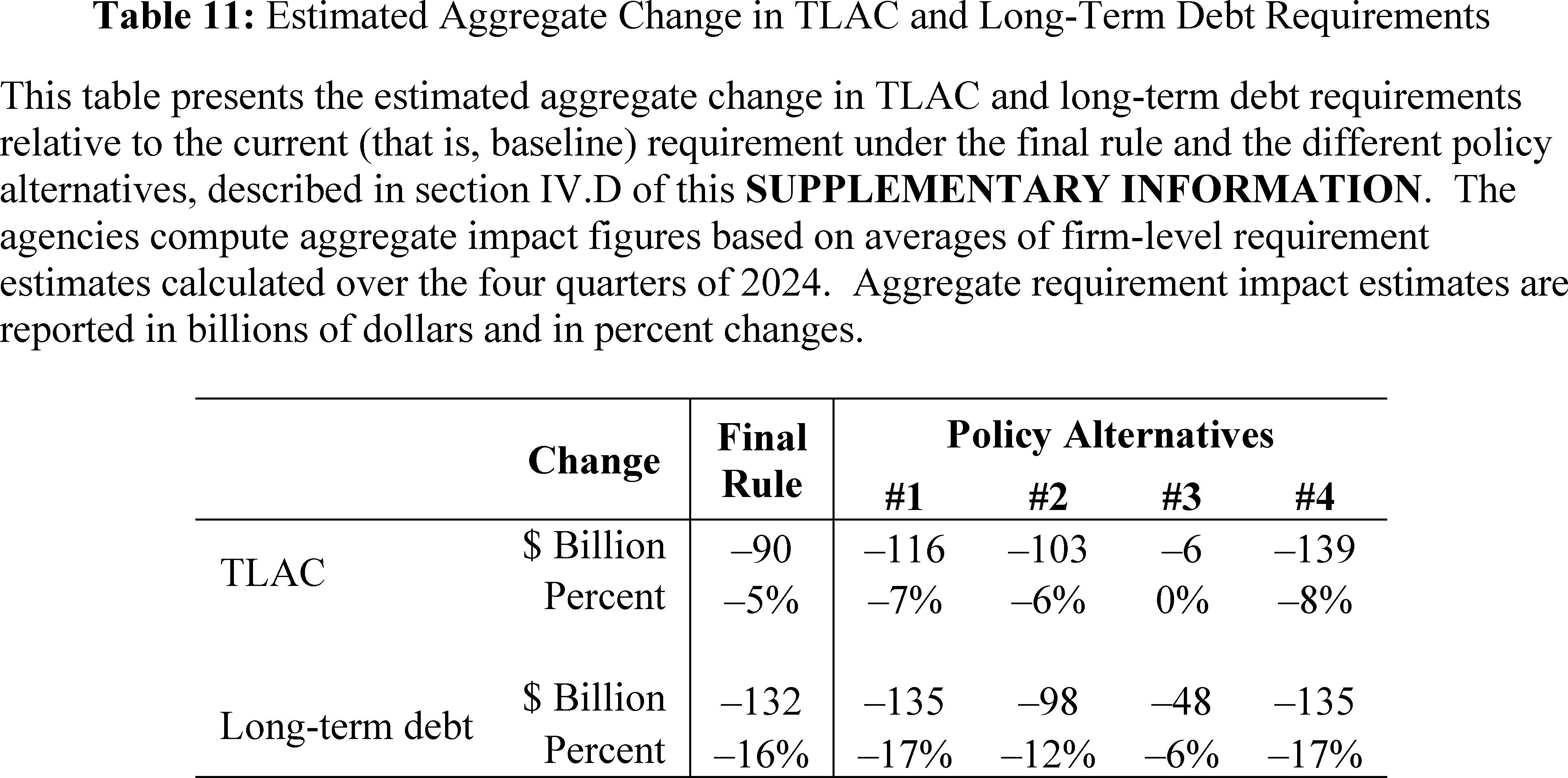
3. Anticipated Economic Effects
As explained above, the final rule leads to moderate expected reductions in TLAC requirements and somewhat greater reductions in long-term debt requirements. The academic and policy literature finds that reducing capital requirements can boost bank lending and economic activity.[121] This suggests that the changes to TLAC requirements under the final rule may provide macroeconomic benefits. That same literature finds that reducing capital requirements can increase risks to safety and soundness and financial stability, with associated expected costs.
These changes will likely result in lower funding costs for GSIBs, enhancing their overall competitiveness relative to both bank and non-bank entities not subject to TLAC requirements. Increased competition in lending and capital markets could lead to more favorable terms for consumers and businesses, representing a potential benefit of the rule. However, this effect is uncertain, as funding costs are just one of many factors affecting competition in these markets. The final rule maintains alignment of the TLAC leverage buffer requirement with leverage capital requirements and, specifically, with the supplementary leverage ratio requirement, and is consistent with the international TLAC standard.[122]
TLAC and long-term debt requirements mandate the use of more expensive capital and long-term debt instead of less expensive short-term debt financing, including deposits. The reduction of these requirements may allow for substantial cost savings to holding companies subject to the rule. However, if the reduction in funding costs occurs because firms deduct more interest expenses, or shift greater risks to taxpayers, insurers, or other creditors, these are private economic transfers from those parties to bank shareholders, not economic benefits. On the other hand, if the relaxation of these funding constraints allows for a lower risk-adjusted cost of funds without shifting the costs to others, then those savings are benefits of the rule. In practice, these savings are likely to be a mix of transfers and economic benefits.
The reduction in long-term debt requirements under the final rule will provide firms with more flexibility over the composition of their TLAC. Keeping TLAC requirements fixed, any reduction in long-term debt used to meet TLAC requirements [123] must be replaced with tier 1 capital.[124] On a going-concern basis, as tier 1 capital provides greater loss absorbency and resilience than long-term debt, giving firms flexibility to use more tier 1 capital instead of long-term debt can be beneficial.[125] As such, the reduction in long-term debt requirements is unlikely to increase financial stability risks. However, the reduction in long-term debt requirements could reduce the potential ( printed page 55283) benefits of long-term debt to an orderly resolution procedure for a firm once it has failed, as described in the TLAC rulemaking.[126]
The Board expects that GSIBs will likely reduce their actual levels of long-term debt outstanding by less than the reduction in their long-term debt requirement because some GSIBs may use long-term debt funding for business purposes beyond meeting long-term debt regulatory requirements. Moreover, the expected funding cost advantages will likely incentivize GSIBs to continue to use long-term debt to meet TLAC requirements, even under a reduced requirement. Finally, because the changes to long-term debt requirements are conforming to changes in the eSLR standard, the ability to recapitalize a firm whose capital is depleted to a level consistent with regulatory minimums and buffers in a resolution will be unchanged by the final rule.
Several commenters supported the conforming changes to TLAC and long-term debt requirements. Some other commenters expressed concern that these changes could increase certain risks. A decline in loss-absorbing capacity at GSIBs, a few commenters argued, could increase the likelihood of a disorderly GSIB resolution and heighten taxpayers' exposure to bailout risk. One commenter argued that changes in TLAC and long-term debt requirements at GSIBs could undermine the resilience of covered depository institutions. By contrast, a few commenters questioned the benefits of the long-term debt requirement, noting that it could be counterproductive to prohibit GSIBs from exchanging debt for equity capital.
Changes to TLAC and long-term debt requirements can have benefits and costs. However, as discussed above and in the proposal, GSIBs will continue to be subject to robust TLAC and long-term debt requirements to help ensure their resiliency and resolvability. Moreover, the reduction in requirements lowers the funding costs of covered organizations, which could facilitate additional lending.[127]
J. Conclusion
The final rule adjusts the supplementary leverage ratio requirement such that it is below risk-based tier 1 capital requirements for all GSIBs and most covered depository institutions. Thereby, the final rule reduces unintended disincentives for these banking organizations to engage in low-risk activities, such as U.S. Treasury market intermediation, and reduces unintended incentives for these banking organizations to engage in higher-risk activities. The changes to the TLAC framework in the final rule maintain alignment with capital requirements and are expected to reduce the funding costs of GSIBs, which may support economic activity.
The costs of the final rule include enabling GSIBs and their depository institution subsidiaries to increase their leverage as well as to increase risk exposures that are not fully captured by the risk-based capital framework. For example, the standardized risk-weighted assets framework does not include an explicit consideration of interest rate risk. The reduction in TLAC requirements under the final rule could lower GSIBs' overall resources available in bankruptcy or resolution.
Some commenters supported the changes in the proposal and agreed with the agencies' economic analysis, whereas others disagreed, raised concerns, or requested further information. Taken together, considering the comments received and the analysis of policy alternatives, the agencies assess that the benefits of the final rule justify its costs.
K. Appendix
In this appendix to the economic analysis, the agencies describe their methodology for estimating the available capacity of holding companies for additional reserves and U.S. Treasury securities held as investment securities at their depository institution subsidiaries, as well as the available capacity of holding companies for additional U.S. Treasury securities held at their broker-dealer subsidiaries, respectively shown in Tables 9 and 10 of section IV.F of this SUPPLEMENTARY INFORMATION.
1. Estimating the Available Capacity of Holding Companies for Additional Reserves and U.S. Treasury Securities Held as Investment Securities at Depository Institution Subsidiaries
For each holding company subject to Category I-III standards, the agencies define “available capacity” as the dollar amount of reserves and U.S. Treasury securities classified as investment securities that their depository institution subsidiaries could add to their balance sheets without raising their or their consolidated holding company's tier 1 capital requirements above baseline levels. The agencies estimate this capacity as follows.
First, the agencies calculate the highest tier 1 capital requirement for each holding company and its major depository institution subsidiaries under the baseline.[128] Specifically, the four tier 1 capital requirements considered are the standardized approach risk-based tier 1 requirement, the advanced approaches risk-based tier 1 requirement, the tier 1 leverage ratio requirement, and the supplementary leverage ratio requirement.
Second, for each holding company and its major depository institution subsidiaries, and for each of the tier 1 capital requirements mentioned above, the agencies calculate the dollar amount of reserves and U.S. Treasury securities classified as investment securities that the major depository institution subsidiaries could add to their balance sheets (and therefore to the balance sheet of their consolidated holding companies) under the baseline, the final rule, and the policy alternatives considered so that the given tier 1 capital requirement becomes equal to the banking organization's highest tier 1 capital requirement, as calculated under the baseline in the first step. In the following, the agencies describe these eight capacity calculations (four tier 1 capital requirements for the holding companies and four tier 1 capital requirements for their major depository institution subsidiaries) in more detail.
Finally, the agencies estimate “available capacity” by taking the smallest of these eight capacity calculations.
Tier 1 Leverage Ratio Requirement
For each holding company and its major depository institution subsidiaries, the agencies calculate the average total consolidated asset amount that would make the tier 1 leverage ratio requirement for these banking organizations equal to their highest tier 1 capital requirement, as calculated under the baseline. The agencies then subtract this average total consolidated asset amount from the baseline average total consolidated asset amount to calculate the capacity with respect to this capital requirement. This calculation is the same under the baseline, the final rule, and the policy alternatives considered because the final rule and the alternatives do not modify the tier 1 leverage ratio requirement. ( printed page 55284)
Supplementary Leverage Ratio Requirement
For each holding company and its major depository institution subsidiaries, the agencies calculate the total leverage exposure amount that would make the supplementary leverage ratio requirement for these banking organizations equal to their highest tier 1 capital requirement, as calculated under the baseline. The agencies then subtract this total leverage exposure amount from the baseline total leverage exposure amount. This calculation varies under the baseline, the final rule, and the alternatives considered because the final rule and the alternatives modify the supplementary leverage ratio requirement.
Under the final rule, as well as Alternatives 1, 3, and 4, which make the eSLR standards a function of the method 1 or method 2 surcharge, the calculations incorporate the effect of increasing total leverage exposures on these surcharges. The agencies describe how they calculate expected changes in method 1 and method 2 surcharges further below.
Under Alternatives 2 and 4, this capacity calculation is not applicable because these policy alternatives exclude reserves and all U.S. Treasury securities holdings from the calculation of total leverage exposure.
Standardized Approach and Advanced Approaches Risk-Based Requirements
Reserves and U.S. Treasury securities held as investment securities have zero risk weight under the risk-based capital framework, and therefore, do not contribute to risk-weighted assets. However, increasing such asset holdings can result in an increase in the GSIB surcharge, which is a component of risk-based capital requirements. Specifically, such asset holdings are reflected in the “size” systemic risk indicator used in the calculation of a GSIB's method 1 and method 2 scores, which in turn determine method 1 and method 2 surcharges, respectively. The higher of these surcharges is the GSIB surcharge. Hence, for each GSIB, the agencies calculate the “size” systemic risk indicator amount that would result in a GSIB surcharge that would make the risk-based tier 1 capital requirement for the GSIB equal to its highest tier 1 capital requirement, as measured under the baseline. The agencies then subtract this “size” systemic risk indicator amount from the baseline “size” systemic risk indicator amount. This calculation is the same under the baseline, the final rule, and the alternatives considered because the final rule and the alternatives do not modify the method 1 and method 2 surcharge calculation.
In the calculations above, the agencies estimate the expected impact of increasing the “size” systemic indicator on method 1 and method 2 surcharges by first calculating the changes in method 1 and method 2 scores and then dividing these score changes by two, respectively. The divisor corresponds to the slope of the continuous function underlying the method 1 and method 2 surcharge schedules used in the GSIB surcharge framework.[129]
Finally, this capacity calculation is not applicable to depository institution subsidiaries because the GSIB surcharge only applies to holding companies.
2. Estimating the Available Capacity of Holding Companies for Additional U.S. Treasury Securities Held at Broker-Dealer Subsidiaries, Assuming Perfect Hedging
For holding companies subject to Category I-III standards, the agencies define “available capacity” as the dollar amount of U.S. Treasury securities that their broker-dealer institution subsidiaries could add to their balance sheets without raising their consolidated holding company's tier 1 capital requirements above baseline levels, assuming that such securities holdings would be perfectly hedged.
This capacity estimation methodology is the same as described in section IV.K.1 of this SUPPLEMENTARY INFORMATION, with two modifications. First, only the capacity calculations related to the tier 1 capital requirements of holding companies are applicable. Second, the capacity calculations related to the supplementary leverage ratio requirement are not applicable under Alternatives 1, 2, and 4 because these policy alternatives exclude U.S. Treasury securities held by at broker-dealer subsidiaries from the calculation of total leverage exposure.
Under the assumption that additional U.S. Treasury securities held at broker-dealers would be fully hedged, there would be no increase in risk-weighted assets under the market risk capital framework. Therefore, in addition to the effect on GSIB surcharges described earlier, there would be no incremental increase in risk-based capital requirements.
V. Administrative Law Matters
A. Paperwork Reduction Act
In connection with the final rule, the Board is revising certain “collections of information” within the meaning of the Paperwork Reduction Act of 1995 (PRA).[130] In accordance with the requirements of the PRA, the agencies may not conduct or sponsor, and a respondent is not required to respond to, an information collection unless it displays a currently valid Office of Management and Budget (OMB) control number. The Board reviewed the final rule under the authority delegated to the Board by OMB. The agencies did not receive any specific comments on the PRA.
Consistent with the final rule, the Board is revising and extending for three years the Financial Statements for Holding Companies (FR Y-9; OMB No. 7100-0128), a current information collection subject to the PRA.
Additionally, the agencies, under the auspices of the Federal Financial Institutions Examination Council (FFIEC), may finalize, in a separate notice, related revisions to the Consolidated Reports of Condition and Income (Call Report) (FFIEC 031, FFIEC 041, and FFIEC 051; OMB Nos. 1557-0081; 3064-0052, and 7100-0036).
Adopted Revisions, With Extension, of the Following Information Collection (Board Only)
Collection title: Financial Statements for Holding Companies.
Collection identifier: FR Y-9C, FR Y-9LP, FR Y-9SP, FR Y-9ES, and FR Y-9CS.
OMB control number: 7100-0128.
General description of report: The FR Y-9 family of reporting forms continues to be the primary source of financial data on holding companies on which examiners rely between on-site inspections. Financial data from these reporting forms is used to detect emerging financial problems, review performance, conduct pre-inspection analysis, monitor and evaluate capital adequacy, evaluate holding company mergers and acquisitions, and analyze a holding company's overall financial condition to ensure the safety and soundness of its operations. The FRY-9C, FRY-9LP, and FRY-9SP serve as standardized financial statements for the consolidated holding company. The Board requires holding companies to provide standardized financial statements to fulfill the Board's statutory obligation to supervise these organizations. The FR Y-9ES is a financial statement for holding companies that are Employee Stock Ownership Plans. The Board uses the FR Y-9CS (a free-form supplement) to collect additional information deemed ( printed page 55285) to be critical and needed in an expedited manner. Holding companies file the FR Y-9C and FR Y-9LP on a quarterly basis, the FR Y-9SP semiannually, the FR Y-9ES annually, and the FR Y-9CS on a schedule that is determined when this supplement is used.
Frequency: Quarterly, semiannually, and annually.
Affected Public: Businesses or other for-profit.
Respondents: Bank holding companies, savings and loan holding companies, securities holding companies, and U.S. intermediate holding companies (collectively, holding companies).
Total estimated number of respondents:
Reporting: FR Y-9C (non-advanced approaches holding companies with less than $5 billion in total assets): 107; FR Y-9C (non-advanced approaches with $5 billion or more in total assets): 236; FR Y-9C (advanced approaches holding companies): 9; FRY-9LP: 411; FRY-9SP: 3,596; FR Y-9ES: 73; FR Y-9CS: 236.
Recordkeeping: FR Y-9C: 352; FR Y-9LP: 411; FR Y-9SP: 3,596; FR Y-9ES: 73; FR Y-9CS: 236.
Total estimated average hours per response:
Reporting: FR Y-9C (non-advanced approaches holding companies with less than $5 billion in total assets): 35.59; FR Y-9C (non-advanced approaches holding companies with $5 billion or more in total assets): 44.23, FR Y-9C (advanced approaches holding companies): 50.76; FR Y-9LP: 5.27; FR Y-9SP: 5.45; FR Y-9ES: 0.50; FR Y-9CS: 0.50.
Recordkeeping: FR Y-9C: 1; FR Y-9LP: 1; FR Y-9SP: 0.50; FR Y-9ES: 0.50; FR Y-9CS: 0.50.
Total estimated annual burden hours: 115,283.
Current Actions: The Board has approved certain revisions to the FR Y-9C, Schedule HC-R, Part I, Regulatory Capital Components and Ratios, to calibrate supplementary leverage ratio requirements. Specifically, the instructions for Schedule HC-R, Part I, line item 64, “Leverage buffer requirement (if applicable),” will be updated to reflect the change to the leverage buffer requirement to an amount equal to 50 percent of a holding company's most recent method 1 surcharge, calculated in accordance with the capital rule. Additionally, the instructions for Schedule HC-R, Part I, line item 62(b), “TLAC leverage buffer,” will be amended in accordance with the revisions to the Board's TLAC framework to replace the two percent TLAC leverage buffer with a buffer equal to the enhanced supplementary leverage ratio buffer under the capital rule as well as an additional revision to update the instructions to be consistent with the TLAC framework. The revisions to the FR Y-9C instructions will become effective with the first report date following the effective date of the final rule. Consistent with the final rule, if a holding company elects to adopt the modified eSLR standard as of January 1, 2026, such holding company should elect early adoption for the March 31, 2026 reporting as-of date.
The Board anticipates that there would be no increase in burden associated with these revisions to the FR Y-9C. The draft reporting forms and instructions are available on the Board's public website at https://www.federalreserve.gov/apps/reportingforms.
B. Regulatory Flexibility Act Analysis
OCC
The Regulatory Flexibility Act (RFA), 5 U.S.C. 601 et seq., requires an agency, in connection with a final rule, to prepare a final Regulatory Flexibility Analysis describing the impact of the rule on small entities (defined by the Small Business Administration (SBA) for purposes of the RFA to include commercial banks and savings institutions with total assets of $850 million or less and trust companies with total assets of $47 million or less) or to certify that the rule will not have a significant economic impact on a substantial number of small entities. The OCC currently supervises approximately 609 small entities.[131]
The OCC estimates that the rule would impact none of these small entities, as the scope of the rule will only apply to depository institution subsidiaries of top-tier U.S. bank holding companies identified as GSIB holding companies. Therefore, the OCC certifies that the rule will not have a significant economic impact on a substantial number of small entities.
Board
The RFA generally requires that, in connection with a final rulemaking, an agency prepare and make available a final regulatory flexibility analysis describing the impact of the final rule on small entities.[132] However, a final regulatory flexibility analysis is not required if the agency certifies that the final rule will not have a significant economic impact on a substantial number of small entities.
Under regulations issued by the SBA, a small entity includes a depository institution, bank holding company, or savings and loan holding company with total assets of $850 million or less.[133] Consistent with the SBA's General Principles of Affiliation, the Board includes the assets of all domestic and foreign affiliates toward the applicable size threshold when determining whether to classify a particular entity as a small entity.[134] For the reasons described below and under section 605(b) of the RFA, the Board certifies that the final rule will not have a significant economic impact on a substantial number of small entities.[135]
In connection with the proposed rule, the Board stated that it believed that the proposal would not have a significant economic impact on a substantial number of small entities. Nevertheless, the Board published and invited comment on an initial regulatory flexibility analysis of the proposal. No comments were received on the initial regulatory flexibility analysis.
The Board is finalizing the amendments to the eSLR standards in the Board's capital rule and prompt corrective action framework and corresponding revisions to the Board's TLAC framework. The final rule helps to ensure that leverage requirements applicable to GSIBs generally serve as a backstop to risk-based requirements. The final rule also makes corresponding changes to the Board's reporting forms. The reasons and justification for the final rule are described above in more detail in the SUPPLEMENTARY INFORMATION.
The Board has considered whether to conduct a final regulatory flexibility analysis in connection with the final rule. However, the final rule amends the eSLR standards applicable to GSIBs and their depository institution subsidiaries, and the only companies subject to these rules, and thus potentially impacted by the final rule's amendments, are GSIBs or subsidiaries within consolidated ( printed page 55286) GSIB organizations. Companies that would be impacted by the final rule therefore substantially exceed the $850 million asset threshold at which a banking entity is considered a “small entity” under SBA regulations. Because the final rule does not apply to any company with total assets of $850 million or less, it is not expected to apply to any small entity for purposes of the RFA. In light of the foregoing, the Board certifies that the final rule does not have a significant economic impact on a substantial number of small entities.
FDIC
The RFA generally requires an agency, in connection with a final rule, to prepare and make available for public comment a final regulatory flexibility analysis that describes the impact of the final rule on small entities.[136] However, a final regulatory flexibility analysis is not required if the agency certifies that the final rule will not, if promulgated, have a significant economic impact on a substantial number of small entities. The SBA has defined “small entities” to include banking organizations with total assets of less than or equal to $850 million.[137] Generally, the FDIC considers a significant economic impact to be a quantified effect in excess of 5 percent of total annual salaries and benefits or 2.5 percent of total noninterest expenses. The FDIC believes that effects in excess of one or more of these thresholds typically represent significant economic impacts for FDIC-supervised institutions.
The final rule would only apply to FDIC-supervised depository institution subsidiaries of a GSIB. As of the quarter ending June 30, 2025, the FDIC supervised 2,808 insured depository institutions, of which 2,085 are considered “small” for the purposes of RFA.[138] As of the same time period, each of the eight U.S. GSIBs reported holding total consolidated assets in excess of $350 billion.[139] As of the quarter ending June 30, 2025, the FDIC-supervised one depository institution that is a subsidiary of a GSIB.[140] Given that this insured depository institution is affiliated with a GSIB, a banking organization with assets far in excess of $850 million, it is not considered to be “small” in accordance with RFA. In light of the foregoing, the FDIC certifies that the final rule would not have a significant economic impact on a substantial number of small entities. Accordingly, a final regulatory flexibility analysis is not required.
C. Plain Language
Section 722 of the Gramm-Leach Bliley Act [141] requires the Federal banking agencies to use plain language in all proposed and final rules published after January 1, 2000. The agencies invited comment on the use of plain language and have sought to present the final rule in a simple and straightforward manner.
D. Riegle Community Development and Regulatory Improvement Act of 1994
Pursuant to section 302(a) of the Riegle Community Development and Regulatory Improvement Act (RCDRIA), in determining the effective date and administrative compliance requirements for new regulations that impose additional reporting, disclosure, or other requirements on insured depository institutions, each Federal banking agency must consider, consistent with the principle of safety and soundness and the public interest, any administrative burdens that such regulations would place on depository institutions, including small depository institutions, and customers of depository institutions, as well as the benefits of such regulations.[142] In addition, section 302(b) of RCDRIA requires new regulations and amendments to regulations that impose additional reporting, disclosures, or other new requirements on insured depository institutions generally to take effect on the first day of a calendar quarter that begins on or after the date on which the regulations are published in final form, with certain exceptions, including for good cause.[143]
The agencies solicited comment on the requirements of RCDRIA, including on any administrative burdens that the proposal would place on depository institutions, including small depository institutions, and their customers, and the benefits of the proposal that should be considered in determining the effective date and administrative compliance requirements for the final rule.
In accordance with section 302 of RCDRIA, the agencies considered any administrative burdens, as well as benefits, that the final rule would place on depository institutions and their customers in determining the effective date and administrative compliance required of the final rule. Consistent with the requirements of section 302 of RCDRIA, the final rule is effective on April 1, 2026; however, banking organizations subject to this final rule may elect to voluntarily adopt the final rule beginning January 1, 2026.
E. Executive Orders 12866, 13563, and 14192
Executive Order 12866 (Regulatory Planning and Review) and Executive Order 13563 (Improving Regulation and Regulatory Review) direct agencies to assess the costs and benefits of available regulatory alternatives and, if regulation is necessary, to select regulatory approaches that maximize net benefits. This rule was drafted and reviewed in accordance with Executive Order 12866 and Executive Order 13563. Within OMB, the Office of Information and Regulatory Affairs (OIRA) has determined that this rulemaking is a “significant regulatory action” under Executive Order 12866. Accordingly, an assessment was submitted to OIRA. As noted in other sections of the SUPPLEMENTARY INFORMATION, the agencies have assessed the costs and benefits of this rulemaking and have made a reasoned determination that the benefits of this rulemaking justify its costs. This final rule is considered to be an Executive Order 14192 deregulatory action.
F. OCC Unfunded Mandates Reform Act of 1995
The OCC has analyzed the final rule under the factors in the Unfunded Mandates Reform Act of 1995 (UMRA) (2 U.S.C. 1532). Under this analysis, the OCC considered whether the final rule includes a Federal mandate that may result in the expenditure by State, local, and tribal governments, in the aggregate, or by the private sector, of $100 million or more in any one year (adjusted annually for inflation). The OCC has determined this final rule would not result in the expenditure by state, local, and tribal governments, or the private sector, of $100 million or more in any one year (adjusted annually for inflation). ( printed page 55287)
G. Congressional Review Act
For purposes of the Congressional Review Act, OMB makes a determination as to whether a final rule constitutes a “major” rule.[144] If a rule is deemed a “major rule” by OMB, the Congressional Review Act generally provides that the rule may not take effect until at least 60 days following its publication.[145]
The Congressional Review Act defines a “major rule” as any rule that the Administrator of the Office of Information and Regulatory Affairs of the OMB finds has resulted in or is likely to result in—(A) an annual effect on the economy of $100,000,000 or more; (B) a major increase in costs or prices for consumers; individual industries; Federal, State, or local government agencies; or geographic regions, or (C) significant adverse effects on competition, employment, investment, productivity, innovation, or on the ability of United States-based enterprises to compete with foreign-based enterprises in domestic and export markets.[146] OMB has determined that the final rule is a major rule for purposes of the Congressional Review Act. As required, the agencies will submit the final rule and other appropriate reports to Congress and the Government Accountability Office for review.
List of Subjects
12 CFR Part 3
- Administrative practice and procedure
- Banks, banking
- Federal Reserve System
- Federal savings associations
- Investments
- National banks
- Reporting and recordkeeping requirements
12 CFR Part 6
- Federal Reserve System
- Federal savings associations
- National banks
- Penalties
12 CFR Part 208
- Confidential business information
- Crime
- Currency
- Federal Reserve System
- Mortgages
- Reporting and recordkeeping requirements
- Securities
12 CFR Part 217
- Administrative practice and procedure
- Banks
- Banking
- Capital
- Federal Reserve System
- Holding companies
- Reporting and recordkeeping requirements
- Risk
- Securities
12 CFR Part 252
- Administrative practice and procedure
- Banks, banking
- Federal Reserve System
- Holding companies
- Investments
- Qualified financial contracts
- Reporting and recordkeeping requirements
- Securities
12 CFR Part 324
- Administrative practice and procedure
- Banks, banking
- Capital adequacy
- Confidential business information
- Investments
- Reporting and recordkeeping requirements
- Savings associations
- State non-member banks
Department of the Treasury
Office of the Comptroller of the Currency
Authority and Issuance
For the reasons set forth in the joint preamble, the OCC amends parts 3 and 6 of chapter I of title 12 of the Code of Federal Regulations as follows:
PART 3—CAPITAL ADEQUACY STANDARDS
1. The authority citation for part 3 continues to read as follows:
Authority: 12 U.S.C. 93a; 161, 1462, 1462a, 1463, 1464, 1818, 1828(n), 1828 note, 1831n note, 1835, 3907, 3909, 5412(b)(2)(B), and Pub. L. 116-136, 134 Stat. 281.
2. In § 3.11:
a. Revise paragraphs (a)(2)(ii) and (iii) and add paragraph (a)(2)(v);
b. Revise paragraphs (a)(3)(i), (a)(4)(ii) and (iii); and
c. Add paragraph (c) and table 2 to § 3.11.
The revisions and additions read as follows:
(a) * * *
(2) * * *
(ii) Maximum payout ratio. The maximum payout ratio is the percentage of eligible retained income that a national bank or Federal savings association can pay out in the form of distributions and discretionary bonus payments during the current calendar quarter. For a national bank or Federal savings association that is not a subsidiary of a U.S. top-tier bank holding company that has more than $700 billion in total assets as reported on the company's most recent Consolidated Financial Statement for Bank Holding Companies (Form FR Y-9C) or more than $10 trillion in assets under custody as reported on the company's most recent Banking Organization Systemic Risk Report (Form FR Y-15), the maximum payout ratio is based on the national bank's or Federal savings association's capital conservation buffer, calculated as of the last day of the previous calendar quarter, as set forth in Table 1 to § 3.11. For a national bank or Federal savings association that is a subsidiary of a U.S. top-tier bank holding company that has more than $700 billion in total assets as reported on the company's most recent Consolidated Financial Statement for Bank Holding Companies (Form FR Y-9C) or more than $10 trillion in assets under custody as reported on the company's most recent Banking Organization Systemic Risk Report (Form FR Y-15), the maximum payout ratio is determined under paragraph (c)(1) of this section.
(iii) Maximum payout amount. A national bank's or Federal savings association's maximum payout amount for the current calendar quarter is equal to the national bank's or Federal savings association's eligible retained income, multiplied by the applicable maximum payout ratio.
(v) Leverage buffer standard. For a national bank or Federal savings association that is a subsidiary of a U.S. top-tier bank holding company that has more than $700 billion in total assets as reported on the company's most recent Consolidated Financial Statement for Bank Holding Companies (Form FR Y-9C) or more than $10 trillion in assets under custody as reported on the company's most recent Banking Organization Systemic Risk Report (Form FR Y-15), the leverage buffer standard is equal to the lesser of 1.0 percent or, if applicable, 50 percent of the most recent method 1 surcharge (expressed as a percentage) that the global systemically important BHC that controls the national bank or Federal savings association was required to calculate pursuant to § 217.403(b), subject to the effective date provisions of § 217.403(d).
(3) * * *
(i) The capital conservation buffer for a national bank or Federal savings association is equal to the lowest of the following ratios, calculated as of the last day of the previous calendar quarter:
(4) * * *
(ii) A national bank or Federal savings association, with a capital conservation buffer that is greater than 2.5 percent plus 100 percent of its applicable countercyclical capital buffer, in accordance with paragraph (b) of this section and, if applicable, a leverage ( printed page 55288) buffer greater than its leverage buffer standard is not subject to a maximum payout amount under this section.
(iii) Negative eligible retained income. Except as provided in paragraph (a)(4)(iv) of this section, a national bank or Federal savings association may not make distributions or discretionary bonus payments during the current calendar quarter if the national bank's or Federal savings association's:
(A) Eligible retained income is negative;
(B) Capital conservation buffer was less than 2.5 percent as of the end of the previous calendar quarter; and
(C) If applicable, leverage buffer, calculated as of the last day of the previous calendar quarter, was less than its leverage buffer standard.
(c) Calculation of maximum payout ratio for a national bank or Federal savings association that is a subsidiary of a U.S. top-tier bank holding company that has more than $700 billion in total assets as reported on the company's most recent Consolidated Financial Statement for Bank Holding Companies (Form FR Y-9C) or more than $10 trillion in assets under custody as reported on the company's most recent Banking Organization Systemic Risk Report (Form FR Y-15) —(1) Maximum Payout Ratio. The maximum payout ratio of a national bank or Federal savings association that is a subsidiary of a U.S. top-tier bank holding company that has more than $700 billion in total assets as reported on the company's most recent Consolidated Financial Statement for Bank Holding Companies (Form FR Y-9C) or more than $10 trillion in assets under custody as reported on the company's most recent Banking Organization Systemic Risk Report (Form FR Y-15) is the lowest of the payout ratios determined by its capital conservation buffer, calculated as of the last day of the previous calendar quarter, as set forth in table 1 to § 3.11 and leverage buffer as set forth in table 2 to this section.
(2) Leverage buffer. (i) The leverage buffer is composed solely of tier 1 capital.
(ii) A national bank or Federal savings association that is a subsidiary of a U.S. top-tier bank holding company that has more than $700 billion in total assets as reported on the company's most recent Consolidated Financial Statement for Bank Holding Companies (Form FR Y-9C) or more than $10 trillion in assets under custody as reported on the company's most recent Banking Organization Systemic Risk Report (Form FR Y-15) has a leverage buffer that is equal to the national bank's or Federal savings association's supplementary leverage ratio minus 3 percent, calculated as of the last day of the previous calendar quarter.
(iii) Notwithstanding paragraph (c)(2)(ii) of this section, if the supplementary leverage ratio of the national bank or Federal savings association that is a subsidiary of a U.S. top-tier bank holding company that has more than $700 billion in total assets as reported on the company's most recent Consolidated Financial Statement for Bank Holding Companies (Form FR Y-9C) or more than $10 trillion in assets under custody as reported on the company's most recent Banking Organization Systemic Risk Report (Form FR Y-15) is less than or equal to 3 percent, the national bank's or Federal savings association's leverage buffer is zero.
| Leverage buffer | Maximum payout |
|---|---|
| Greater than the national bank's or Federal savings association's leverage buffer standard | No payout ratio limitation applies. |
| Less than or equal to 100 percent of the national bank's or Federal savings association's leverage buffer standard, and greater than 75 percent of the national bank's or Federal savings association's leverage buffer standard | 60 percent. |
| Less than or equal to 75 percent of the national bank's or Federal savings association's leverage buffer standard, and greater than 50 percent of the national bank's or Federal savings association's leverage buffer standard | 40 percent. |
| Less than or equal to 50 percent of national bank's or Federal savings association's leverage buffer standard, and greater than 25 percent of the national bank's or Federal savings association's leverage buffer standard | 20 percent. |
| Less than or equal to 25 percent of the national bank's or Federal savings association's leverage buffer standard | 0 percent. |
PART 6—PROMPT CORRECTIVE ACTION
3. The authority citation for part 6 continues to read as follows:
Authority: 12 U.S.C. 93a, 1831o, 5412(b)(2)(B).
4. In § 6.4 revise paragraphs (a)(1)(iv)(B) and (b)(1)(i)(D) to read as follows:
(a) * * *
(1) * * *
(iv) * * *
(B) With respect to an advanced approaches national bank or Federal Savings association, or a Category III OCC-regulated institution, the supplementary leverage ratio; and
(b) * * *
(1) * * *
(i) * * *
(D) Leverage Measure: The national bank or Federal savings association has a leverage ratio of 5.0 percent or greater; and
Federal Reserve System
Authority and Issuance
For the reasons set forth in the joint preamble, the Board of Governors of the Federal Reserve System amends chapter II of title 12 of the Code of Federal Regulations as follows:
PART 208—MEMBERSHIP OF STATE BANKING INSTITUTIONS IN THE FEDERAL RESERVE SYSTEM (REGULATION H)
5. The authority citation for part 208 continues to read as follows:
Authority: 12 U.S.C. 24, 36, 92a, 93a, 248(a), 248(c), 321-338a, 371d, 461, 481-486, 601, 611, 1814, 1816, 1817(a)(3), 1817(a)(12), 1818, 1820(d)(9), 1833(j), 1828(o), 1831, 1831o, 1831p-1, 1831r-1, 1831w, 1831x, 1835a, 1882, 2901-2907, 3105, 3310, 3331-3351, 3905-3909, 5371, and 5371 note; 15 U.S.C. 78b, 78I(b), 78l(i), 780-4(c)(5), 78q, 78q-1, 78w, 1681s, 1681w, 6801, and 6805; 31 U.S.C. 5318; 42 U.S.C. 4012a, 4104a, 4104b, 4106, and 4128.
6. In § 208.41, revise paragraphs (d), (m), and (p) to read as follows:
(d) Common equity tier 1 risk-based capital ratio means the ratio of common equity tier 1 capital to total risk-weighted assets, as calculated in accordance with § 217.10(b)(1) or § 217.10(d)(1) of Regulation Q (12 CFR 217.10(b)(1), 12 CFR 217.10(d)(1)), as applicable.
(m) Tier 1 risk-based capital ratio means the ratio of tier 1 capital to total risk-weighted assets, as calculated in accordance with § 217.10(b)(2) or § 217.10(d)(2) of Regulation Q (12 CFR 217.10(b)(2), 12 CFR 217.10(d)(2)), as applicable.
(p) Total risk-based capital ratio means the ratio of total capital to total risk-weighted assets, as calculated in accordance with § 217.10(b)(3) or § 217.10(d)(3) of Regulation Q (12 CFR 217.10(b)(3), 12 CFR 217.10(d)(3)), as applicable.
7. In § 208.43:
a. Revise paragraph (a)(1)(iv)(B);
b. Remove paragraph (a)(1)(iv)(C); and,
b. Revise paragraph (b)(1)(i)(D).
The revisions read as follows:
(a) * * *
(1) * * *
(iv) * * *
(B) With respect to an advanced approaches bank or, if applicable, a bank that is a Category III Board-regulated institution (as defined in § 217.2 of this chapter), the supplementary leverage ratio.
(b) * * *
(1) * * *
(i) * * *
(D) Leverage Measure: The bank has a leverage ratio of 5.0 percent or greater; and
PART 217—CAPITAL ADEQUACY OF BANK HOLDING COMPANIES, SAVINGS AND LOAN HOLDING COMPANIES, AND STATE MEMBER BANKS (REGULATION Q)
8. The authority citation for part 217 continues to read as follows:
Authority: 12 U.S.C. 248(a), 321-338a, 481-486, 1462a, 1467a, 1818, 1828, 1831n, 1831o, 1831p-1, 1831w, 1835, 1844(b), 1851, 3904, 3906-3909, 4808, 5365, 5368, 5371, 5371 note, and sec. 4012, Pub. L. 116-136, 134 Stat. 281.
9. In § 217.11:
a. Revise paragraphs (a)(2)(iii), (a)(2)(v), (b)(1) introductory text, (c)(1)(ii), (c)(2)(ii)(A), (B), and (C);
b. Add paragraph (f) and table 3 to § 217.11(f).
The revisions and addition read as follows:
(a) * * *
(2) * * *
(iii) Maximum payout ratio. The maximum payout ratio is the percentage of eligible retained income that a Board-regulated institution can pay out in the form of distributions and discretionary bonus payments during the current calendar quarter. For a Board-regulated institution that is not subject to 12 CFR 225.8 or 238.170 and that is not a state member bank subsidiary of a global systemically important BHC, the maximum payout ratio is determined by the Board-regulated institution's capital conservation buffer, calculated as of the last day of the previous calendar quarter, as set forth in table 1 to paragraph (a)(4)(iv) of this section. For a Board-regulated institution that is subject to 12 CFR 225.8 or 238.170, the maximum payout ratio is determined under paragraph (c)(1)(ii) of this section. For a state member bank that is a subsidiary of a global systemically important BHC, the maximum payout ratio is determined under paragraph (f) of this section.
(v) Leverage buffer requirement. (A) A global systemically important BHC's leverage buffer requirement is 50 percent of the most recent method 1 surcharge (expressed as a percentage) that the Board-regulated institution was required to calculate pursuant to § 217.403(b), subject to the effective date provisions of § 217.403(d).
(B) The leverage buffer requirement of a state member bank that is a subsidiary of a global systemically important BHC is equal to the lesser of 1.0 percent or 50 percent of the most recent method 1 surcharge (expressed as a percentage) that the global systemically important BHC that controls the state member bank was required to calculate pursuant to § 217.403(b), subject to the effective date provisions of § 217.403(d).
(b) * * *
(1) General. An advanced approaches Board-regulated institution or a Category III Board-regulated institution must calculate a countercyclical capital buffer amount in accordance with this paragraph (b) for purposes of determining its maximum payout ratio under table 1 to § 217.11(a)(4)(iv) and, if applicable, table 2 to § 217.11(c)(4)(iii) or table 3 to § 217.11(f).
(c) * * *
(1) * * *
(ii) Maximum payout ratio. The maximum payout ratio of a Board-regulated institution that is subject to 12 CFR 225.8 or 238.170 is the lowest of the payout ratios determined by its standardized approach capital conservation buffer, calculated as of the last day of the previous calendar quarter; if applicable, advanced approaches capital conservation buffer, calculated as of the last day of the previous calendar quarter; and, if applicable, leverage buffer, as set forth in table 2 to § 217.11(c)(4)(iii), calculated as of the last day of the previous calendar quarter.
(2) * * *
(ii) * * *
(A) The ratio calculated by the Board-regulated institution under § 217.10(b)(1) or (d)(1)(i), as applicable, minus the Board-regulated institution's minimum common equity tier 1 capital ratio requirement under § 217.10(a);
(B) The ratio calculated by the Board-regulated institution under § 217.10(d)(2)(ii) minus the Board-regulated institution's minimum tier 1 capital ratio requirement under § 217.10(a); and
(C) The ratio calculated by the Board-regulated institution under § 217.10(d)(3)(ii) minus the Board-regulated institution's minimum total capital ratio requirement under § 217.10(a).
(f) Leverage buffer for a state member bank that is a subsidiary of a global systemically important BHC —(1) Maximum payout ratio. The maximum payout ratio of a state member bank that is a subsidiary of a global systemically important BHC is the lowest of the payout ratios determined by its capital conservation buffer, calculated as of the last day of the previous calendar quarter, as set forth in table 1 to § 217.11(a)(4)(iv), and leverage buffer, calculated as of the last day of the previous calendar quarter, as set forth in table 3 to § 217.11(f).
( printed page 55290)(2) Limits on distributions and discretionary bonus payments. Except as provided in paragraph (a)(4)(iv) of this section, a state member bank that is a subsidiary of a global systemically important BHC may not make distributions or discretionary bonus payments during the current calendar quarter if the Board regulated institution's leverage buffer, calculated as of the last day of the previous calendar quarter, is less than its leverage buffer requirement as calculated under paragraph (a)(2)(v) of this section.
(3) Leverage buffer. (i) The leverage buffer is composed solely of tier 1 capital.
(ii) A state member bank that is a subsidiary of a global systemically important BHC has a leverage buffer that is equal to the state member bank's supplementary leverage ratio minus 3 percent, calculated as of the last day of the previous calendar quarter.
(iii) Notwithstanding paragraph (f)(3)(ii) of this section, if the state member bank's supplementary leverage ratio is less than or equal to 3 percent, the state member bank's leverage buffer is zero.
| Leverage buffer | Maximum payout ratio |
|---|---|
| Greater than the state member bank's leverage buffer requirement | No payout ratio limitation applies. |
| Less than or equal to 100 percent of the state member bank's leverage buffer requirement, and greater than 75 percent of the state member bank's leverage buffer requirement | 60 percent. |
| Less than or equal to 75 percent of the state member bank's leverage buffer requirement, and greater than 50 percent of the state member bank's leverage buffer requirement | 40 percent. |
| Less than or equal to 50 percent of the state member bank's leverage buffer requirement, and greater than 25 percent of the state member bank's leverage buffer requirement | 20 percent. |
| Less than or equal to 25 percent of the state member bank's leverage buffer requirement | 0 percent. |
PART 252—ENHANCED PRUDENTIAL STANDARDS (REGULATION YY)
10. The authority citation for part 252 continues to read as follows:
Authority: 12 U.S.C. 321-338a, 481-486, 1467a, 1818, 1828, 1831n, 1831o, 1831p-l, 1831w, 1835, 1844(b), 1844(c), 3101 et seq., 3101 note, 3904, 3906-3909, 4808, 5361, 5362, 5365, 5366, 5367, 5368, 5371.
11. In § 252.61, revise the definition of “Common equity tier 1 capital ratio” to read as follows:
Common equity tier 1 capital ratio has the same meaning as in 12 CFR 217.10(b)(1) and 12 CFR 217.10(d), as applicable.
12. In § 252.62, revise paragraph (a)(2) to read as follows:
(a) * * *
(2) The global systemically important BHC's total leverage exposure multiplied by the sum of 2.5 percent plus the global systemically important BHC's leverage buffer requirement under 12 CFR 217.11 (expressed as a percentage).
13. In § 252.63, revise paragraphs (c)(4)(ii) and (c)(4)(iii)(B), and table 2 to § 252.63 to read as follows:
(c) * * *
(4) * * *
(ii) A global systemically important BHC with an external TLAC risk-weighted buffer level that is greater than the external TLAC risk-weighted buffer and an external TLAC leverage buffer level that is greater than the global systemically important BHC's leverage buffer requirement under 12 CFR 217.11, in accordance with paragraph (c)(5) of this section, is not subject to a maximum external TLAC risk-weighted payout amount or a maximum external TLAC leverage payout amount.
(iii) * * *
(B) External TLAC risk-weighted buffer level was less than the external TLAC risk-weighted buffer as of the end of the previous calendar quarter or external TLAC leverage buffer level was less than the global systemically important BHC's leverage buffer requirement under 12 CFR 217.11 as of the end of the previous calendar quarter.
| External TLAC leverage buffer level | Maximum external TLAC leverage payout ratio (as a percentage of eligible retained income) |
|---|---|
| Greater than 100 percent of the global systemically important BHC's leverage buffer requirement under 12 CFR 217.11 | No payout ratio limitation applies. |
| Less than or equal to 100 percent of the global systemically important BHC's leverage buffer requirement under 12 CFR 217.11, and greater than 75 percent of the global systemically important BHC's leverage buffer requirement under 12 CFR 217.11 | 60 percent. |
| Less than or equal to 75 percent of the global systemically important BHC's leverage buffer requirement under 12 CFR 217.11, and greater than 50 percent of the global systemically important BHC's leverage buffer requirement under 12 CFR 217.11 | 40 percent. |
| Less than or equal to 50 percent of the global systemically important BHC's leverage buffer requirement under 12 CFR 217.11, and greater than 25 percent of the global systemically important BHC's leverage buffer requirement under 12 CFR 217.11 | 20 percent. |
| Less than or equal to 25 percent of global systemically important BHC's leverage buffer requirement under 12 CFR 217.11 | 0 percent. |
14. In § 252.161, revise the definition of “Common equity tier 1 capital ratio” as follows:
Common equity tier 1 capital ratio has the same meaning as in 12 CFR 217.10(b) and 12 CFR 217.10(d), as applicable.
Federal Deposit Insurance Corporation
SUBCHAPTER B
Authority and Issuance
For the reasons stated in the common preamble, the Board of Directors of the Federal Deposit Insurance Corporation amends 12 CFR part 324 as follows:
PART 324—CAPITAL ADEQUACY OF FDIC-SUPERVISED INSTITUTIONS
15. The authority citation for part 324 continues to read as follows:
Authority: 12 U.S.C. 1815(a), 1815(b), 1816, 1818(a), 1818(b), 1818(c), 1818(t), 1819(Tenth), 1828(c), 1828(d), 1828(i), 1828(n), 1828(o), 1831o, 1835, 3907, 3909, 4808; 5371; 5412; Pub. L. 102-233, 105 Stat. 1761, 1789, 1790 (12 U.S.C. 1831n note); Pub. L. 102-242, 105 Stat. 2236, 2355, as amended by Pub. L. 103-325, 108 Stat. 2160, 2233 (12 U.S.C. 1828 note); Pub. L. 102-242, 105 Stat. 2236, 2386, as amended by Pub. L. 102-550, 106 Stat. 3672, 4089 (12 U.S.C. 1828 note); Pub. L. 111-203, 124 Stat. 1376, 1887 (15 U.S.C. 78o-7 note), Pub. L. 115-174; section 4014 § 201, Pub. L. 116-136, 134 Stat. 281 (15 U.S.C. 9052).
16. Amend § 324.11 by:
a. Revising paragraphs (a)(2)(ii) and (iii);
b. Adding paragraph (a)(2)(v);
c. Revising paragraph (a)(4)(ii);
d. Removing the word “and” at the end of paragraph (a)(4)(iii)(A);
e. Revising paragraph (a)(4)(iii)(B);
f. Adding paragraph (a)(4)(iii)(C);
g. Removing table 1 to § 324.11 from paragraph (a)(4)(iv);
h. In paragraph (b)(2)(ii), redesignating footnote 11 as footnote 1;
i. Adding paragraph (c); and
j. Adding tables 1 and 2 to § 324.11.
The revisions and additions read as follows:
(a) * * *
(2) * * *
(ii) Maximum payout ratio. The maximum payout ratio is the percentage of eligible retained income that an FDIC-supervised institution can pay out in the form of distributions and discretionary bonus payments during the current calendar quarter. For an FDIC-supervised institution that is not a subsidiary of a bank holding company designated as a global systemically important BHC pursuant to 12 CFR 217.402, the maximum payout ratio is based on the FDIC-supervised institution's capital conservation buffer, calculated as of the last day of the previous calendar quarter, as set forth in Table 1 to § 324.11. For an FDIC-supervised institution that is a subsidiary of a global systemically important BHC, as identified pursuant to 12 CFR 217.402, the maximum payout ratio is determined under paragraph (c)(1) of this section.
(iii) Maximum payout amount. An FDIC-supervised institution's maximum payout amount for the current calendar quarter is equal to the FDIC-supervised institution's eligible retained income, multiplied by the applicable maximum payout ratio.
(v) Leverage buffer standard. For an FDIC-supervised institution that is a subsidiary of a bank holding company designated as a global systemically important BHC pursuant to 12 CFR 217.402, the leverage buffer standard is equal to the lesser of 1.0 percent or 50 percent of the most recent method 1 surcharge (expressed as a percentage) that the global systemically important BHC that controls the FDIC-supervised institution, was required to calculate pursuant to § 217.403(b), subject to the effective date provisions of § 217.403(d).
(4) * * *
(ii) An FDIC-supervised institution, with a capital conservation buffer that is greater than 2.5 percent plus 100 percent of its applicable countercyclical capital buffer, in accordance with paragraph (b) of this section and, if applicable, a leverage buffer greater than its leverage buffer standard is not subject to a maximum payout amount under this section.
(iii) * * *
(B) Capital conservation buffer was less than 2.5 percent as of the end of the previous calendar quarter; and
(C) If applicable, leverage buffer was less than its leverage buffer standard as of the end of the previous calendar quarter.
(c) Calculation of maximum payout ratio for an FDIC-supervised institution that is a subsidiary of a bank holding company designated as a global systemically important BHC pursuant to 12 CFR 217.402 —(1) Maximum payout ratio. The maximum payout ratio of an FDIC-supervised institution that is a subsidiary of a bank holding company designated as a global systemically important BHC pursuant to 12 CFR 217.402 is the lowest of the payout ratios determined by its capital conservation buffer as set forth in table 1 to § 324.11 and leverage buffer as set forth in table 2 to § 324.11.
(2) Leverage buffer. (i) The leverage buffer is composed solely of tier 1 capital.
(ii) An FDIC-supervised institution that is a subsidiary of a global systemically important BHC designated pursuant to 12 CFR 217.402 has a leverage buffer that is equal to its supplementary leverage ratio minus 3.0 percent, calculated as of the last day of the previous calendar quarter.
(iii) Notwithstanding paragraph (c)(2)(ii) of this section, if the supplementary leverage ratio of the FDIC-supervised institution that is a subsidiary of a global systemically important BHC designated pursuant to 12 CFR 217.402 is less than or equal to 3.0 percent, the FDIC-supervised institution's leverage buffer is zero.
| Capital conservation buffer | Maximum payout ratio |
|---|---|
| Greater than 2.5 percent plus 100 percent of the FDIC-supervised institution's applicable countercyclical capital buffer amount | No payout ratio limitation applies. |
| Less than or equal to 2.5 percent plus 100 percent of the FDIC-supervised institution's applicable countercyclical capital buffer amount, and greater than 1.875 percent plus 75 percent of the FDIC-supervised institution's applicable countercyclical capital buffer amount | 60 percent. |
| Less than or equal to 1.875 percent plus 75 percent of the FDIC-supervised institution's applicable countercyclical capital buffer amount, and greater than 1.25 percent plus 50 percent of the FDIC-supervised institution's applicable countercyclical capital buffer amount | 40 percent. |
| ( printed page 55292) | |
| Less than or equal to 1.25 percent plus 50 percent of the FDIC-supervised institution's applicable countercyclical capital buffer amount, and greater than 0.625 percent plus 25 percent of the FDIC-supervised institution's applicable countercyclical capital buffer amount | 20 percent. |
| Less than or equal to 0.625 percent plus 25 percent of the FDIC-supervised institution's applicable countercyclical capital buffer amount | 0 percent. |
| Leverage buffer | Maximum payout ratio |
|---|---|
| Greater than the FDIC-supervised institution's leverage buffer standard | No payout ratio limitation applies. |
| Less than or equal to 100 percent of the FDIC-supervised institution's leverage buffer standard, and greater than 75 percent of the FDI-supervised institution's leverage buffer standard | 60 percent. |
| Less than or equal to 75 percent of the FDIC-supervised institution's leverage buffer standard, and greater than 50 percent of the FDI-supervised institution's leverage buffer standard | 40 percent. |
| Less than or equal to 50 percent of the FDIC-supervised institution's leverage buffer standard, and greater than 25 percent of the FDI-supervised institution's leverage buffer standard | 20 percent. |
| Less than or equal to 25 percent of the FDIC-supervised institution's leverage buffer standard | 0 percent. |
17. Amend § 324.403 by:
a. Revising paragraphs (a)(1)(iv)(B) and (b)(1)(ii);
b. Removing paragraph (b)(1)(iii); and
c. Revising paragraphs (b)(2)(vi) and (b)(3)(v).
The revisions read as follows:
(a) * * *
(1) * * *
(iv) * * *
(B) With respect to an advanced approaches FDIC-supervised institutions or Category III FDIC-supervised institution, the supplementary leverage ratio.
(b) * * *
(1) * * *
(ii) A qualifying community banking organization, as defined under § 324.12, that has elected to use the community bank leverage ratio framework under § 324.12 shall be considered to have met the capital ratio requirements for the well capitalized capital category in paragraphs (b)(1)(i)(A) through (D) of this section.
(2) * * *
(vi) An advanced approaches or Category III FDIC-supervised institution will be deemed to be “adequately capitalized” if it satisfies paragraphs (b)(2)(i) through (v) of this section and has a supplementary leverage ratio of 3.0 percent or greater, as calculated in accordance with § 324.10.
(3) * * *
(v) An advanced approaches or Category III FDIC-supervised institution will be deemed to be “undercapitalized” if it has a supplementary leverage ratio of less than 3.0 percent, as calculated in accordance with § 324.10.
Jonathan V. Gould,
Comptroller of the Currency.
By order of the Board of Governors of the Federal Reserve System.
Benjamin W. McDonough,
Deputy Secretary of the Board.
Federal Deposit Insurance Corporation.
By order of the Board of Directors.
Dated at Washington, DC, on November 25, 2025.
Jennifer M. Jones,
Deputy Executive Secretary.
Footnotes
1. See “Regulatory Capital Rule: Modifications to the Enhanced Supplementary Leverage Ratio Standards for U.S. Global Systemically Important Bank Holding Companies and Their Subsidiary Depository Institutions; Total Loss-Absorbing Capacity and Long-Term Debt Requirements for U.S. Global Systemically Important Bank Holding Companies,” 90 FR 30780 (July 10, 2025).
Back to Citation2. See 12 CFR part 217, subpart H (GSIB surcharge framework). A bank holding company subject to the GSIB surcharge framework must determine whether it is a GSIB by applying a multifactor methodology based on size, interconnectedness, substitutability, complexity, and cross-jurisdictional activity. See 12 CFR 217.402.
Back to Citation3. This SUPPLEMENTARY INFORMATION uses the term “covered depository institutions” to refer to depository institutions that are subject to the eSLR standard under the current rule or final rule, as applicable. Under the current rule, the eSLR standard is made applicable to depository institutions under the prompt corrective action framework and therefore applies only to depository institutions the deposits of which are federally insured. The final rule changes the form of the eSLR standard applicable to depository institutions, as discussed in greater detail in section II.A.4 of this SUPPLEMENTARY INFORMATION , and as a result of this change, certain national bank subsidiaries, specifically, uninsured national banks chartered pursuant to 12 U.S.C. 27(a), are subject to the eSLR standard under the final rule. This change in scope is a result of the prompt corrective action framework's applicability to insured depository institutions and the capital rule's applicability to certain uninsured depository institutions.
Back to Citation4. Dodd-Frank Wall Street Reform and Consumer Protection Act, Public Law 111-203, 124 Stat. 1376 (2010).
Back to Citation5. Economic Growth, Regulatory Relief, and Consumer Protection Act, Public Law 115-174, 132 Stat. 1296 (2018).
Back to Citation6. See 12 U.S.C. 5365(a)(1), (b)(1)(A)(i). Section 165 of the Dodd-Frank Act also provides that the Board may apply any prudential standard established under section 165 to any bank holding company with $100 billion or more in total consolidated assets to which the prudential standard does not otherwise apply, under certain circumstances. 12 U.S.C. 5365(a)(2)(C). Section 165, in relevant part, also applies to foreign banks or companies that are treated as a bank holding company for purposes of the Bank Holding Company Act. See 12 U.S.C. 3106(a), 5311(a)(1). See also section 401(g) of the Economic Growth, Regulatory Relief, and Consumer Protection Act (regarding the Board's authority to establish enhanced prudential standards for foreign banking organizations with total consolidated assets of $100 billion or more). 12 U.S.C. 5365 note.
Back to Citation7. See 12 U.S.C. 1831o(c)(1)(A), (c)(1)(B)(i).
Back to Citation8. See 12 U.S.C. 93a (national banking associations); 12 U.S.C. 248(i), 324, 327, 329 (state member banks); 12 U.S.C. 1463 (savings associations); 12 U.S.C. 1467a(g)(1) (savings and loan holding companies); 12 U.S.C. 1844(b) (bank holding companies); 12 U.S.C. 3106 (certain U.S. operations of foreign banking organizations); 12 U.S.C. 3902(1)-(2), 3907(a), 3909(a), (c)(1)-(2) (depository institutions; affiliates of depository institutions, including holding companies; and certain U.S. operations of foreign banking organizations); 12 U.S.C. 5371 (insured depository institutions, depository institution holding companies, and nonbank financial companies supervised by the Board).
Back to Citation9. The Board and the OCC issued a joint final rule on October 11, 2013 (78 FR 62018), and the FDIC issued a substantially identical interim final rule on September 10, 2013 (78 FR 55340). The FDIC adopted the interim final rule as a final rule with no substantive changes on April 14, 2014 (79 FR 20754). See 12 CFR part 3 (OCC); 12 CFR part 217 (Board); 12 CFR part 324 (FDIC).
Back to Citation10. See 12 CFR 3.10(a) (OCC); 12 CFR 217.10(a) (Board); 12 CFR 324.10(a) (FDIC). The term “banking organizations,” as used in this SUPPLEMENTARY INFORMATION , includes national banks; state member banks; state nonmember banks; Federal savings associations; state savings associations; top-tier bank holding companies domiciled in the United States not subject to the Board's Small Bank Holding Company and Savings and Loan Holding Company Policy Statement (12 CFR part 225 app'x C); U.S. intermediate holding companies of foreign banking organizations; and top-tier savings and loan holding companies domiciled in the United States, except for certain savings and loan holding companies that are significantly engaged in commercial activities and certain savings and loan holding companies that are subject to the Small Bank Holding Company and Savings and Loan Holding Company Policy Statement.
Back to Citation11. See 12 CFR 3.10(a)(1)(iv), 6.4(b)(1)(i)(D) (OCC); 12 CFR 208.43(b)(1)(i)(D), 217.10(a)(1)(iv) (Board); 12 CFR 324.10(a)(1)(iv), 324.403(b)(1)(i)(D) (FDIC); see also12 CFR 3.12 (OCC); 12 CFR 217.12 (Board); 12 CFR 324.12 (FDIC).
Back to Citation12. In 2019, the agencies adopted rules establishing four categories of capital standards for U.S. banking organizations with $100 billion or more in total consolidated assets and foreign banking organizations with $100 billion or more in combined U.S. assets. Under this framework, Category I standards apply to GSIBs and their depository institution subsidiaries. Category II standards apply to banking organizations with at least $700 billion in total consolidated assets or at least $75 billion in cross-jurisdictional activity and their depository institution subsidiaries. Category III standards apply to banking organizations with total consolidated assets of at least $250 billion or at least $75 billion in weighted short-term wholesale funding, nonbank assets, or off-balance sheet exposure and their depository institution subsidiaries. Category IV standards apply to banking organizations with total consolidated assets of at least $100 billion that do not meet the thresholds for a higher category and their depository institution subsidiaries. See 12 CFR 3.2 (OCC); 12 CFR 238.10, 252.5, (Board); 12 CFR 324.2 (FDIC); “Prudential Standards for Large Bank Holding Companies, Savings and Loan Holding Companies, and Foreign Banking Organizations,” 84 FR 59032 (Nov. 1, 2019); “Changes to Applicability Thresholds for Regulatory Capital and Liquidity Requirements,” 84 FR 59230 (Nov. 1, 2019).
Back to Citation13. See 12 CFR 3.10(c) (OCC); 12 CFR 217.10(c) (Board); 12 CFR 324.10(c) (FDIC).
Back to Citation14. See “Regulatory Capital Rules: Regulatory Capital, Enhanced Supplementary Leverage Ratio Standards for Certain Bank Holding Companies and Their Subsidiary Insured Depository Institutions,” 79 FR 24528 (May 1, 2014). The eSLR standards were originally applicable to bank holding companies with more than $700 billion in total consolidated assets or $10 trillion in assets under custody and their subsidiary depository institutions. The Board revised the applicability of the eSLR standards in its rules to apply to GSIBs and their subsidiary depository institutions in connection with the GSIB surcharge rule. See 80 FR 49082 (Aug. 14, 2015). The FDIC made an equivalent change in 2020, while the OCC retained the original applicability thresholds. See 85 FR 74257 (Nov. 20, 2020).
Back to Citation15. The leverage buffer requirement follows the same general mechanics and structure as the capital conservation buffer requirement that applies to all banking organizations subject to the capital rule, though the capital conservation buffer requirement is calibrated differently. Specifically, a GSIB that maintains a leverage buffer of more than two percent of its total leverage exposure would not be subject to limitations on its distributions and certain discretionary bonus payments. A GSIB that maintains a leverage buffer of two percent or less would be subject to increasingly strict limitations on such payouts. See 12 CFR 217.11.
Back to Citation16. See 12 CFR 6.4(b)(1)(i)(D)(2) (OCC); 12 CFR 208.43(b)(1)(i)(D)(2) (Board); 12 CFR 324.403(b)(1)(ii) (FDIC).
Back to Citation17. The regulatory capital framework is designed to help ensure that banking organizations maintain sufficient resources to absorb losses and prevent the distress or failure of a banking organization. See 12 CFR 3.1 (OCC); 12 CFR 217.1 (Board); 12 CFR 324.1 (FDIC). The regulatory capital framework consists of both risk-based and leverage capital requirements. Risk-based capital requirements establish a minimum amount of regulatory capital a banking organization must maintain based on the risk profile of its on- and off-balance sheet exposures, whereas leverage capital requirements establish minimum risk-insensitive capital requirements. See 12 CFR 3.10 (OCC); 12 CFR 217.10 (Board); 12 CFR 324.10 (FDIC).
Back to Citation18. Risk-based and leverage capital measures can also contain complementary information about a banking organization's condition. See, e.g., Arturo Estrella, Sangkyun Park, and Stavros Peristiani, “Capital Ratios as Predictors of Bank Failure,” Federal Reserve Bank of New York Economic Policy Review (2000).
Back to Citation19. See section IV of this SUPPLEMENTARY INFORMATION for further discussion of the incentive effects of a binding leverage capital requirement.
Back to Citation20. See, e.g., Zhiguo He, Stefan Nagel, and Zhaogang Song, Treasury Inconvenience Yields During the COVID-19 Crisis. 143 J. Fin. Econ. 57-79 (2022).
Back to Citation21. See U.S. Department of the Treasury, Board of Governors of the Federal Reserve System, Federal Reserve Bank of New York, U.S. Securities and Exchange Commission, and U.S. Commodity Futures Trading Commission, Enhancing the Resilience of the U.S. Treasury Market: 2023 Staff Progress Report (Nov. 6, 2023).
Back to Citation22. During the March 2020 economic turmoil, U.S. Treasury market liquidity rapidly deteriorated as a result of supply-demand imbalance, while primary dealers were reluctant to increase their holdings of U.S. Treasury securities, prompting market participants and regulators to consider enhancements to the resilience of the U.S. Treasury market. On April 1, 2020, the Board provided holding companies a temporary exclusion for U.S. Treasury securities and deposits at the Federal Reserve from the denominator of the supplementary leverage ratio through March 31, 2021. On May 15, 2020, the Board, OCC, and FDIC extended comparable treatment to depository institutions, which could elect this exclusion subject to capital action preapproval. Both interim final rules expired as scheduled on March 31, 2021. See “Temporary Exclusion of U.S. Treasury Securities and Deposits at Federal Reserve Banks from the Supplementary Leverage Ratio,” 85 FR 20578 (April 14, 2020) and “Regulatory Capital Rule: Temporary Exclusion of U.S. Treasury Securities and Deposits at Federal Reserve Banks from the Supplementary Leverage Ratio for Depository Institutions,” 85 FR 32980 (June 1, 2020).
Back to Citation23. The Board's capital rule requires a GSIB to calculate its GSIB risk-based surcharge in two ways, known as method 1 and method 2, and apply the higher of the two results. See 12 CFR 217.403(a). The first method (method 1) is based on five categories that are correlated with systemic importance—size, interconnectedness, cross-jurisdictional activity, substitutability, and complexity. The second method (method 2) uses similar inputs but replaces substitutability with the use of short-term wholesale funding and is calibrated in a manner that generally will result in surcharge levels for GSIBs that are higher than those calculated under method 1.
Back to Citation24. As a result of this change, certain national bank subsidiaries, specifically, uninsured national banks chartered pursuant to 12 U.S.C. 27(a), would have become subject to the eSLR standard. See supra n. 3.
Back to Citation25. These commenters cited research in support of their statements on the adverse incentives of a regularly binding supplementary leverage ratio requirement on U.S. Treasury markets functioning, discussed in section IV.F of this SUPPLEMENTARY INFORMATION .
Back to Citation26. See Basel Committee, “Basel III: Finalising post-crisis reforms” (Dec. 2017), available at: https://www.bis.org/bcbs/publ/d424.pdf; Basel Committee, “Basel III leverage ratio framework and disclosure requirements” (Jan. 2014) available at http://www.bis.org/publ/bcbs270.htm. The Basel Committee is an international coordinating committee of banking supervisory authorities, established by the central bank governors of the G-10 countries in 1975, and comprised of representatives from supervisory authorities of 28 jurisdictions. More information regarding the Basel Committee and its membership is available at https://www.bis.org/bcbs/about.htm. Documents issued by the Basel Committee are available through the Bank for International Settlements website at https://www.bis.org.
Back to Citation27. These exclusions were added to the capital rule to implement section 402 of the Economic Growth, Regulatory Relief, and Consumer Protection Act. See Public Law 115-174, at section 402(b)(2)(B), 132 Stat. 1359 (codified as amended at 12 U.S.C. 1831o note).
Back to Citation28. Section IV.F of this SUPPLEMENTARY INFORMATION discusses the expected impact of the final rule on U.S. Treasury market activities.
Back to Citation29. See Section IV.F of this SUPPLEMENTARY INFORMATION .
Back to Citation30. See 12 CFR 217.402.
Back to Citation31. Under the regulatory tailoring framework, banking organizations subject to Category I-III capital standards are subject to the supplementary leverage ratio requirement. 12 CFR 3.2, 3.10(c) (OCC); 12 CFR 217.10(c), 252.5 (Board); 12 CFR 324.2, 324.10(c) (FDIC).
Back to Citation32. 80 FR 49082, at 49083 (Aug. 14, 2015).
Back to Citation33. For example, the Basel Committee was originally formed after the failure of Herstatt Bank in Germany in 1974, which contributed to serious disruptions to foreign currency and banking markets within and beyond Germany, demonstrating the need for better coordination among bank regulators in different jurisdictions. See History of the Basel Committee, available at https://www.bis.org/bcbs/history.htm. See also, e.g.,12 U.S.C. 1828 note, 3901, 3907, 3911, and 5373; 22 U.S.C. 9522 note; Federal Deposit Insurance Corporation Improvement Act of 1991 section 305(b)(2), Public Law 102-242, 105 Stat. 2236, 2355.
Back to Citation34. The cumulative impact of changes to the capital rule to implement section 402 of the Economic Growth, Regulatory Relief, and Consumer Protection Act and the final rule are reflected in the analysis discussed in section IV of this SUPPLEMENTARY INFORMATION .
Back to Citation35. The expected impacts of the proposal are further discussed in section IV.F of this SUPPLEMENTARY INFORMATION .
Back to Citation36. For example, during the COVID economic event, the agencies issued a statement and a letter emphasizing that capital and liquidity buffers have been designed to provide banking organizations with the means to support the economy in adverse situations and allow banking organizations to continue to support households and businesses. See Joint Release: Statement on the Use of Capital and Liquidity Buffers (Mar. 17, 2020), available at https://www.federalreserve.gov/newsevents/pressreleases/files/bcreg20200317a1.pdf; Supervisory Letter: Questions and Answers (Q&As) on Statement regarding the Use of Capital and Liquidity Buffers (SR 20-5), (Mar. 19, 2020), available at https://www.federalreserve.gov/supervisionreg/srletters/SR2005.pdf.
Back to Citation37. The eSLR buffer standard applicable to a national bank or Federal savings association that is a subsidiary of a U.S. top-tier bank holding company with total consolidated assets of more than $700 billion or assets under custody of more than $10 trillion that does not have a parent GSIB method 1 surcharge is one percent.
Back to Citation38. In the economic analysis, a “major covered depository institution” refers to a GSIB's largest depository institution subsidiary as well as any of its depository institution subsidiaries with total assets greater than $50 billion at the end of any quarter in 2024.
Back to Citation39. See section IV of this SUPPLEMENTARY INFORMATION .
Back to Citation40. As discussed in Section IV.E this SUPPLEMENTARY INFORMATION , the new calibration of the eSLR standard would reduce the aggregate tier 1 capital required by the eSLR for the major covered depository institutions by about 37 percent.
Back to Citation41. Each of the agencies have issued regulations to implement the statutory prompt corrective action framework, set forth at 12 U.S.C. 1831o, which codifies section 131 of the Federal Deposit Insurance Corporation Improvements Act of 1991 (FDICIA), Public Law 102-242, 105 Stat. 2253 (Dec. 19, 1991). The prompt corrective action capital categories are critically undercapitalized, significantly undercapitalized, undercapitalized, adequately capitalized, and well capitalized. See 12 CFR part 6 (national banks and Federal savings associations) (OCC); 12 CFR part 208, subpart D (state member banks) (Board); 12 CFR part 324, subpart H (state nonmember banks and state savings associations) (FDIC).
Back to Citation42. Under section 38 of the FDI Act, the agencies are required to prescribe relevant capital measures for the prompt corrective action framework that incorporate leverage-based requirements. See 12 U.S.C. 1831o(c)(1)(A)(i).
Back to Citation44. See 12 CFR 252.63. There is no buffer requirement over the leverage-based minimum total loss-absorbing capacity requirement for a U.S. intermediate holding company of a foreign banking organization subject to TLAC requirements. The TLAC requirement based on total leverage exposure for a U.S. intermediate holding company of a foreign banking organization subject to the TLAC framework is either 6.75 percent or six percent, depending on the planned resolution strategy of the company's parent global systemically important foreign banking organization. 12 CFR 252.165.
Back to Citation45. See “Total Loss-Absorbing Capacity, Long-Term Debt, and Clean Holding Company Requirements for Systemically Important U.S. Bank Holding Companies and Intermediate Holding Companies of Systemically Important Foreign Banking Organizations,” 82 FR 8266, at 8276 (Jan. 24, 2017).
Back to Citation46. 82 FR 8266, at 8275 (Jan. 24, 2017).
Back to Citation47. See “Temporary Exclusion of U.S. Treasury Securities and Deposits at Federal Reserve Banks from the Supplementary Leverage Ratio,” 85 FR 20578 (Apr. 14, 2020); “Regulatory Capital Rule: Temporary Exclusion of U.S. Treasury Securities and Deposits at Federal Reserve Banks from the Supplementary Leverage Ratio for Depository Institutions,” 85 FR 32980 (June 1, 2020).
Back to Citation48. 12 CFR 3.132(c) (OCC); 12 CFR 217.132(c) (Board); 12 CFR 324.132(c) (FDIC).
Back to Citation49. In addition, on July 22, 2025, the Board held a conference on the capital framework for large banking organizations, which was publicly streamed and available on the Board's website. See Integrated Review of the Capital Framework for Large Banks Conference (July 22, 2025), https://www.federalreserve.gov/conferences/integrated-review-of-the-capital-framework-for-large-banks.htm.
Back to Citation50. Throughout the economic analysis section, the agencies use the term “supplementary leverage ratio requirement” to refer to the combination of the supplementary leverage ratio minimum requirement, which is three percent for all banking organizations subject to Category I-III standards, plus the eSLR standards, which are an additional two percent for GSIBs and an additional three percent for covered depository institutions. See Section I.A of this SUPPLEMENTARY INFORMATION for a detailed description of the eSLR standards.
Back to Citation51. The U.S. Treasury market is a key financial market because it (i) constitutes an important channel through which the Federal Reserve can conduct its monetary policy; (ii) enables the U.S. government to obtain financing at a low and stable cost; (iii) provides the yield curve widely used as a risk-free benchmark in the valuation of other financial assets and derivatives; and (iv) offers a large supply of safe and liquid assets for global investors.
Back to Citation52. See the discussion related to Table 5 in section IV.B of this SUPPLEMENTARY INFORMATION .
Back to Citation53. The activities of U.S. Treasury securities dealers extend well beyond buying and selling U.S. Treasury securities outright in the primary and secondary markets. In particular, these entities also act as key counterparties in secured financing and derivatives transactions. For a detailed analysis of how the activities and positions of the broker-dealer subsidiaries of GSIBs evolved over time, see P. Cochran et al., Dealers' Treasury Market Intermediation and the Supplementary Leverage Ratio, FEDS Notes, Board of Governors of the Federal Reserve System (Aug. 3, 2023).
Back to Citation54. One commenter requested that the agencies further explain why GSIBs are important for U.S. Treasury market intermediation. While all primary dealers in general play a critical role as intermediaries in the U.S. Treasury market and dedicated counterparties of the Federal Reserve Bank of New York, as described at https://www.newyorkfed.org/markets/primarydealers in more detail, the broker-dealers of GSIBs are particularly important market participants. Indeed, the six largest U.S. Treasury securities dealers are all subsidiaries of GSIBs, whose activities therefore have an outsized influence on the liquidity and price dynamics in the U.S. Treasury market. See, e.g., P. Cochran et al., Dealers' Treasury Market Intermediation and the Supplementary Leverage Ratio, FEDS Notes, Board of Governors of the Federal Reserve System (Aug. 3, 2023) and J. Goldberg, Liquidity Supply by Broker-Dealers and Real Activity, Journal of Financial Economics, 136(3) (Apr. 14, 2020).
Back to Citation55. To assess the size of the U.S. Treasury market from the perspective of broker-dealers, the agencies exclude the U.S. Treasury securities holdings in the Federal Reserve's SOMA because broker-dealers' market intermediation activity is closely related to U.S. Treasury securities held by the public sector.
Back to Citation56. The positive empirical relationship between the size of the U.S. Treasury market and primary dealers' U.S. Treasury securities positions is also documented in P. Cochran et al., Assessment of Dealer Capacity to Intermediate in Treasury and Agency MBS Markets, FEDS Notes, Board of Governors of the Federal Reserve System (Oct. 22, 2024).
Back to Citation57. In this table, the agencies use publicly available data reported in field FL313161105 of the Financial Accounts of the United States (Z.1) for the amount of U.S. Treasury securities outstanding; the Federal Reserve Bank of New York's public reports for the amount of U.S. Treasury securities holdings in the Federal Reserve's SOMA, see https://www.newyorkfed.org/markets/soma-holdings; publicly available data reported in SEC Form X-14A-5 Part IIA filings for the total assets of primary dealers; and the sum of the values reported in fields GSWA M438, N749, M440, M442, M444, M446, M448, M450, LF56, LF58, M452, M454, M456, M458 of the confidential FR 2004A filings for the amount of long U.S. Treasury securities positions of primary dealers, measured at the end of 2014 and 2024.
Back to Citation58. See, e.g., the discussion of concerns about U.S. Treasury market functioning and proposed solutions in D. Duffie, Still the World's Safe Haven? Redesigning the U.S. Treasury Market After the COVID-19 Crisis, Hutchins Center on Fiscal and Monetary Policy, Brookings (June 22, 2020) and N. Liang and P. Parkinson, Enhancing Liquidity of the U.S. Treasury Market Under Stress, Hutchins Center on Fiscal and Monetary Policy, Brookings (Dec. 16, 2020).
Back to Citation59. See the Board's and the agencies' interim final rules temporarily excluding these assets from the calculation of total leverage exposure for holding companies subject to Category I-III standards, as well as their depository institution subsidiaries, effective April 14, 2020, and June 1, 2020. 85 FR 20578 (Apr. 14, 2020); 85 FR 32980 (June 1, 2020).
Back to Citation60. Basel Committee, Early Lessons from the Covid-19 Pandemic on the Basel Reforms, Bank for International Settlements (July 2021) (“BCBS (2021)”). Throughout the economic analysis section, the agencies use the term “management buffer” to refer to the amount of regulatory capital that a company has in excess of the sum of its minimum regulatory capital requirements and any regulatory capital buffer requirements.
Back to Citation61. For example, Li, Petrasek, Tian (2024) find that internal risk limits are important determinants of broker-dealers' capacity and willingness to intermediate financial markets. D. Li, L. Petrasek and M. H. Tian, Risk-Averse Dealers in a Risk-Free Market—The Role of Internal Risk Limits, SSRN (Mar. 1, 2024) (“Li, Petrasek, Tian (2024)”).
Back to Citation62. G. Favara, S. Infante, and M. Rezende, Leverage Regulations and Treasury Market Participation: Evidence from Credit Line Drawdowns, SSRN (Aug. 4, 2022) (“Favara, Infante, Rezende (2022)”).
Back to Citation63. D. Duffie et al., Dealer Capacity and U.S. Treasury Market Functionality, Federal Reserve Bank of New York Staff Report (Aug. 2023, rev. Oct. 2023) (“Duffie et al. (2023)”).
Back to Citation64. F. Bräuning and H. Stein, The Effect of Primary Dealer Constraints on Intermediation in the Treasury Market, Federal Reserve Bank of Boston Research Department Working Papers (2024) (“Bräuning and Stein (2024)”).
Back to Citation65. In response to comments, the agencies also calculate the main impact estimates using the most recent quarter of balance sheet data in section IV.H.1 of this SUPPLEMENTARY INFORMATION .
Back to Citation66. From FR Y-9C filings, the agencies use the fields BHCA8274, BHCAA223, BHCWA223, BHCAA224, BHCK2170, BHCK3368, BHCM3531, BHCK0211, BHCK0213, BHCK1286, BHCK1287, BHCALE85. From FFIEC Call Reports, the agencies use the fields RCFA8274, RCFAA223, RCFWA223, RCFAA224, RCFD2170, RCFAH015, RCFD3531, RCFD0211, RCFD0213, RCFD1286, RCFD1287, RCFD0090, RCON0090.
Back to Citation67. From FFIEC 101 filings, the agencies use the field AAABH015.
Back to Citation68. From FR Y-15 filings, the agencies use the fields RISK Y832, M362, M370, M376, M390, M405, M408, M411, N255, G506, M422, M426, Y896. Additionally, in method 1 surcharge calculations, the agencies use the aggregate global indicator amounts published by the Board at https://www.federalreserve.gov/supervisionreg/basel/denominators.htm.
Back to Citation69. From FR 2004A filings, the agencies use the sum of the values reported in fields GSWA M438, N749, M440, M442, M444, M446, M448, M450, LF56, LF58, M452, M454, M456, M458 to calculate the amount of long U.S. Treasury securities positions of primary dealers.
Back to Citation70. These depository institution subsidiaries include the uninsured national bank subsidiaries of GSIBs that are subject to the eSLR standard under the final rule, as discussed in section II.A of this SUPPLEMENTARY INFORMATION . There are six such uninsured national bank subsidiaries, which account for 0.01 percent of the total assets of GSIBs, in aggregate.
Back to Citation71. The agencies calculated tier 1 capital requirements for banking organizations subject to Category I-III standards as per the applicable rules. See 12 CFR 3.10 and 3.11, 12 CFR 6.4 (OCC); 12 CFR 208.43, 12 CFR 217.10 and 217.11 (Board); 12 CFR 324.10, 324.11, and 324.403 (FDIC).
Back to Citation72. One commenter raised questions about the need for adjusting the eSLR standard for GSIBs predominantly engaged in custody, safekeeping, and asset servicing activities. The agencies' baseline calculations show that the supplementary leverage ratio requirement was often the highest tier 1 capital requirement for these GSIBs and their covered depository institutions.
Back to Citation73. Risk-based capital buffer requirements are higher for GSIBs than for covered depository institutions because of the GSIB surcharge and the stress capital buffer requirement.
Back to Citation74. Under U.S. Generally Accepted Accounting Principles, investment securities holdings can be classified as “available-for-sale” or “held-to-maturity” securities on banking organizations' balance sheets.
Back to Citation75. See the discussion related to Table 5 in Section IV.B of this SUPPLEMENTARY INFORMATION .
Back to Citation76. In this table, the agencies use publicly available data reported in the Financial Accounts of the United States (Z.1): field FL313161105 for the amount of U.S. Treasury securities outstanding; field FL764194005 for the total assets of U.S. depository institutions; and field LM763061100 for the U.S. Treasury securities holdings of U.S. depository institutions, measured at the end of 2014 and 2024.
Back to Citation77. Using confidential FR 2004 data for GSIBs' primary dealer subsidiaries, the agencies confirm that, on average, 92 percent of the U.S. Treasury securities holdings classified as trading assets on GSIBs' consolidated balance sheets and not held by their depository institution subsidiaries are indeed held by their primary dealer subsidiaries. Section IV.B of this SUPPLEMENTARY INFORMATION describes the data used in this calculation.
Back to Citation78. See the Board's and the agencies' interim final rules temporarily excluding these assets from the calculation of total leverage exposure for holding companies subject to Category I-III standards, as well as their depository institution subsidiaries, effective April 14, 2020, and June 1, 2020. 85 FR 20578 (Apr. 14, 2020); 85 FR 32980 (June 1, 2020).
Back to Citation79. See “Regulatory Capital Rules: Regulatory Capital, Enhanced Supplementary Leverage Ratio Standards for U.S. Global Systemically Important Bank Holding Companies and Certain of Their Subsidiary Insured Depository Institutions; Total Loss-Absorbing Capacity Requirements for U.S. Global Systemically Important Bank Holding Companies.” 83 FR 17317 (Apr. 19, 2018).
Back to Citation80. Under Alternative 1, the estimated reduction in the supplementary leverage ratio requirement for holding companies subject to Category II and III is modest because it is solely driven by the exclusion of U.S. Treasury securities held by their broker-dealer subsidiaries from the calculation of total leverage exposure for these holding companies, while their minimum supplementary leverage ratio requirement remains unchanged.
Back to Citation81. Throughout the economic analysis, for each holding company subject to Category I to III standards, the agencies approximate the amount of U.S. Treasury securities classified as trading assets and held by its broker-dealer subsidiaries by taking the amount of U.S. Treasury securities reported as trading assets by the consolidated holding company and subtracting the amount of U.S. Treasury securities reported as trading assets by its depository institution subsidiaries.
Back to Citation82. The effect of Alternative 4 is less than the sum of the final rule's effect and the effect of Alternative 2 because the exclusion of reserves and U.S. Treasury securities holdings from the supplementary leverage ratio's denominator reduces the effect of the reduced calibration of the eSLR standards under this combined policy alternative.
Back to Citation83. More precisely, lowering the supplementary leverage ratio requirement reduces the tier 1 capital requirement only up to the point that the risk-based tier 1 capital requirement or the tier 1 leverage ratio requirement becomes the binding tier 1 capital requirement. One commenter requested more information regarding the relative bindingness of the tier 1 leverage ratio requirement compared to other tier 1 capital requirements. Under the baseline, the risk-based tier 1 capital requirement exceeds the tier 1 leverage ratio requirement for all except one GSIB.
Back to Citation84. The estimated aggregate reduction in the tier 1 capital requirement for these covered depository institutions was $213 billion under the proposal and is $219 billion under the final rule.
Back to Citation85. For example, for each dollar of an asset with 100 percent risk weight, GSIBs are required to maintain 5 cents of tier 1 capital under the baseline supplementary leverage ratio requirement and, on average, 12.3 cents of tier 1 capital under the risk-based capital framework.
Back to Citation86. In particular, banking organizations will be able to increase their asset holdings that do not increase their total risk weighted assets. Such asset holdings include reserves, U.S. Treasury securities, and Ginnie Mae mortgage-backed securities held as investment securities.
Back to Citation87. Notably, the agencies use this capacity estimate to illustrate the magnitude of the final rule's effect on the ability of banking organizations to hold additional low-risk assets. The capacity estimates are not meant to suggest how or to what extent any additional capacity may be used.
Back to Citation88. Reserves and U.S. Treasury securities held as investment securities have a zero percent risk weight under the risk-based capital framework. Accordingly, the agencies estimate the capacity of holding companies to increase such asset holdings at their depository institution subsidiaries by calculating how this would increase supplementary leverage ratio and tier 1 leverage ratio requirements for both the depository institutions and their consolidated holdings companies. The calculation also incorporates the effect on the “size” systemic indicator, which could lead to higher method 1 and method 2 surcharges, which in turn could increase risk-based tier 1 capital requirements for GSIBs. This methodology is consistent with one commenter's suggestion that the agencies also consider the effect of increasing U.S. Treasury securities holdings on GSIB surcharges. In particular, due to this GSIB surcharge element in the calculation, the capacity estimate is zero for GSIBs with binding risk-based tier 1 capital requirements. Section IV.K.1 of this SUPPLEMENTARY INFORMATION describes the capacity estimation in detail.
Back to Citation89. The estimate for GSIBs' available capacity is close to zero under the baseline because the supplementary leverage ratio requirement is the binding tier 1 capital requirement for most GSIBs and covered depository institutions.
Back to Citation90. Notably, under the “broader exclusion” and the “combined” alternatives, increases in reserves or U.S. Treasury securities holdings increase tier 1 leverage ratio requirements, as well as GSIB method 1 and method 2 scores, which limits the respective available capacity estimates.
Back to Citation91. Also see the discussion in Section IV.A in this SUPPLEMENTARY INFORMATION .
Back to Citation92. Under the market risk capital framework, the risk-based tier 1 capital requirement for the U.S. Treasury securities holdings of GSIBs' broker-dealer subsidiaries can be lower than the tier 1 capital requirement under the supplementary leverage ratio requirement if such securities holdings are sufficiently hedged. As U.S. Treasury market intermediation inherently involves providing liquidity to both buyers and sellers in the market and thus taking opposing (that is, long and short) positions, the net market risk exposures of such positions are likely small.
Back to Citation93. Even though U.S. Treasury securities generally have zero risk weight under the risk-based capital framework, increasing U.S. Treasury securities held at broker-dealer subsidiaries can increase the risk-weighted asset amounts of their consolidated holding companies because such securities holdings are classified as trading assets, which are subject to market risk capital requirements. However, as explained in the previous footnote, if such U.S. Treasury securities are perfectly hedged, then they do not add to risk-weighted asset amounts. With the understanding that much of broker-dealers' securities holdings related to market intermediation are hedged, the agencies create a simple estimate for the capacity of holding companies for such assets by assuming that they would be perfectly hedged. Hence, in the calculation, the agencies consider how increasing U.S. Treasury securities holdings at broker-dealer subsidiaries would increase the supplementary leverage ratio and tier 1 leverage ratio requirements for their consolidated holdings companies. The calculation incorporates the related effect on method 1 and method 2 surcharges, increasing because of the increase in “size” systemic indicators, which in turn would increase risk-based tier 1 capital requirements for GSIBs. Section IV.K.2 of this SUPPLEMENTARY INFORMATION describes the capacity estimation in detail.
Back to Citation94. The estimates for available capacity would be meaningfully lower for U.S. Treasury securities that are not fully hedged because increasing such securities holdings on broker-dealers' balance sheets can increase the risk-weighted asset amounts for consolidated holding companies, thereby raising their risk-based capital requirements. This effect would reduce the capacity estimates because risk-based tier 1 capital requirements are either the binding tier 1 capital requirement or lie closely below the binding tier 1 capital requirement for GSIBs under the baseline.
Back to Citation95. J. Goldberg, Liquidity Supply by Broker-Dealers and Real Activity, Journal of Financial Economics, 136(3) (Apr. 14, 2020) (“Goldberg (2020)”).
Back to Citation96. M.K. Brunnermeier and L.H. Pedersen, Market Liquidity and Funding Liquidity, The Review of Financial Studies, 22(6) (June 2009) (“Brunnermeier and Pedersen (2009)”).
Back to Citation97. Notably, U.S. Treasury market participation is just one example for low-risk, low-return activities that could be constrained by a binding supplementary leverage ratio requirement.
Back to Citation98. More specifically, through reducing the tier 1 capital requirement for GSIBs, the final rule will create room for GSIBs to increase any asset holdings on their balance sheets, not just the ones with low risk weights. However, because risk-based tier 1 capital requirements will become the binding tier 1 capital requirement for most GSIBs under the final rule, and the reduction in their tier 1 capital requirement will be small, GSIBs will have limited additional capacity to increase asset holdings with higher risk weights.
Back to Citation99. Risk-weighted asset density, expressed as a percentage, is the ratio of risk-weighted assets to total assets multiplied by 100. From 2015 to 2024, the aggregate total consolidated assets of GSIBs grew by almost 50 percent, from $10.5 trillion to $15.5 trillion, while their average risk-weighted asset density declined from 58 percent to about 45 percent.
Back to Citation100. GSIBs' ability to distribute their equity capital to external shareholders is also limited by common equity tier 1 capital requirements.
Back to Citation101. See, e.g.,12 CFR part 217; 12 CFR part 249; 12 CFR part 252.
Back to Citation102. Depository institutions typically maintain a management buffer above their binding capital requirements. Management buffers offer depository institutions flexibility to allow capital levels to fluctuate without realizing the consequences of dropping below the binding requirement. As the consequences of dropping below a prompt corrective action standard are more severe than the consequences of dropping below a buffer standard, covered depository institutions may prefer to maintain a larger management buffer above a prompt corrective action standard, and a smaller one under the final rule.
Back to Citation103. 12 CFR 3.10(e) (OCC); 12 CFR 217.10(e) (Board); 12 CFR 324.10(e) (FDIC).
Back to Citation105. See, e.g., I. Drechsler, A. Savov, and P. Schnabl, Banking on Deposits: Maturity Transformation without Interest Rate Risk, The Journal of Finance, 76(3) (Feb. 15, 2021).
Back to Citation106. In 2024, U.S. Treasury securities and Ginnie Mae mortgage-backed securities made up, on average, about 80 percent and 20 percent of GSIBs' investment securities holdings with zero risk weight, respectively. These investment securities holdings accounted for about 11 percent of GSIBs' total leverage exposures.
Back to Citation107. Using confidential data on GSIBs' individual securities positions reported on Schedule B of their FR Y-14Q filings as of the fourth quarter of 2024, the agencies calculate that the average duration of GSIBs' U.S. Treasury securities holdings classified as available-for-sale and held-to-maturity assets was 2.8 years and 3.6 years, respectively, with 16 percent of such U.S. Treasury securities holdings having durations longer than 5 years, on average across GSIBs.
Back to Citation108. D. Greenwald, J. Krainer, and P. Paul, Monetary Transmission Through Bank Securities Portfolios, National Bureau of Economic Research, Working Paper No. 32449 (May 2024) (“Greenwald, Krainer, Paul (2024)”).
Back to Citation109. Specifically, unrealized gains and losses on available-for-sale securities holdings are included in Accumulated Other Comprehensive Income, which in turn is included in book equity as well as regulatory capital calculations for GSIBs under the current capital framework.
Back to Citation110. 12 CFR part 30 (OCC); 12 CFR part 208, app'x D-1 (Board); 12 CFR part 364 (FDIC).
Back to Citation111. See “Advisory on Interest Rate Risk Management,” Federal Financial Institutions Examination Council (Jan. 6, 2010).
Back to Citation112. Notably, as discussed in section IV.B.2 of this SUPPLEMENTARY INFORMATION, about two thirds of U.S. Treasury securities held by GSIBs are investment securities, whose interest rate risk is not captured in the risk-based framework.
Back to Citation113. For the proposed rulemaking that would reduce the volatility of the capital requirements stemming from the Board's annual stress test results (“stress capital buffer requirement averaging proposal”), see90 FR 16843 (Apr. 22, 2025).
Back to Citation114. See Federal Reserve Board Announces Final Individual Capital Requirements for All Large Banks, Effective on October 1 (Aug. 14, 2024), available at https://www.federalreserve.gov/newsevents/pressreleases/bcreg20240828a.htm.
Back to Citation115. The agencies released a proposal to amend risk-based capital requirements for large banking organizations, including GSIBs, in 2023. See “Regulatory Capital Rule: Large Banking Organizations and Banking Organizations with Significant Trading Activity,” 88 FR 64028 (Sep. 18, 2023). Because the agencies do not anticipate finalizing the 2023 proposal without broad and material changes, the economic analysis of the eSLR final rule does not consider potential interaction effects with that proposal.
Back to Citation116. See “Standards for Covered Clearing Agencies for U.S. Treasury Securities and Application of the Broker-Dealer Customer Protection Rule with Respect to U.S. Treasury Securities,” 89 FR 2714 (Jan. 16, 2024).
Back to Citation117. See, e.g., the analysis in N. Liang and H. Zhu, Clearing the Path for Treasury Market Resilience, Hutchins Center on Fiscal and Monetary Policy, Brookings (July 29, 2025).
Back to Citation118. This derivation assumes an imperfect Miller-Modigliani offset; that is, the funding cost effect of a potential increase in GSIBs' leverage would not be completely offset by increases in GSIBs' unit cost of capital. See F. Modigliani and M. H. Miller, The Cost of Capital, Corporation Finance, and the Theory of Investment. The American Economic Review, 48(3) (June 1958).
Back to Citation119. During 2024, all U.S. GSIBs had the leverage-based requirements as their binding long-term debt requirement. Three U.S. GSIBs had leverage-based requirements as their binding TLAC requirement.
Back to Citation120. The analysis of the changes to the TLAC and long-term debt requirements under the final rule uses consolidated holding company data from FR Y-9C filings, in addition to the data sources used by the agencies to estimate changes in the method 1 and method 2 surcharges as well as the total leverage exposures of GSIBs under the final rule, described earlier.
Back to Citation121. Simon Firestone, Amy Lorenc & Ben Ranish, An Empirical Economic Assessment of the Costs and Benefits of Bank Capital in the United States, 101 Federal Reserve Bank of St. Louis Rev. 203, 203-30 (2018); Martin Brooke, Oliver Bush, Robert Edwards, Jas Ellis, Bill Francis, Rashmi Harimohan, Katharine Neiss & Caspar Siegert, Measuring the Macroeconomic Costs and Benefits of Higher UK Bank Capital Requirements, Bank of England, Financial Stability Paper No. 35, (Dec. 2015); David Miles, Jing Yand, & Gilberto Marcheggiano, Optimal Bank Capital, 123 Econ. J. 1, 29 & Table 10 (Mar. 2013); Financial Stability Board, Assessing the Economic Costs and Benefits of TLAC Implementation (Nov. 2015) (“FSB (2015)”).
Back to Citation122. The international standard established by the Financial Stability Board in November 2015 specifies that GSIBs should be subject to a minimum TLAC requirement equal to the higher of 18 percent of risk-weighted assets and 6.75 percent of the Basel III leverage ratio denominator, plus any applicable Basel III regulatory capital buffers, which must be met in addition to the TLAC minimum. Although the Financial Stability Board standard expresses an expectation that at least one-third of the TLAC requirement be met with long-term debt, it does not establish a long-term debt minimum. See Financial Stability Board, “Principles on Loss-absorbing and Recapitalization Capacity of G-SIBs in Resolution: Total Loss-absorbing Capacity Term Sheet,” (Nov. 2015), available at https://www.fsb.org/uploads/TLAC-Principles-and-Term-Sheet-for-publication-final.pdf.
Back to Citation123. The amount of eligible long-term debt that can be counted for purposes of the long-term debt and TLAC requirements is different. The long-term debt requirement imposes a 50 percent haircut on debt maturing between one and two years whereas the TLAC requirement incorporates no such haircut. See 12 CFR 252.62(b) and 12 CFR 252.63(b). Hence, the changes to long-term debt requirements under the final rule could result in covered firms reducing the average maturity of their eligible long-term debt.
Back to Citation124. The minimum long-term debt requirement seeks to balance the costs and benefits of the net equity position for the going-concern capital with the costs and benefits of dischargeable debt under the capital refill framework described in section II.B of this SUPPLEMENTARY INFORMATION .
Back to Citation125. See, e.g., Anat Admati, Peter M. DeMarzo, Martin Hellwig, and Paul Pfleiderer, Fallacies, Irrelevant Facts, and Myths in the Discussion of Capital Regulation: Why Bank Equity is Not Socially Expensive, Preprints of the Max Planck Institute for Research on Collective Goods, No. 2013/23, (2013); Anat Admati & Martin Hellwig. The Bankers' New Clothes: What's Wrong with Banking and What to Do about It (2023 Ed.); Luca Leanza, Alessandro Sbuelz, and Andrea Tarelli, Bail-in vs. Bail-out: Bank Resolution and Liability Structure, 73 International Review of Financial Analysis 1 (Jan. 2021); Federal Reserve Bank of Minneapolis, The Minneapolis Plan to End Too Big to Fail (Dec. 2017).
Back to Citation126. See 80 FR 74926, 74932 (Nov. 30, 2015); 82 FR 8266, 8270 (Jan. 24, 2017).
Back to Citation127. See, e.g., M. Plosser and J.A.C. Santos, The Cost of Bank Regulatory Capital, The Review of Financial Studies, 37(3) (Mar. 2024).
Back to Citation128. If a holding company has multiple major depository institution subsidiaries, the agencies use the aggregate of such major depository institution subsidiaries in the calculations.
Back to Citation129. See 12 CFR 217.403.
Back to Citation130. 44 U.S.C. 3501 et seq.
Back to Citation131. The OCC bases the estimate of the number of small entities on the Small Business Administration's size thresholds for commercial banks and savings institutions (NAICS Code: 522110), and trust companies (NAICS Code: 523991), which are $850 million and $47 million, respectively. Consistent with the General Principles of Affiliation 13 CFR 121.103(a), the OCC counts the assets of affiliated financial institutions when determining whether to classify an OCC-supervised institution as a small entity. The OCC uses December 31, 2024, to determine size because a “financial institution's assets are determined by averaging the assets reported on its four quarterly financial statements for the preceding year.” See footnote 8 of the U.S. Small Business Administration's Table of Size Standards.
Back to Citation132. 5 U.S.C. 601 et seq.
Back to Citation133. See 13 CFR 121.201.
Back to Citation134. See 13 CFR 121.103.
Back to Citation136. 5 U.S.C. 601 et seq.
Back to Citation137. The SBA defines a small banking organization as having $850 million or less in assets, where an organization's “assets are determined by averaging the assets reported on its four quarterly financial statements for the preceding year.” See 13 CFR 121.201 (as amended by 87 FR 69118, effective Dec. 19, 2022). In its determination, the “SBA counts the receipts, employees, or other measure of size of the concern whose size is at issue and all of its domestic and foreign affiliates.” See 13 CFR 121.103. Following these regulations, the FDIC uses an insured depository institution's affiliated and acquired assets, averaged over the preceding four quarters, to determine whether the insured depository institution is “small” for the purposes of RFA.
Back to Citation138. FDIC Call Report data, June 30, 2025.
Back to Citation139. Federal Reserve Y-9C data as of June 30, 2025.
Back to Citation140. FDIC Call Report data, June 30, 2025.
Back to Citation141. Public. Law 106-102, section 722, 113 Stat. 1338, 1471 (1999); 12 U.S.C. 4809.
Back to Citation144. 5 U.S.C. 801 et seq.
Back to Citation[FR Doc. 2025-21626 Filed 11-28-25; 8:45 am]
BILLING CODE 4810-33-P; 6210-01-P; 6714-01-P
Common questions
- What does "Regulatory Capital Rule: Modifications to the Enhanced Supplementary Leverage Ratio Standards for U.S. Global Systemically Important Bank Holding Companies and Their Subsidiary Depository Institutions; Total Loss-Absorbing Capacity and Long-Term Debt Requirements for U.S. Global Systemically Important Bank Holding Companies" cover?
- This final rule adjusts the enhanced supplementary leverage ratio (eSLR) standards for U.S. global systemically important bank holding companies (GSIBs)…
- Which agency issued this update?
- This update was issued by Treasury Department.
- When does it take effect?
- It takes effect on April 1, 2026.
Related updates
- Ocwen Financial Corp. order issued by the Division of Banking and find answers to frequently asked questions. (frequently asked questions)
- Security State Bank Order issued by the Division of Banking and the FDIC
- Request for Comment on Model Changes for the Board's 2027 Supervisory Stress Test
- Enhanced Transparency and Public Accountability of the Supervisory Stress Test Models and Scenarios; Modifications to the Capital Planning and Stress Capital Buffer Requirement Rule, Enhanced Prudential Standards Rule, and Regulation LL
- Implementing the Federal Reserve Board's Responsibilities Under the GENIUS Act
- Unsafe or Unsound Practices, Matters Requiring Attention; Correction