
Housing and Urban Development Department
Section 3 Project Threshold Updates for Creating Economic Opportunities for Low- and Very Low-Income Persons and Eligible Businesses
February 13, 2026 · Effective March 16, 2026
Summary
HUD has issued a notice establishing updated financial assistance thresholds for Section 3 projects, adjusting previous limits to account for national construction cost inflation from 2017 to 2023. These updated thresholds apply to housing rehabilitation, construction, and public construction projects assisted under HUD programs that trigger Section 3 requirements.
AI-generated summary · May 24, 2026. Verify with your compliance counsel before acting.
How this was generated
We record the exact prompt, model, and output for every AI response so it can be audited for accuracy.
Document headings vary by document type but may contain the following:
- the agency or agencies that issued and signed a document
- the number of the CFR title and the number of each part the document amends, proposes to amend, or is directly related to
- the agency docket number / agency internal file number
- the RIN which identifies each regulatory action listed in the Unified Agenda of Federal Regulatory and Deregulatory Actions
See the Document Drafting Handbook for more details.
Department of Housing and Urban Development
- 24 CFR Part 75
- [Docket No. FR-6085-N-05]
AGENCY:
Office of the Assistant Deputy Secretary for Field Policy and Management, HUD.
ACTION:
Notification of Section 3 Project Funding Threshold Updates.
SUMMARY:
The Section 3 rule “Enhancing and Streamlining the Implementation of Section 3 Requirements for Creating Economic Opportunities for Low- and Very Low-Income Persons and Eligible Businesses” published in the Federal Register on September 29, 2020, includes a requirement that the HUD Secretary update Section 3 project thresholds “not less than once every 5 years based on a national construction cost inflation factor through Federal Register notice not subject to public comment.” This notice serves as an update of the 2020 version of the final rule, discusses the establishment of a national construction cost inflation factor for Section 3 projects, and ( printed page 6753) establishes new Section 3 project thresholds.
DATES:
Effective Date: March 16, 2026.
FOR FURTHER INFORMATION CONTACT:
Ashley E. Mendoza, Director of Strategic Initiatives, Office of Field Policy and Management, Department of Housing and Urban Development, 451 7th Street SW, Room 7118-21, Washington, DC 20410; telephone 202-372-8530 (this is not a toll-free number). General email inquiries regarding Section 3 may be sent to: OfficeofFieldPolicyandManagement@hud.gov. HUD welcomes and is prepared to receive calls from individuals who are deaf or hard of hearing, as well as individuals with speech or communication disabilities. To learn more about how to make an accessible telephone call, please visit www.fcc.gov/consumers/guides/telecommunications-relay-service-trs.
SUPPLEMENTARY INFORMATION:
I. Background
Section 3 of the Housing and Urban Development Act of 1968, as amended by the Housing and Community Development Act of 1992 (Section 3) contributes to the establishment of stronger, more sustainable communities by ensuring that employment and other economic opportunities generated by Federal financial assistance for housing and community development programs are, to the greatest extent feasible, directed toward low- and very low-income persons, particularly those who are recipients of government assistance for housing. HUD is statutorily charged with the authority and responsibility to implement and enforce Section 3 through regulation, which HUD has done through the final rule titled “Enhancing and Streamlining the Implementation of Section 3 Requirements for Creating Economic Opportunities for Low- and Very Low-Income Persons and Eligible Businesses,” published on September 29, 2020 in the Federal Register at 85 FR 61524 (“Section 3 final rule”), which amended, among others, 24 CFR part 75.
Applicability is covered in 24 CFR 75.3, where the regulation establishes that Section 3 requirements apply to “public housing financial assistance and Section 3 projects.” Public housing does not have a threshold for financial assistance and any dollar amount of public housing financial assistance provided to grantees will trigger Section 3 compliance requirements. Therefore, this notice does not apply to public housing financial assistance, which is subsequently defined at 24 CFR 75.3(a)(1).
A “Section 3 project” on the other hand is a unique term that is subject to financial assistance thresholds and is defined in 24 CFR 75.3(a)(2)(i) to mean
. . . housing rehabilitation, housing construction, and other public construction projects assisted under HUD programs that provide housing and community development financial assistance when the total amount of assistance to the project exceeds a threshold of $200,000. The threshold is $100,000 where the assistance is from the Lead Hazard Control and Healthy Homes programs, as authorized by Sections 501 or 502 of the Housing and Urban Development Act of 1970 (12 U.S.C. 1701z-1 or 1701z-2), the Lead-Based Paint Poisoning Prevention Act (42 U.S.C. 4801 et seq.); and the Residential Lead-Based Paint Hazard Reduction Act of 1992 (42 U.S.C. 4851 et seq.). The project is the site or sites together with any building(s) and improvements located on the site(s) that are under common ownership, management, and financing.
HUD's Section 3 final rule requires at 24 CFR 75.3(a)(2)(ii) that “[t]he Secretary must update the thresholds provided in paragraph (a)(2)(i) not less than once every 5 years based on a national construction cost inflation factor through Federal Register notice not subject to public comment.”
II. Research and Methodology
The final rule indicates that updates to the established financial assistance thresholds for Section 3 projects must be based on a “national construction cost inflation factor.” The determination of how to calculate the national construction cost inflation factor is left to the discretion of HUD as the term is undefined in the final rule and comments.
The current definition of Section 3 projects requires Section 3 compliance if a housing rehabilitation, housing construction, or other public construction project receives more than $200,000 of HUD housing and community development financial assistance or receives more than $100,000 from Lead Hazard Control and Healthy Homes programs. This means that the thresholds that need to be adjusted for construction cost inflation are $200,000 and $100,000 respectively.
The first step in establishing this “national construction cost inflation factor” (hereafter Construction Inflation Factor) is defining “construction.” “Construction” is left undefined in the Section 3 regulations, so analysis requires additional sources. The original drafters of 24 CFR part 75 considered Bureau of Labor Statistics (BLS) publications when first determining the threshold levels for housing and community development projects, so it makes sense to look to the BLS for additional guidance around this analysis.
The North American Industry Classification System (NAICS), originally developed by the Office of Management and Budget (OMB), is the standard used by Federal statistical agencies, including BLS, in classifying businesses for collecting, analyzing, and publishing statistical data related to U.S. businesses. The NACIS uses two- to six-digit codes to classify different sectors and subsectors of the U.S. business economy, and NAICS 23 broadly covers the construction sector. The NAICS defines Sector 23—Construction as comprising “establishments primarily engaged in the construction of buildings or engineering projects.” It also establishes that “Construction work done may include new work, additions, alterations, or maintenance and repairs.” As Section 3 projects are defined as “housing rehabilitation, housing construction, and other public construction projects,” [1] NAICS 23 clearly encompasses the type of work that is performed on Section 3 projects.
With “construction” defined for purposes of this analysis, the next step is to evaluate and determine what data elements should be considered in developing the “Factor.” When initially determining the threshold, HUD looked at BLS data on labor share for construction projects as part of the calculations. While this analysis does not seek to recreate the same formula that was used in that initial determination of the threshold, which also analyzed CDBG, HOME, and lead hazard grant amounts, it will continue the precedent of using BLS data to estimate cost shares as part of the formula.[2]
The BLS Office of Productivity and Technology (OPT) defines five different cost shares that represent a portion of and aggregate to the total cost of construction:
1. Capital Share
2. Labor share
3. Energy share*
4. Materials share*
5. Services share*
Each of these shares are defined by OPT as “the proportion of current-dollar ( printed page 6754) output attributed to the use of [the applicable factor].” [3] The final three shares are identified with an asterisk because the BLS also publishes data on “intermediate inputs,” which is an aggregate data point for all energy, materials, and services that are used in the production of other goods and services for final consumption. So, the data related to energy, materials, and services can be combined and represented in the aggregate as “intermediate inputs,” but, for the purposes of this analysis, these three categories will be discussed independently to illustrate the methodology more clearly. This also allows for a more granular investigation of the changes in construction costs over time. Additionally, OPT publishes their cost shares as fractional shares represented by a decimal to the thousandth place (three decimal places). The published shares are displayed as a percentage to the tenth place (one decimal place) for simplicity, and calculated percentages will be displayed the same way for the sake of consistency.[4]
Table 1 below shows the cost shares (as a percentage of the total construction cost) for each of the components in 2017 and 2023 with the percentage changes over that time period indicated. The percentage change for each category is calculated by finding the difference between the 2023 share and the 2017 share and then dividing that difference by the baseline 2017 value. A decrease in a category's share is reflected as a negative percentage change. As illustrated by the data, these five cost share percentages have either increased or decreased by different amounts over the identified period of time, so this analysis will need to consider these changes in calculating the new threshold levels. If these changes in cost shares are not considered, the new thresholds may over- or undervalue certain categories of construction projects and yield a less representative calculation.
| % of construction cost (2017) | % of construction cost (2023) | % Change | |
|---|---|---|---|
| Capital Share | 10.4 | 12.8 | 23.1 |
| Labor Share | 42.8 | 39.4 | −7.9 |
| Energy Share | 2.4 | 2.1 | −12.5 |
| Materials Share | 35.3 | 35.2 | −0.3 |
| Services Share | 9.1 | 10.5 | 15.4 |
Subdividing into those same five categories, BLS also publishes data on construction cost per component of construction:
1. Capital costs
2. Labor costs
3. Energy costs*
4. Materials costs*
5. Services costs*
Each of these costs is defined by OPT as “the payments to purchase [applicable factor] for use in the production of goods and services.” [5] Again, like with component shares, BLS aggregates energy, materials, and services costs into “intermediate input” cost, but this analysis will use each of the individual component costs.
Table 2 below shows the BLS data on costs for each component of construction from both 2017 and 2023 with the percentage changes included for each. The percentage change for each cost category is calculated by finding the difference between the 2023 cost and the 2017 cost and then dividing that difference by the baseline 2017 cost.[6]
| 2017 Cost in billions (2017) | Cost in billions (2023) | % Change | |
|---|---|---|---|
| Capital Cost | $163.653 | $298.578 | 82.4 |
| Labor Cost | 674.710 | 919.092 | 36.2 |
| Energy Cost | 37.992 | 49.116 | 29.3 |
| Materials Cost | 556.730 | 821.047 | 47.5 |
| Services Cost | 142.764 | 244.623 | 71.3 |
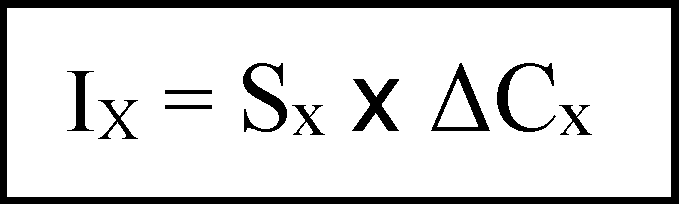
In order to determine how much the overall cost of construction has increased over the identified time period (2017-2023), calculation is first required to find how much each category individually has contributed to the overall cost change. This can be done by multiplying the category's current cost share percentage by the percentage change in construction which will result in the fractional (or percentage) contribution of that category's cost changes to the overall change in total construction cost.
Variables:
If:
Sx = the share of total construction cost at a given time for a single category of construction with the subscript X serving as a placeholder (expressed as a decimal)
ΔCx = the percentage change in cost for a single category of construction with the subscript X serving as a placeholder (expressed as a decimal) ( printed page 6755)
Then the calculation can be written as,
- Sx × ΔCx
The result of this formula tells us how much the total construction cost has changed due to the change in a single category's cost, as a percentage of the overall cost (expressed as a decimal). Stated differently, it is the fractional (or percentage) impact on total construction cost due to a single category's cost change. The final equation for impact (represented by IX) of the construction category can therefore be written as:
Single Category Example
To more clearly illustrate this concept, one can plug values into the formula. This example will use the category of labor simply because it is the largest cost share of the five. Calculations for the other categories will follow later in this analysis.
For this example, the subscript X will be replaced with subscript L to represent labor, and thus the equation can be rewritten as . . .
IL = SL × ΔCL
Where:
SL = Labor Share
ΔCL = the percentage change in Labor Cost over time
IL = Impact of labor costs on the overall construction cost change
This calculation will give us the fractional (or percentage) impact on total construction cost due to labor cost changes over the given time frame (in this case 2017-2023).
Using the percentages (expressed as decimals) provided in Tables 1 and 2 respectively, the formula becomes:
- 0.394 × 0.362 = 0.143
This means that the overall cost of a construction project went up by 14.3% from 2017 to 2023 as a result of the increase in labor costs over the same period.
Total Cost Increase Formula
As noted, the formula derived above only gives the percentage contribution of a single category to the overall change in total construction cost. To determine the overall percentage increase in total construction cost over time, the contribution of each category's cost increase must be calculated and then combined. This formula will follow the same logic and naming convention as demonstrated in the single category example with labor share.
SC = Capital Share
SL = Labor Share
SE = Energy Share
SM = Materials Share
SS = Services Share
ΔCC = the percentage change in Capital Cost over time
ΔCL = the percentage change in Labor Cost over time
ΔCE = the percentage change in Energy Cost over time
ΔCM = the percentage change in Materials Cost over time
ΔCS = the percentage change in Services Cost over time
IC = Impact of capital costs on the overall construction cost change
IL = Impact of labor costs on the overall construction cost change
IE = Impact of energy costs on the overall construction cost change
IM = Impact of materials costs on the overall construction cost change
IS = Impact of services on the overall construction cost change
This calculation can be expressed as five individual formulas (one for the impact of each category), as demonstrated in the labor example above, added together. Thus, the construction inflation factor (CIF) referenced in 24 CFR 75.3(a)(2)(ii) is defined as the total percentage increase in construction cost over a given time period, which can be expressed as:

Or, if the respective equations for impact on overall construction cost are inserted, the equation can be rewritten:

Substituting percentages given in Tables 1 and 2 (expressed as decimals) results in the following calculation:
- (0.128 × 0.824) + (0.394 × 0.362) + (0.021 × 0.293) + (0.352 × 0.475) + (0.105 × 0.713)
After solving for each category's contribution to the overall change in construction cost, the formula can be simplified and then solved:
- 0.106 + 0.143 + 0.006 + 0.167 + 0.075 = 0.496
This means that, accounting for the contribution of each of the five categories, total construction cost increased by 49.6% from 2017 to 2023.[7]
Application to Section 3 Thresholds
With the national construction cost inflation factor defined, the formula can be applied to the existing Section 3 project funding thresholds. To determine the change (in dollars) to the threshold, first multiply the construction inflation factor times the current project threshold. In the formula, the construction inflation factor will be represented by CIF and the current threshold will be represented by TC:
CIF × TC
However, this result only shows the change in the threshold. In order to find the new threshold, the current threshold total must be added to the above formula, resulting in the equation for the new threshold (represented as TN):
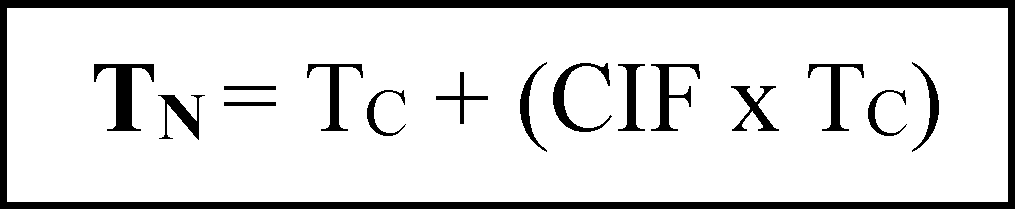
This equation can also be combined with the above CIF equation to give a single equation to determine the new Section 3 thresholds:
( printed page 6756)
Or, if each of the individual equations is substituted for impact on total construction cost, the equation can be rewritten:

III. Threshold Update
The final step is to plug in the numbers and find the new Section 3 funding thresholds. As was determined in the previous section, the CIF equation showed that the cost of construction increased by 49.6% [8] from 2017-2023. Using the current thresholds, one can then solve for TN . There are currently different thresholds for general Housing and Community Development projects and Lead Hazard Control and Healthy Homes projects; therefore, we will solve for both. Housing and Community Development Threshold: [9]
TN = 200,000 + (0.496 × 200,000)
TN = $299,200
Lead Hazard Control and Healthy Homes Threshold [10]
TN = 100,000 + (0.496 × 100,000)
TN = $149,600
New Section 3 Thresholds
This analysis determines that the Section 3 project thresholds for Housing and Community Development projects and Lead Hazard Control and Healthy Homes projects should be about $299,200 and $149,600 respectively. These numbers were computed using the original threshold amounts of $200,000 and $100,000 and then using the newly defined national construction cost inflation factor to account for the nationwide increases in construction cost from 2017-2023.
However, it is not practical for compliance efforts to use such exact numbers. Therefore, HUD has decided to round these numbers to $300,000 for Section 3 Projects that receive Housing and Community Development financial assistance and $150,000 where the assistance is from Lead Hazard Control and Healthy Homes programs for ease of both external compliance and internal administration and monitoring. The proximity of the raw calculation results to these rounded numbers makes the decision to round very sensible, but it should not serve as a precedent for future calculations as HUD cannot anticipate the adjustments that may later be needed to best administer Section 3.
Joseph DeFelice,
Assistant Deputy Secretary for Field Policy and Management.
Footnotes
2. When the original threshold calculations were made, HUD used 2017 BLS data as it was most recent available data. Thus, this analysis will use 2017 data as the baseline for the calculation of the construction cost increase and new thresholds. At the time of writing, the most recent available data for cost shares is 2023 data.
Back to Citation3. BLS Productivity Glossary ( https://www.bls.gov/productivity/glossary.htm).
Back to Citation4. All calculated values are displayed to the tenth place to match BLS data, but the calculated values themselves were not rounded in the process of the calculations.
Back to Citation5. BLS Productivity Glossary ( https://www.bls.gov/productivity/glossary.htm).
Back to Citation6. The calculated change is displayed as a percentage to the tenth place (one decimal) to match the display of published BLS data. These values were not rounded during the process of the calculation.
Back to Citation7. Individual category contributions: Capital = 10.6%; Labor = 14.3%; Energy = 0.6%; Materials = 16.7%; Services = 7.5%
Back to Citation8. This number is expressed as a percentage rounded to the tenth place for simplicity in the narrative, but it is not recommended to be rounded during the calculation. Rounding should only take place at the end of the entire calculation process to maintain accuracy.
Back to Citation9. The total of $299,200 is found if the result of the equation for the CIF is rounded to three decimal places, 0.496 in this case. If the results are left unrounded throughout the equation, which is recommended, the total comes to a more accurate $299,284.11 (rounded to two decimals).
Back to Citation10. The total of $149,600 is found if the result of the equation for the CIF is rounded to three decimal places, 0.496 in this case. If the results are left unrounded throughout the equation, which is recommended, the total comes to a more accurate $149,642.05 (rounded to two decimals).
Back to Citation[FR Doc. 2026-03002 Filed 2-12-26; 8:45 am]
BILLING CODE 4210-67-P
Common questions
- What does "Section 3 Project Threshold Updates for Creating Economic Opportunities for Low- and Very Low-Income Persons and Eligible Businesses" cover?
- HUD has issued a notice establishing updated financial assistance thresholds for Section 3 projects, adjusting previous limits to account for national…
- Which agency issued this update?
- This update was issued by Housing and Urban Development Department.
- When does it take effect?
- It takes effect on March 16, 2026.
Related updates
- Establishes Office of Algorithmic Civil Rights in DLPS to prevent discrimination in use of algorithms.
- Merger Transactions
- Proposed Third-Party Risk Management Guidance
- Regulates use of artificial intelligence in certain mortgage lending tools to minimize discrimination in lending.
- Announcement SEL-2026-08: Selling Guide Updates
- Violations of Laws or Regulations